Austria 3-2 West Germany
Argentina 1978 | Second group stage
Estadio Olimpico Chateau Carreras, Cordoba
Attendance: 38,318
Austria goals: Berti Vogts (59, o.g.), Hans Krankl (66, 87)
West Germany goals: Karl-Heinz Rummenigge (19), Bernd Holzenbein (68)
Teams
Coach: Helmut Senekowitsch
Starting XI: Friedl Koncilia; Heinrich Strasser, Bruno Pezzey, Erich Obermayer, Robert Sara; Eduard Krieger, Wilhelm Kreuz, Herbert Prohaska, Josef Hickersberger; Hans Krankl, Walter Schachner
Substitutions: Franz Oberacher for Schachner (71)
Coach: Helmut Schon
Starting XI: Sepp Maier; Bernard Dietz, Rolf Russmann, Manfred Kaltz, Berti Vogts; Bernd Holzenbein, Rainer Bonhof, Erich Beer; Karl-Heinz Rummenigge, Dieter Muller, Rudiger Abramczik
Substitutions: Hansi Muller for Beer (46), Klaus Fischer for Dieter Muller (60)
Hitherto head-to-head record
6 Austria wins
11 (West) Germany wins
4 draws
Going into the game
Having travelled to Argentina as unfancied underdogs, Austria caused a sensation in the first group stage, pipping Brazil to top spot in Group 3 after edging past Spain 2-1 and Sweden 1-0 before an equally tightly contested 1-0 loss to the Seleção.
While the Austrians were earning unexpected plaudits, it was the opposite story for the West Germans in Group 2. Helmut Schon’s side laboured to live up to their status as world champions: goalless draws in their opener against Poland and their curtain-closer against Tunisia – who had their illustrious opponents on the ropes and staring an early exit in the face – sandwiched a 6-0 mauling of Mexico that failed to paper over the cracks.
Nevertheless, the holders squeaked through to the next stage as runners-up in their pool, behind the Poles. There, an all-European Group A awaited, consisting of Italy, the Netherlands, West Germany and Austria. The second round got off to a sobering start for the Austrians in the shape of a 5-1 thrashing by the Dutch. This was followed by a 1-0 reverse against Italy that put paid to Helmut Senekowitsch’s charges’ chances of progressing to the final or the play-off for third place.
The West Germans, for their part, played out yet another 0-0 stalemate – on this occasion, against the Azzurri – before sharing the spoils once more in a thriller against the Dutch, whom they twice led before being pegged back. Going into the clash with Austria, Schon’s men thus found themselves on two points, just one behind both Italy and the Netherlands, and having scored as many goals as they had conceded in the group.
This left Die Mannschaft’s hopes intact… albeit hanging by a thread, as the reigning titlists required nothing less than an emphatic victory over their neighbours, coupled with a draw in the contest between the other two teams, in order to keep their trophy defence alive. However, a win of any description would have served to salvage West German pride and at the very least secured a spot in the third-place play-off, regardless of the result in the other match.
The match
After an end-to-end opening to the encounter, West Germany took control and were rewarded for their purposeful approach when Karl-Heinz Rummenigge side-footed them in front in the 19th minute following some fine interplay with Dieter Müller down the right. The defending champions dictated proceedings for practically the rest of the opening period but failed to add to their advantage, while Austria, seemingly set on damage limitation, sat deep, only threatened sporadically and were grateful to go into the break a single goal adrift.
The action followed a similar script after the restart as Schon’s troops continued to look commanding. Yet the whole complexion of the match was to change just before the hour mark, when Eduard Krieger’s whipped cross sailed into the German penalty area and Berti Vogts, under pressure from an opposition attacker, got his attempted clearance horribly wrong and succeeded only in diverting the ball into his own net. Having been gifted a route back into the game, the Austrians needed no second invitation and moved ahead seven minutes later when Hans Krankl took one touch to cushion Krieger’s lofted pass and then acrobatically volleyed across goal and into the top left-hand corner.
The onus was now on West Germany to react, and they wasted no time in showing their mettle, taking just two minutes to draw level courtesy of Bernd Holzenbein’s towering header from Rainer Bonhof’s perfectly flighted free kick. With the Netherlands leading the other fixture in the group, Schon’s team looked on course to finish second and advance to the match for third place.
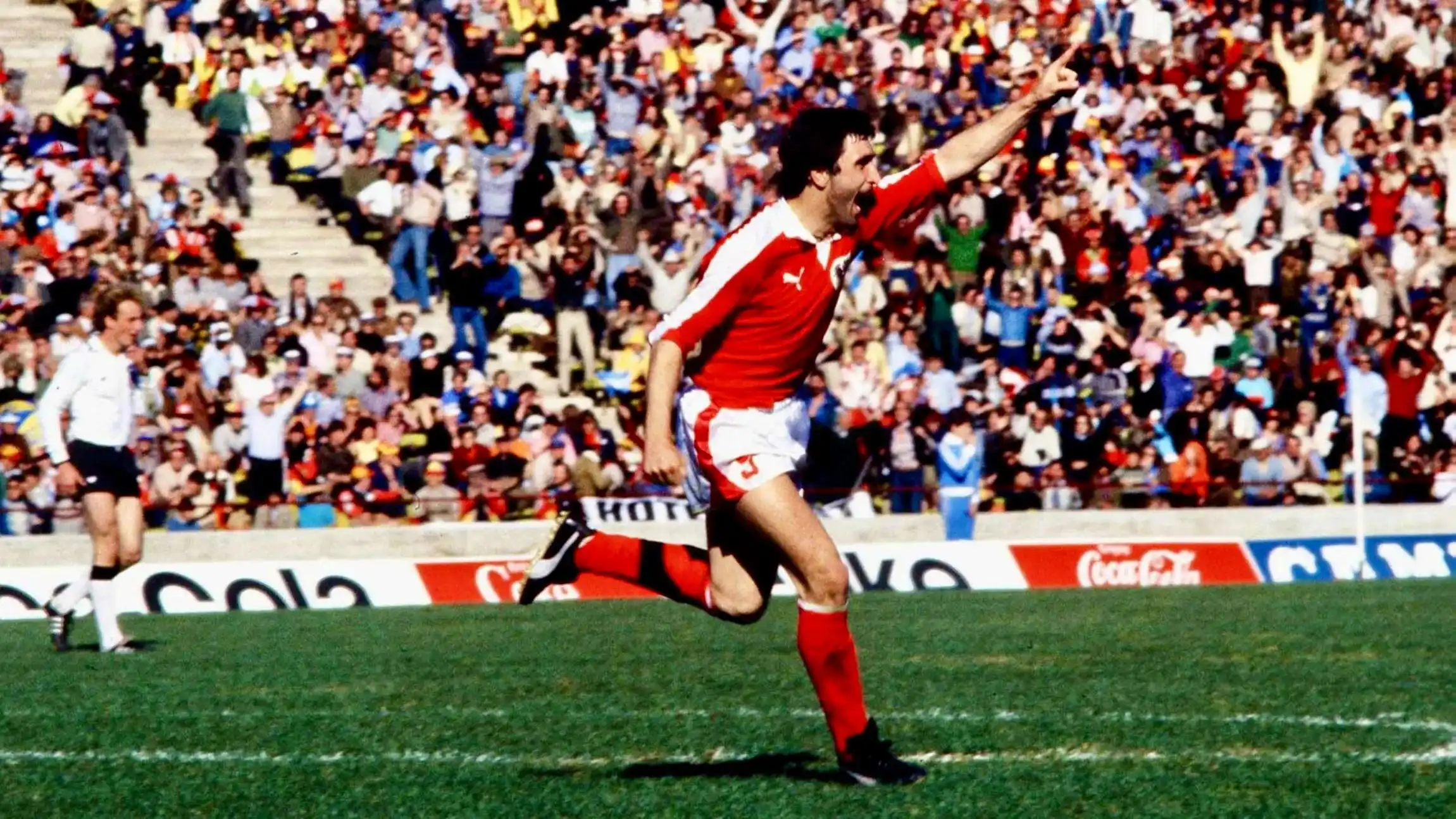
However, the Germans were not ready to settle for a shot at a bronze medal and instead poured forward in search of a winner. This played right into the hands of their neighbours, who were happy to exploit the gaps left by their increasingly cavalier opponents and hit them on the break. The sting in the tail came in the dying stages, when Krankl seized on a loose ball down the left, surged beyond one defender, displayed some nifty footwork to cut inside past another and drilled a low drive past Sepp Maier to hand Austria a 3-2 lead.
When referee Abraham Klein blew the full-time whistle just a few minutes later, a monumental upset was complete: West Germany had been eliminated, while Austria had bowed out with a historic victory.
Quotes
“Goal! Goal! Goal! Goal! Goal! Goal! I’m going crazy! Krankl scores! 3-2 to Austria!”
Arguably the most iconic piece of commentary in Austrian football history, delivered by public radio journalist Edi Finger Sr
“We no longer deserve to be classed as one of the best teams in the world. This is a huge blow to our reputation.”
West Germany defender Berti Vogts after the game
“That day in Cordoba was nothing short of fantastic. It showed that miracles do happen sometimes: it was a classic case of David against Goliath.”
Austria hero Hans Krankl in an interview with Vienna daily Der Standard in 2018
Stats
3
The barnstorming bout in 1978 was the third meeting between the two teams at the FIFA World Cup™ and remains the only time that the Austrians have overcome their old foes on this stage. The Germans had prevailed in the two previous encounters, triumphing 3-2 to bag the bronze medal in 1934 and running rampant in a 6-1 victory in the 1954 semi-finals. The pair later locked horns for the fourth and final occasion at the tournament (to date) in the first group stage at Spain 1982, with Die Mannschaft claiming a 1-0 win.
4
Hans Krankl’s legendary winner was his fourth strike at the 1978 FIFA World Cup™, a tally bettered by only three players at the competition in Argentina: the hosts’ Mario Kempes (six goals), Peru’s Teofilo Cubillas (five) and the Netherlands’ Rob Rensenbrink (also five).
47
The result in Cordoba ended Austria’s agonising winless run against (West) Germany, which stretched back 47 years. A 5-0 victory in a friendly on 13 September 1931 had been the Austrians’ last triumph against their neighbours.