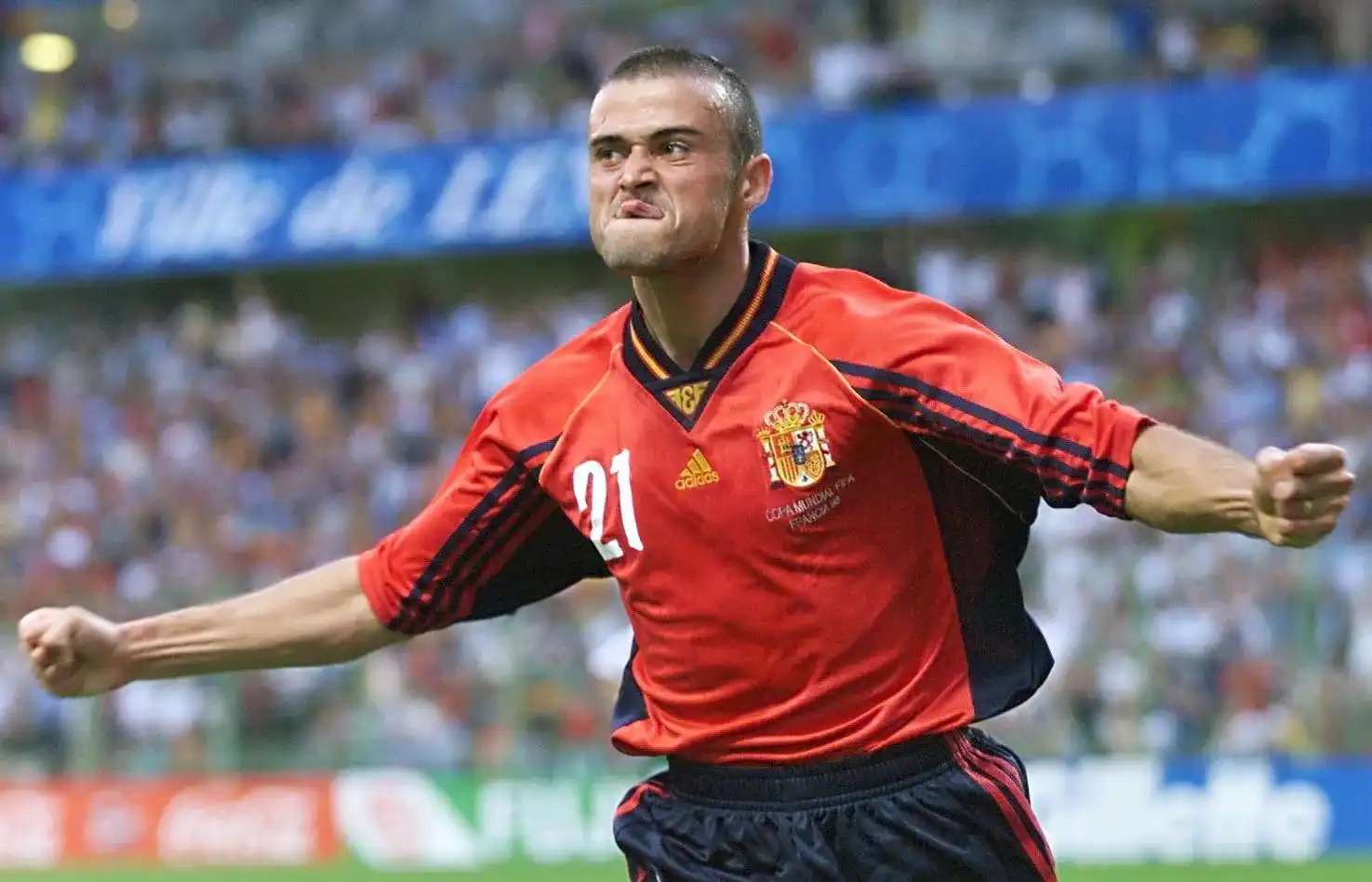
Given his many successes as a coach, the memory of Luis Enrique’s playing career can sometimes be overshadowed by his incredible achievements thereafter.
However, the most recent winner of The Best FIFA Men’s Coach award would likely not be where he is today were it not for his time on the pitch, including his years playing for the Spanish national team and his three – occasionally frustrating – appearances at the FIFA World Cup™.
USA 1994: The elbow that shocked the world
Luis Enrique’s first World Cup appearance came at USA 1994. At the age of 24, the then-Real Madrid player had done enough to impress coach Javier Clemente and earn a place within Spain’s squad. At the time, Spain were in a transition period with their style of play, moving away from ‘La Furia’ and developing their own artful way of playing the beautiful game, and Luis Enrique perhaps embodied the confluence of these two styles better than anyone else. Their World Cup campaign, though, got off to an inauspicious start, with La Roja held to consecutive draws by Korea Republic and the defending champions, Germany.
Luis Enrique watched on from the bench in Spain’s final group match against Bolivia (a 3-1 victory), but returned to the starting line-up in their round-of-16 clash against Switzerland, and made his presence felt. Deployed up front and fed into space by Sergi Barjuan, the man from Madrid doubled Spain’s lead in the 74th minute, setting his nation on course for a stylish 3-0 victory. That would turn out to be the first of 12 international goals that Luis Enrique would score in his career.
In the quarter-finals, Spain came up against Italy, with Luis Enrique once again expected to play a key role. Dino Baggio opened the scoring for Italy in the first half, though Spain would draw level in the second thanks to Jose Luis Caminero, only for Roberto Baggio to restore the Azzurri’s lead. The main talking point, though, came in the 79th minute, when Mauro Tassotti appeared to elbow Luis Enrique in the face, an incident that was missed by the officials. As a result, Spain were denied a penalty and never found a way back into the game.
“It happened so long ago that I think my nose has finally healed,” remarked Luise Enrique in 2021 ahead of Spain and Italy’s semi-final face-off at UEFA EURO 2020. “I’ve spoken to Mauro Tassotti three or four times over the years, and I’ve always found him to be a good, honest person. It’s part of the past, part of the history of our football and I’m sure we’d have both liked things to have gone differently at the time.”
France 1998: A national trauma
Reappointed as Spain’s head coach for the 1994-98 cycle, Clemente gave Luis Enrique increasingly more responsibility within the team after USA 1994. “He is a player who is always a reliable choice for a coach, wherever you play him,” Clemente said on television ahead of France 1998. “In any position… in defence, in attack, in midfield, he is always ready to do a good job. He is a player driven by his tremendous passion for the game.”
Luis Enrique, who in the meantime had swapped Real Madrid’s white for the blaugrana of Barcelona, was determined to put that quarter-final incident against Italy four years previously behind him. “We felt we were the better side, even though they scored first. We equalised and, just when we were playing our best football, Baggio scored to make it 2–1, which made the game very difficult for us,” he said ahead of the tournament in France. “In recent World Cups, Spain have often been eliminated just when they were playing their best football. Let’s see if we can change that. To be honest, though, I’d be happy to not play as well and go beyond the quarter-finals. That would be a good ending.”
Drawn in Group D, Spain’s optimism quickly faded. A 3-2 defeat to Nigeria left them with their backs to the wall, before a goalless draw against Paraguay pushed them to the brink of elimination. In Spain’s final group match, Luis Enrique more than rose to the occasion. In a 6–1 win over Bulgaria, he scored, provided an assist and won a penalty. Meanwhile, however, Paraguay beat the Nigerian Super Eagles, sealing a traumatic first-round exit for a Spain side that had arrived brimming with ambition.
Korea/Japan 2002: The dawn of a revival
Seriously injured ahead of UEFA EURO 2000, Luis Enrique nevertheless made the trip to Asia for the 2002 FIFA World Cup Korea/Japan™. Spain adopted a cautious approach, while the future Paris Saint-Germain coach, at the twilight of his international career, was there to pass the torch. Nevertheless, coach Jose Antonio Camacho still used him in every match. In the opener, a 3-1 victory against Slovenia, La Roja’s No21 led by example, supplying an assist for Raul. Although he was taken off at half-time for tactical reasons when coming from behind to win 3-1 against Paraguay, and was on the pitch for just eight minutes in the 3-2 victory against South Africa, Luis Enrique played a pivotal role in the hard-fought last-16 battle with the Republic of Ireland, which was won 4-3 on penalties.
As it was against Italy eight years earlier, Spain showed in the quarter-finals that they were not far short of breaking through their glass ceiling. Introduced in the 80th minute of the clash with a surprising Korea Republic side, Luis Enrique’s determination and tireless commitment through extra time were not enough to prevent La Roja’s elimination in the dreaded shootout. Despite all the disappointment, the transformation that would lead the country to its first world title eight years later had quietly begun.
“In my day, we were called the ‘Spanish Fury’, but when we got to the World Cup and saw the Germans or the African teams, we’d say to ourselves: With the Fury, how far are we really going to go?”, Luis Enrique quipped on his Twitch channel, referring back to 2002 and to his belief at the time that Spain needed to play differently to make the final step up.
Luis Enrique’s story with Spain may be seen as a troubled one, even incomplete, and tinged with frustrations that his mixed spell on the bench at Qatar 2022 also helped to fuel, yet the former Barcelona coach arguably embodies better than anyone the transformation that ultimately led Spain to glory.
Although he never won a title with La Roja, alongside figures such as Fernando Hierro, the former midfielder clearly succeeded in doing what he does best: leading the way.