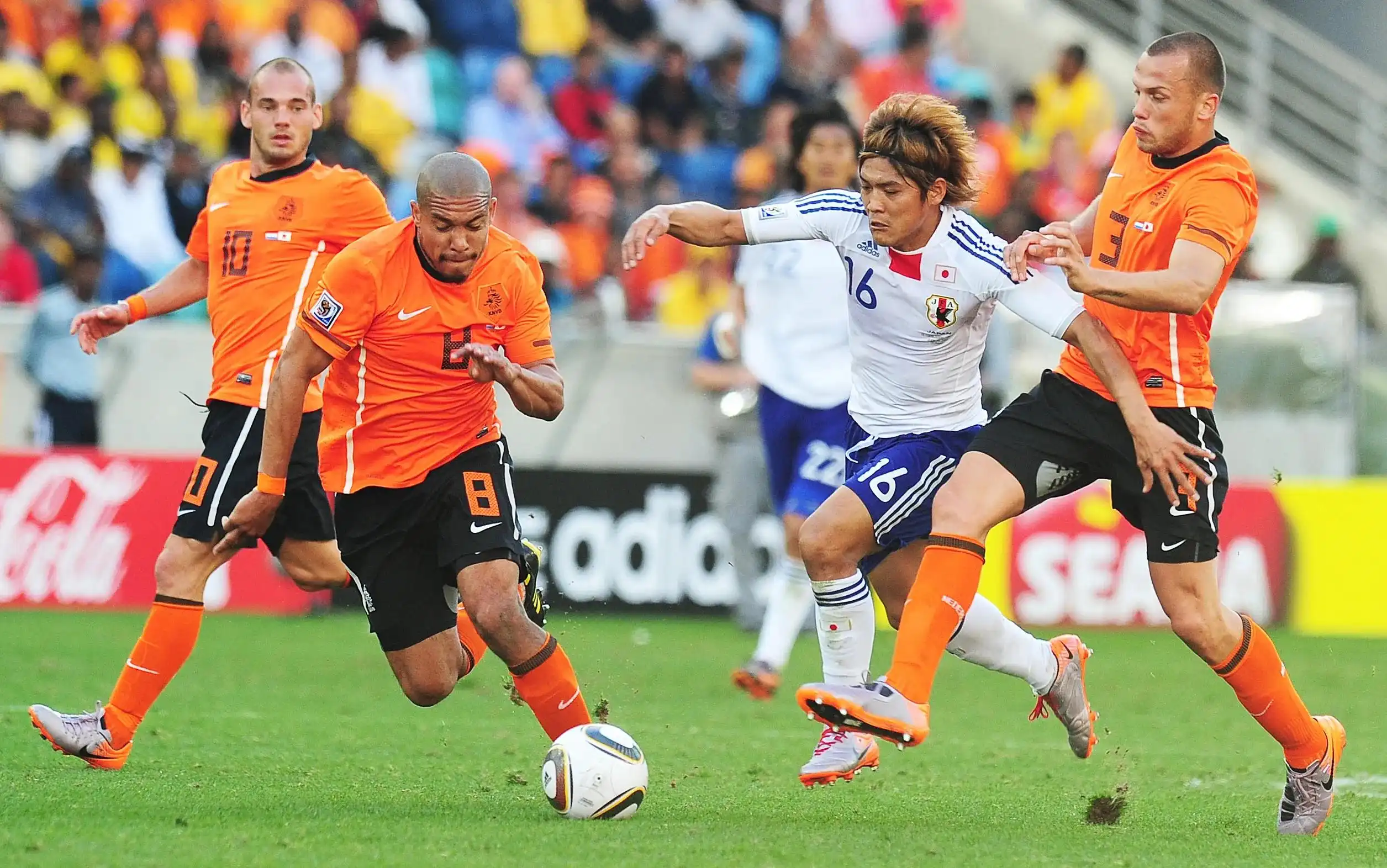
If you were to ask a fan about the footballing history between Japan and the Netherlands, the first thing to come to mind would most likely be their encounter at the 2010 FIFA World Cup™ in South Africa. Both teams had been drawn into Group E, and the second group stage fixture saw them clash swords in Durban. The match finished with the Netherlands claiming a 1-0 victory, but this scoreline does not tell the full story of what happened across the 90 minutes.
Armed with excellent concentration and their ability to defend as a collective, the Samurai Blue managed to go toe to toe with a Netherlands side who would eventually contest the final. Japan found themselves needing to counter an opponent who they knew would look to keep the ball and dictate the pace. They did this by forming a compact block and looking for their chance to break, an approach they doggedly maintained throughout the match, ensuring it remained a tense affair until the final whistle.
It was a powerful second-half effort from outside of the area by Dutch playmaker Wesley Sneijder that pierced through Japan’s armour and settled the match. However, the fact that it took a moment of brilliance to separate the two sides was a testament to how evenly matched they were. This observation was echoed by the match-winner himself, who said: “Japan were one of the toughest teams we faced at this World Cup. They were incredibly impressive and we had to be at our absolute best for the full 90 minutes to win.”
Indeed, this victory over Japan was about more than just three points for the Netherlands. In hindsight, the match represented an important touchstone and a sorely needed morale boost. Wins breed confidence, and securing such a hard-fought victory gave the Oranje the belief that helped carry them through the knockout stages and all the way to the final against Spain. Although they fell at the last hurdle, losing 1-0 in extra time, their run to the final included impressive wins over the likes of Brazil and Uruguay, and it was their challenges in the group stage – including the match with Japan – that provided the foundations for this success.
The football connection between the two nations is one that runs far deeper than just this match, and extends back for a number of years. At the heart of their relationship is the Dutch top flight, the Eredivisie. It is a league in which many a Japanese player has cut their teeth, honing their skills, their tactical awareness, and their ability to deal with the intense pace of the European game. This then feeds back into the national team.
For many people, Shinji Ono is the pioneer who kick-started this trend. In 2001, he made the move to Feyenoord, adding his outstanding technique and creativity to their arsenal, which culminated in him becoming the first Japanese player to secure a major European title as the Dutch outfit won the 2001/02 UEFA Cup. His long Eredivisie career left a lasting impression on players back home, and opened the eyes of many of his compatriots to the possibility that they too could play an important role in the world of European football.
The trail blazed by Ono has since been followed by the next generation of players. Japan’s current squad boasts several Eredivisie regulars, including prolific Feyenoord frontman Ayase Ueda, his team-mate Tsuyoshi Watanabe, NEC duo Koki Ogawa and Kodai Sano, as well as Ajax’s Takehiro Tomiyasu, who recently joined Ko Itakura at the Johan Cruyff Arena. Ritsu Doan and Keito Nakamura also have experience playing club football in the Netherlands, and are examples of how the country’s competitiveness and development-focused environment has brought out the best in some Japanese stars. The way these players have built up their reputation and reliability embodies the strength in depth that Japan possess.
All of this ties in with the words spoken by Dutch coach Ronald Koeman following the group stage draw for this year’s World Cup, saying: “Obviously playing against Japan is going to be a big challenge. They’re a fantastic side; I think that they’re a lot better than most Dutch fans realise. It’s going to be a very tricky one,” he concluded, showing the esteem in which he holds them as opponents. He then added: “What we need to do now is to take our time and thoroughly prepare for the match against Japan. Whatever happens, I know this group of players will put on a great display. It’s going to be one of those fun matches that everyone’s looking forward to and everyone will be watching.”
Koeman finished by giving a straightforward and succinct assessment of how Japan are seen on the global stage. “I don’t think I expected them to become as strong as they are. I’d say they’re one of the most fascinating teams in world football right now.”
When it comes to the World Cup, the connection between Japan and Netherlands will soon no longer be the story of a single game. The regular expeditions of Japanese players to the Eredivisie, the skills they have developed there and the experiences they have brought back to the national side have all turned Japan into a team that can no longer be taken for granted.
The hint of potential that we glimpsed in 2010 has now come to fruition as a new chapter dawns in the football history of both nations.