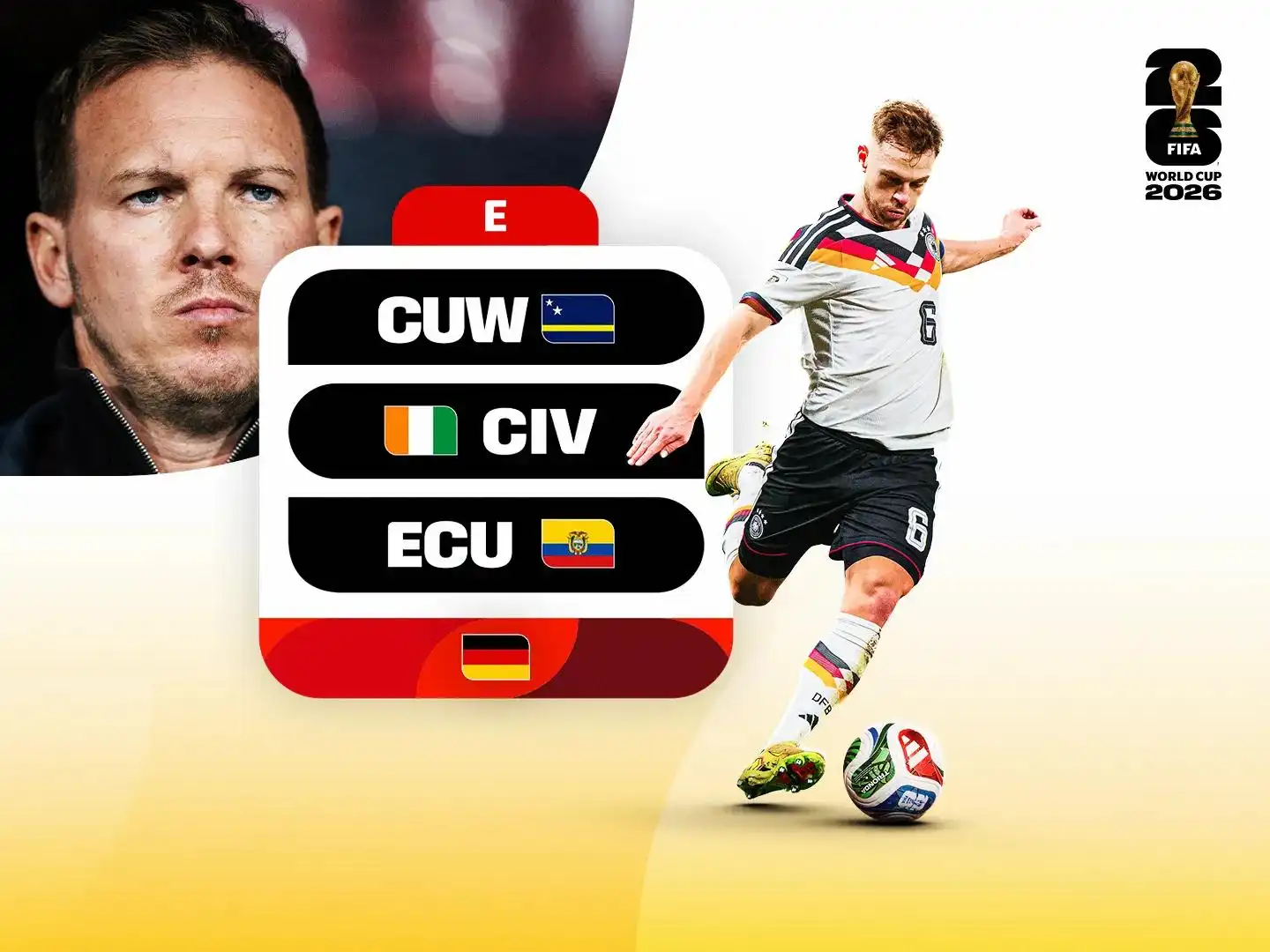
The FIFA World Cup 2026™ in Canada, Mexico and the United States will be Germany’s 19th consecutive World Cup and their 21st overall.
Germany have lifted the trophy four times and hold the record for the most quarter-final appearances with eight, but failed to make it past the group stage in both 2018 and 2022.
They will be looking to put those recent struggles behind them in North America. Julian Nagelsmann’s charges recovered well after a poor start to their qualifying campaign, but the team are still in transition following the squad shake-up that began in 2024.
Germany coach: Julian Nagelsmann
Nagelsmann was appointed in September 2023 following the dismissal of Hansi Flick and had little time to prepare for UEFA EURO 2024 on home soil. He initially took the job until the end of the tournament but then extended his deal until 2026 before the EURO got under way. He has since signed his third contract with the German FA (DFB), which runs until EURO 2028 inclusive.
The 38-year-old – the youngest head coach in Germany’s history – had successful spells at Hoffenheim, RB Leipzig and Bayern Munich before accepting the call from the DFB. He is known for instilling a great deal of tactical flexibility into his teams, but in his time with the national team so far, he has generally pursued a controlled, aggressive pressing style of play. Under Nagelsmann, Germany tend to play with slightly less risk in possession than under Flick and have become more solid defensively, but purposeful transitions are still a key feature of the side.
Germany’s World Cup 2026 fixtures and group
Full World Cup 2026 match schedule
How Germany qualified for World Cup 2026
Germany booked their World Cup ticket in their final qualifying match in November 2025, topping Group A ahead of Slovakia, Northern Ireland and Luxembourg with five wins in six matches, scoring 16 goals and conceding just three. After a shock 2-0 defeat in their opener in Bratislav, Germany steadily improved and capped their successful campaign with a thrilling 6-0 win over the Slovakians in their final home game.
During the qualifiers, Nagelsmann had to do without several potential regulars, with Jamal Musiala, Kai Havertz, Niclas Füllkrug, Tim Kleindienst, Benjamin Henrichs and Antonio Rudiger, as well as goalkeeper Marc-Andre ter Stegen, either missing the entire campaign or out for long periods due to injury.
Germany’s World Cup history
Germany’s best World Cup
Germany have won the World Cup four times, but the Miracle of Bern – when head coach Sepp Herberger surprisingly led a team captained by Fritz Walter to their first World Cup title at the 1954 World Cup in Switzerland –is still considered their greatest triumph.
The Germans were the clear underdogs going into the final against Hungary, especially as they had already lost 8-3 to the same opposition in the group stage. Herberger’s side conceded twice in the opening ten minutes of the final, but quickly hauled themselves level with goals from Max Morlock and Helmut Rahn.
Somehow, they withstood the Hungarians’ sustained periods of pressure before Rahn scored the game’s fifth and decisive goal in the 84th minute.
Germany’s last World Cup
From a German perspective, Qatar 2022 was a stark contrast to Switzerland 1954. The Germans’ campaign came to a shuddering halt at the end of the group stage in Qatar, just as it had four years previously in Russia. In a topsy-turvy Group E, Germany fell to an opening 2-1 defeat at the hands of Japan despite taking the lead through an İlkay Gündoğan penalty, before a 1-1 draw with Spain in their second game kept their chances of progressing alive.
In their final match, Germany came from behind to defeat Costa Rica 4-2, but it proved to be in vain as Japan stunned Spain 2-1 at the same time, leaving the Germans in third place and consigned to the exit door.
Germany’s first World Cup
Germany made their World Cup debut at Italy 1934 and immediately achieved a podium finish. They got off to a flyer in Turin by defeating Belgium 5-2, and a 2-1 win over Sweden in the quarter-finals saw them progress to the semi-finals, where they lost 3-1 to Czechoslovakia. They then saw off Austria 3-2 in the match for third place to claim a bronze medal in their first World Cup appearance.
Germany’s World Cup top scorer
Miroslav Klose has held the German World Cup scoring record since 2014. Klose, currently the head coach of Nuremberg, notched 16 goals in four World Cups, lifting the trophy in 2014 and surpassing the previous German record held by Gerd Müller (14) and edging past Brazil’s Ronaldo to claim the honour of all-time leading World Cup goalscorer. Klose also has one adidas Golden Boot on his mantlepiece, having led the scoring charts with five goals at the 2006 World Cup on home soil.
Germany’s record World Cup appearance-maker
With 25 appearances to his name, Lothar Matthaus is Germany’s most-capped player at the global showpiece. The midfielder played in five World Cups (1982, 1986, 1990, 1994, 1998) and was only 21 years old when he made his debut at the competition in 1982. He skippered his side to the title in Italy in 1990 and played his last World Cup match in 1998 at the age of 37. With his 25 World Cup outings, Matthaus also held the world record for a long time, only to see Lionel Messi move past him in 2022.
Germany’s memorable World Cup moments
Germany’s most memorable World Cup performance was perhaps their 7-1 win over hosts Brazil in the 2014 semi-finals. They raced into a 5-0 lead in Belo Horizonte with less than 30 minutes on the clock, setting a new semi-final record.
Germany’s illustrious World Cup history is also dotted with many other unforgettable moments, such as 1970’s ‘Game of the Century’ in Mexico City – a dramatic semi-final clash that Italy ultimately won 4-3 after extra time.
The ‘Night of Seville’ in 1982 was another game that has good down in football folklore. West Germany were 3-1 down in extra time of their semi-final with France, but roared back to equalise with two late goals before prevailing in the first-ever penalty shoot-out at the World Cup.
The 2006 World Cup in Germany was a true festival of football. The tournament known in the host country as the Summer Fairytale is remembered for its colourful fan miles and sweltering temperatures. Germany were involved in some thrilling matches, but ultimately fell short in their quest for the biggest title of all, losing to Italy in a thrilling semi-final, but there was at least some consolation in the form of a bronze medal in the match for third place.
Germany’s biggest World Cup win
Germany’s most emphatic World Cup triumph dates back to the group stage of the 2002 World Cup when they cruised to an 8-0 victory over Saudi Arabia in their opening match. Klose scored three headers, and Michael Ballack also got his name on the scoresheet, setting the tone for their impressive individual campaigns and laying the foundations for the team’s run to the final.