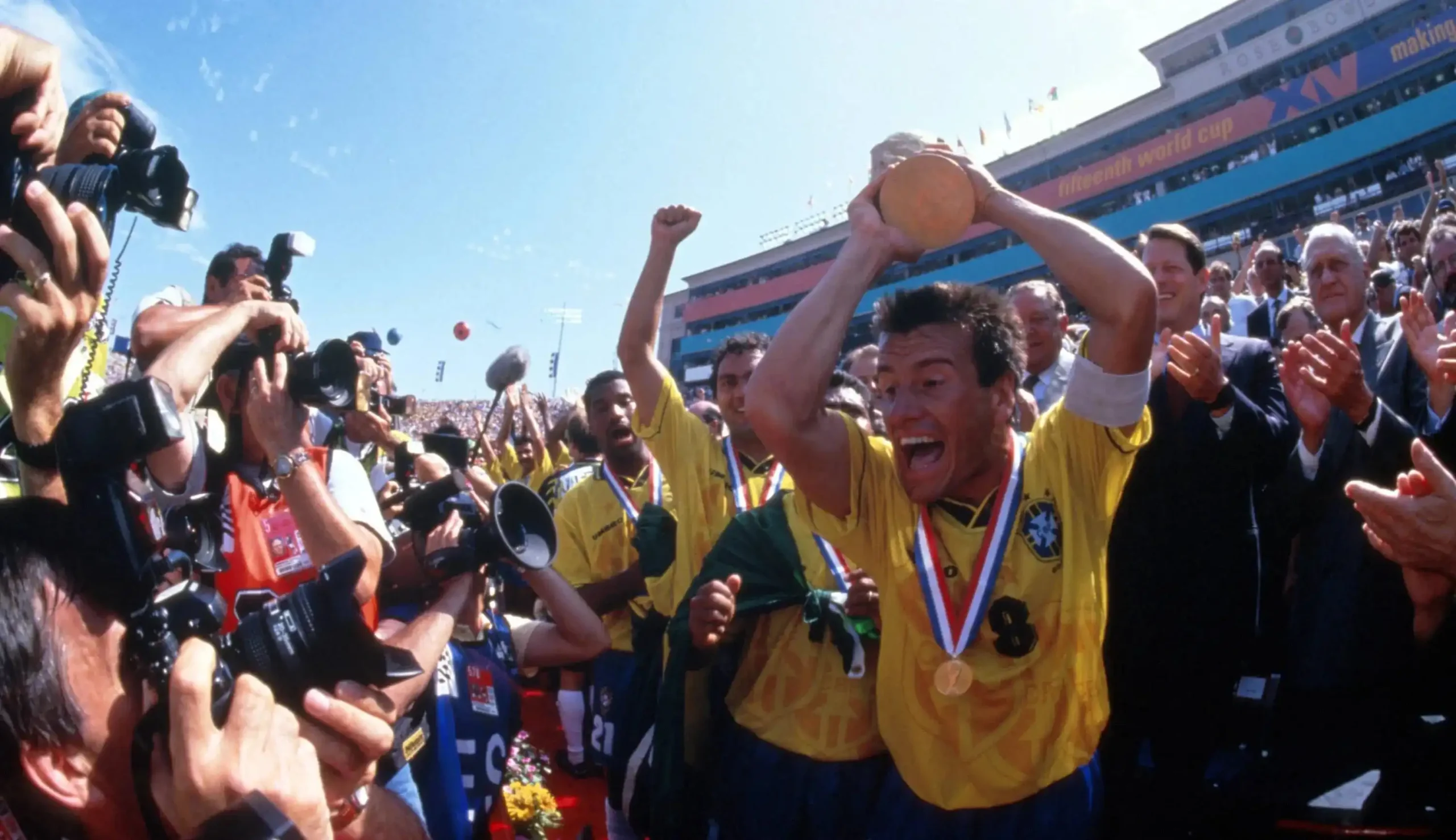
With the schedule for the FIFA World Cup 2026™ now finalised, Mexico City is preparing for the high-profile tournament opener between co-hosts Mexico and South Africa. While many fans are counting down to that first whistle, the competition has already begun for those who will be crossing the white line. At least that is how Dunga, Brazil’s World Cup-winning captain of USA 1994, thinks players should be looking at it if they want to get their hands on that coveted trophy on 19 July.
The pathway to the final has pretty much been set, with only a few places left to be filled through the FIFA World Cup 2026 Play-Off Tournament and UEFA Playoffs. Looking back on memories from three decades ago, the former midfielder told FIFA: “When a country wins a World Cup, it’s because they’ve done the things that others haven’t done. You have to win the game before training, in your preparation.”
Once the draw has been made, teams start to study their opponents and begin their specific preparations, looking for the details that can make all the difference. Dunga looks back at how his Brazil side utilised the information they had – which was scarce back then – and turned it into a valuable asset.
“Nowadays people say that we didn’t use to study [our opponents] back then, but we did. It just took a little longer,” he explains. “First we had to wait for the TV broadcast, then the coaching team – [head coach] Carlos Alberto Parreira, [assistant coach Mario] Zagallo and [team manager] Americo Faria – would start to study each team.”
Clearly, in 2026, things are very different as video footage and data on all 48 teams at the tournament are readily available. As far as the captain is concerned, however, the thinking remains the same. The tools may be different, but the search for competitive edges must be relentless.
Information is gold
Dunga looks back on those days with pride. Much of the preparation came in the form of conversations, which would even happen over dinner. Football’s nascent globalisation did help a little, though. The exchange of information, with many Brazilian players spread across Europe, was crucial. “At dinner, I’d sit down with all the players, who were playing in different countries, and we’d talk about our opponents’ strengths and weaknesses and how they played,” he recalls.
That exchange, he reveals, went beyond technical quality and went as far as looking at each player’s emotional profile. “That helped us gain an advantage.” Today, the abundance of data and images allows national teams to be able to find out virtually everything about their opponents. The challenge, according to Dunga, is no longer obtaining information, but knowing how to filter it.
“Back then we didn’t have video footage. We were working with photos, slides, but we always studied them. Today there’s an excess of material. You need to have criteria so that you don’t get lost in it,” he explains. In that sense, the World Cup draw is still the starting point of the tournament: it is when the preparation roadmap is set out, be it with limited resources or with cutting-edge technology.
What it takes to win
Studying opponents is one thing, executing a plan is another. Knowing your opponents is only the first step; what comes next is just as important. And, from Dunga’s point of view, this is where the pillars that are the foundation of any successful campaign come into play. The preparation never stops.
“There’s no point in studying opponents if you can’t apply what you’ve learned. You have to improve every day,” he says. At the World Cup, improvisation is not enough. Every match is important. One mistake can be the difference between a team progressing to the next round and heading to the airport. That is why extreme care is required when it comes to deciphering the information gathered.
Another key aspect is mindset. Dunga could not be more emphatic in saying that winning a World Cup requires mental strength. “It’s going to be hard for everyone. But if you want to win a World Cup, you have to be able to beat anyone,” he says.
As far as he is concerned, there are no easy paths: you have to be ready to go up against any opponent and deal with the pressure of representing an entire country. Discipline is also at the heart of his analysis. “The main thing [you need] to win a World Cup is for everyone to be willing to pay the price. The price you pay for lifting that trophy is enormous, but it’s worth it,” he says.
That price involves personal sacrifice. “For those 30 days, you have to forget about the world. A lot of people won’t like to hear it, but you have to forget about your family, forget about everything, and focus on your job,” he explains.
Collective victories, individual rewards
For Dunga, that total commitment is what sets winners apart from contenders. According to the captain of that Seleção team that conquered the world in the United States, unity is what ensures that even the smallest details are taken care of, and at a World Cup, details are the difference between winning and losing. Dunga sums up his philosophy in a phrase he often repeats: “Collective victories, individual rewards.”
Winning the tournament is the result of a collective effort that goes way beyond the players who take to the pitch. And this is where the preparation done in the past connects with the modern day – or, for teams competing at the FIFA World Cup 2026, the preparation that is already being done.
“It’s the entire structure that has to row in the same direction. It’s not enough to be in the same boat; you have to row in the same direction,” he says. “Over those 30 days, you have the chance to achieve something you’ll never achieve again for the rest of your life.”