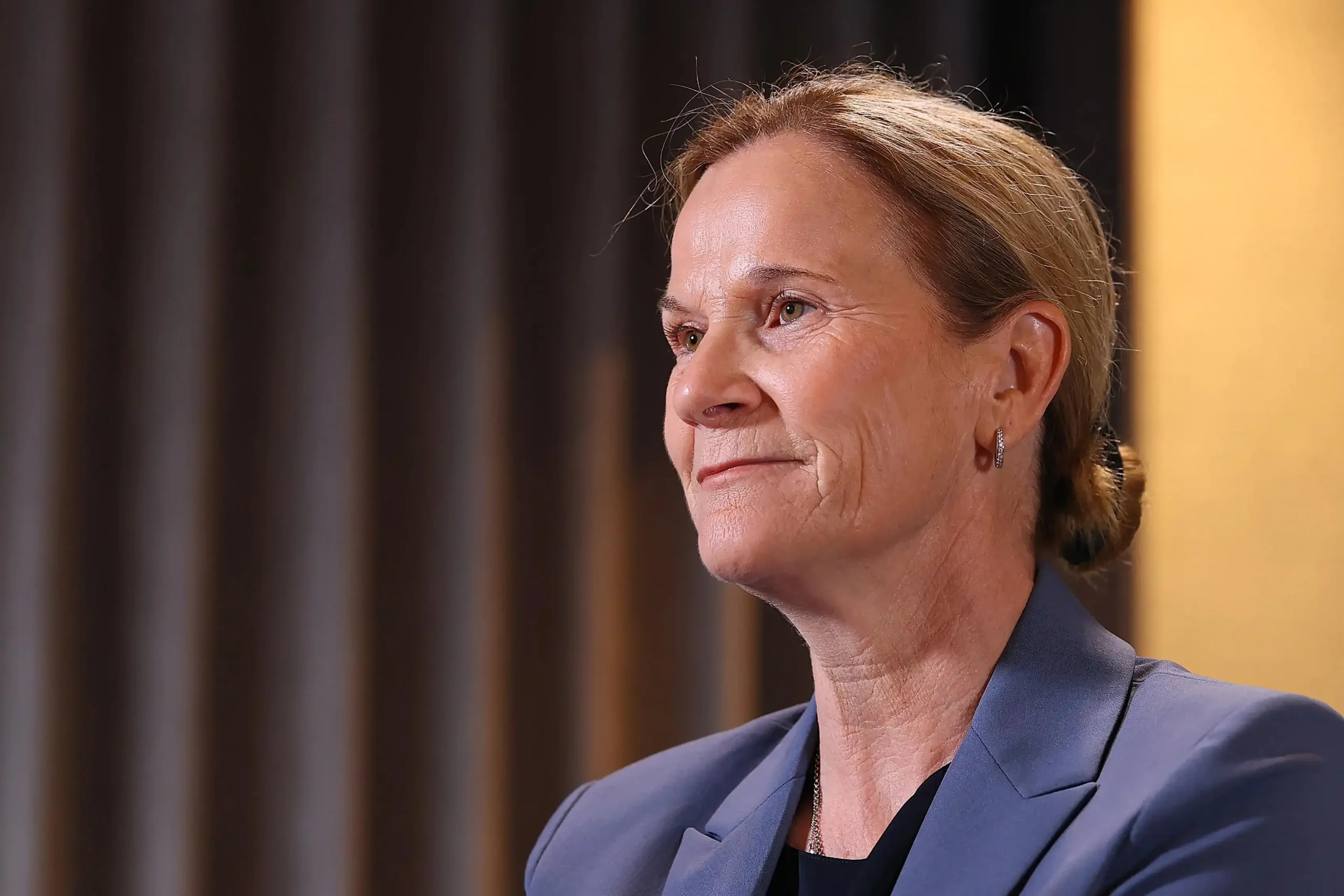
Jill Ellis needs no introduction. Under her leadership, USA won the FIFA Women’s World Cup™ twice, in 2015 and 2019. She also mentored formidable players such as Abby Wambach, Megan Rapinoe, Carli Lloyd, Hope Solo, Alex Morgan, Julie Ertz and Rose Lavelle, to name but a few.
“When you step back, [you remember] the people you went on the journey with”, recalls the 59-year-old, who is now FIFA Chief Football Officer. With 500 days to go until the FIFA Women’s World Cup 2027™ in Brazil, The Best FIFA Women’s Coach 2019 shared her memories of the 2015 and 2019 titles, explained how she kept the Stars and Stripes at the top and what she expects from an “epic” Women’s World Cup in Brazil where she thinks “there’ll be some surprises and some upsets”.
Jill Ellis: It’s not necessarily the big picture of winning a trophy, or going through a tournament – it’s the people you went on that journey with: the players, the conversations, the staff. [2015 and 2019] were two very different journeys. I was brand new in 2015, just trying to learn as I went, and figure this thing out. In 2019, we had a lot more time in terms of preparing and building a team. But ultimately, again, it’s the people you went on that journey with.
The other thing is when I think of those tournaments, I think of small moments and details: the late-night meetings with my staff, we were ordering ice-cream at two in the morning to get us through – and pizza – to individual meetings with players to nail a very specific moment that we would focus on in the game. So, even though it’s such a big-picture thing, you really remember these little details along the way.
I think, in 2015, having Abby Wambach and Christine Rampone – two icons and veterans in the women’s game – enter the field in a [FIFA Women’s] World Cup final and finish their careers, essentially, as world champions… That’s always something that always emotionally resonates with me. That’s a special moment. From 2019, for sure the game against France in Parc des Princes: the energy, what was at stake, just the quality of the game, the players on the pitch. That also was a really special moment in the journey.
From 2015 to 2019, we learned valuable lessons along the way, going into the 2016 Olympics too. What we tried to bring was a team where 11 players attack, 11 players defend – and we had an answer for any question that our opponent posed to us. To be able to diversify our tactics when we needed to, to have a variety of different profiles of players. If a team’s sitting very low on you, you need a specific type of player that can play in really tight spaces, that can solve the game too. If a team is pressing, sometimes you want to play with pace up top to play in. So, it’s just the idea of having a very balanced team and bench. When we were presented with a challenge, we had a solution. Training that way to have flexibility, but also not lose sight of what we were about. We were a team that was incredibly competitive, [had] a strong desire to win – a very close-knit team that was hard to beat. And then, we had incredible playmakers on the pitch as well.
I think the US is used to having a big target on their back. They’ve won World Cups, they’ve won Olympic medals, and so when the US enters a major competition, there’s an expectation. These players come into an environment that’s competitive every single day. They are tested, they have to prove themselves, and they’re built for going into a pressure-cooker of a world championship. I always sort of said that if we can maximise who we are and what we can do, the result takes care of itself.
That’s a great question. How do you sustain success? Because getting on top of the podium is very, very hard and very few teams have done it. But to do it repeatedly or back-to-back… Sometimes, success is actually not a great teacher. People kind of forget the risks that they were willing to take and the boldness of the decisions when you’re trying to win it for the first time. And then sometimes when you win something, you take the approach of “Ah, I’ve got to protect this, it’s ours to lose”.
So, what we really emphasised with our players [was], “We’re not defending our trophy in 2019; we are attacking the next one, we’ve got to be as bold, as willing to take risks, and not play with anything to lose.” [It’s about] setting the demands of having this idea: “Can we be better tomorrow than we are today?” And, again, that whole mindset is part of the culture in the US women’s team.
Maybe I’ll go personal for a second. I think one of the [proudest] moments I’ve ever had [was] having my daughter and my wife [with me], because they go on that journey. Every player will tell you, every coach will tell you, that your family are really on that journey with you. They live every high, they suffer every low. So, seeing them after the games, and sharing that [happiness] with your family, I think that is a really, really cool moment.
Every iteration of the World Cup that we’ve had on the women’s side, we’ve seen more and more countries, more and more competitive matches, talent emerging from a variety of countries. So, what’s my expectation? Certainly, the heavyweights will be in there. Spain’s the defending champion. Brazil are the hosts, and they have such amazing players. England has had a taste of success, and that’s an important element when you’re trying to win, that you believe that you can win. The US are perennially in the mix and always trying to hit that mark. France have amazing players. Those teams will certainly be challenging. But I’m also excited to see some of the countries that are really growing in their journey. If we think about Morocco from 2023, making the knockout stages, what they’re trying to do to develop the game there. We’re seeing such growth everywhere that I think there’ll be some surprises and some upsets.
Emma [Hayes] has done an amazing job. I think she’s the right person. You always have to understand that there’s a cycle to playing in World Cups where you have to infuse. I think the best team that takes the stage is a team that has the experience of leadership and people that have done it before with the infusion of young, hungry talent – and I think Emma’s building that. She’s brought in a lot: more younger players, given a lot more opportunity now to new talent. It’s like a painter – if you have more colours to choose from, you can really create something beautiful.
The Women’s World Cup 2027 is going to be epic. I mean, there’s no other word. That’s part of the tagline, and it will be that. Every time we see another iteration of the Women’s World Cup, we are raising the level. It will, unequivocally, be the best. It’s being hosted in a country that’s absolutely nuts about football. They love it. It’s in the streets. It’s in the life there. You’re combining an incredible product with talent, competitiveness, energy and skill with an incredible host. So I think it’s going to be extraordinary.