At the FIFA World Cup™, teams are not defined by the number of appearances they make alone, but also by the matches that live on forever. Some games end with the final whistle; others endure because they altered the course of a tournament, defied expectations, or reshaped perceptions of an entire team. And Saudi Arabia have achieved exactly that on more than one occasion.
Often arriving outside the spotlight of the favourites, the Green Falcons have frequently embraced the role of underdogs. Whilst that status has frequently led to modest expectations from outsiders, it has also allowed the team to compete with full focus, concentrating solely on their task on the pitch.
Several Saudi victories have come at pivotal moments, against opponents with greater pedigree and global profile. They were not displays of overwhelming dominance, but rather disciplined performances decided by fine margins and unforgettable moments.
As a seventh appearance at the FIFA World Cup 2026™ approaches – where they will face Spain, Cabo Verde and Uruguay in Group H – FIFA looks back at four matches that best encapsulate the Saudi spirit. These games do not tell the entire story of the Green Falcons, but they help explain why their presence at the global finals has so often suggested that anything can happen.
Saudi Arabia 2-1 Morocco | USA 1994
Saudi Arabia entered their second group match at USA 1994 carrying mixed emotions from their opener against the Netherlands. Despite a 2-1 defeat, the Green Falcons had taken the lead through Fuad Anwar and delivered a performance that surprised many, demonstrating they could compete at the highest level on their World Cup debut. That display instilled belief that their showing was no fluke, but instead was a foundation to build upon.
Jorge Solari’s side now had to convert promise into points in a match shaped by demanding circumstances. Against Morocco, the physical battle was intense and the atmosphere charged, with elimination looming over both sides. The Atlas Lions, for their part, had produced a strong display against Belgium in their opening fixture, losing by a single goal, meaning another defeat would result in an early exit from the competition.
In Washington, in front of more than 50,000 spectators, Sami Al Jaber opened the scoring after just seven minutes, converting a penalty he had himself won. Morocco responded through Mohamed Chaouch, who finished from close range following a precise assist from Ahmed Bahja in the 26th minute.
Saudi Arabia were not the dominant side in possession, but they approached the contest with patience and discipline, absorbing pressure and waiting for opportunities on the counter-attack. Just before half-time, Anwar won the ball in midfield, surged forward and unleashed a powerful strike that slipped past goalkeeper Khalil Azmi. In the second half, Morocco pushed for an equaliser, but the Saudis held firm. Goalkeeper Mohamed Al Deayea produced key saves, and the crossbar came to their rescue late on, sealing a crucial 2-1 victory.
Belgium 0-1 Saudi Arabia | USA 1994
Belgium arrived for the final group match with qualification to the Round of 16 almost secured after victories over Morocco and the Netherlands. Saudi Arabia’s situation was more finely balanced: a win would guarantee progress, while a draw would leave them relying on other results.
Despite their impressive display against the Netherlands and subsequent victory over Morocco, Solari’s side were not widely regarded as genuine contenders against Belgium in the final group match. Saeed Al Owairan recalled those moments in a previous interview with FIFA, saying: “I remember before our first match against the Netherlands, some newspapers predicted us to lose 12-0. We knew what to expect in the second match against Morocco, because they were another Arab team. Then, once again, before we faced Belgium, people predicted we would lose 12-0. Can you imagine?”
Al Owairan answered those doubts in spectacular fashion. After just five minutes, wearing the no10 shirt, he collected the ball in his own half and embarked on a breathtaking run, surging past four defenders before calmly finishing beyond goalkeeper Michel Preud’homme. The goal, often compared to Diego Maradona’s iconic strike in 1986, became one of the most memorable in World Cup history.
Protecting that early lead required resilience. Belgium pressed repeatedly, but Saudi Arabia delivered a disciplined collective performance, anchored by an outstanding display from Al Deayea in goal. He stood firm against Belgium’s attempts to find an equaliser, preserving the lead until the final whistle. With that victory, Saudi Arabia moved to six points and secured second place in the group, before their journey came to an end in the next round with a 3-1 defeat to Sweden.
Saudi Arabia 2-1 Egypt | Russia 2018
In Saint Petersburg, with both teams already eliminated following Uruguay and hosts Russia securing qualification, Saudi Arabia and Egypt sought to conclude their campaigns on a positive note.
After a tightly contested opening quarter-hour, Egypt struck first. Mohamed Salah controlled a precise long pass from Abdallah El Said and lofted the ball over advancing goalkeeper Yasser Al Mosailem.
Saudi Arabia responded by increasing their possession and attacking intent. A handball led to a penalty, but Essam El Hadary – the oldest player in World Cup history – denied Fahad Al Muwallad from the spot.
In the second half, El Hadary produced further saves, but Saudi Arabia maintained control. Deep into stoppage time, Salem Al Dawsari finished from close range following a clever short pass from Mohammed Al Breik, sealing a dramatic 2-1 victory and ensuring a memorable farewell to the tournament.
Argentina 1-2 Saudi Arabia | Qatar 2022
Few anticipated what would unfold in Lusail. Argentina arrived in Qatar as Copa America champions, unbeaten in 36 matches and widely regarded as one of the tournament favourites. Lionel Messi had finally secured a major international title, and confidence within the squad was high. But Herve Renard’s Saudi side stepped onto the pitch well-drilled and convinced they could rewrite the script.
Argentina controlled the first half and took the lead through Messi’s penalty. Yet Saudi Arabia remained composed with an aggressive defensive line and applied the offside trap effectively to keep the deficit at just one.
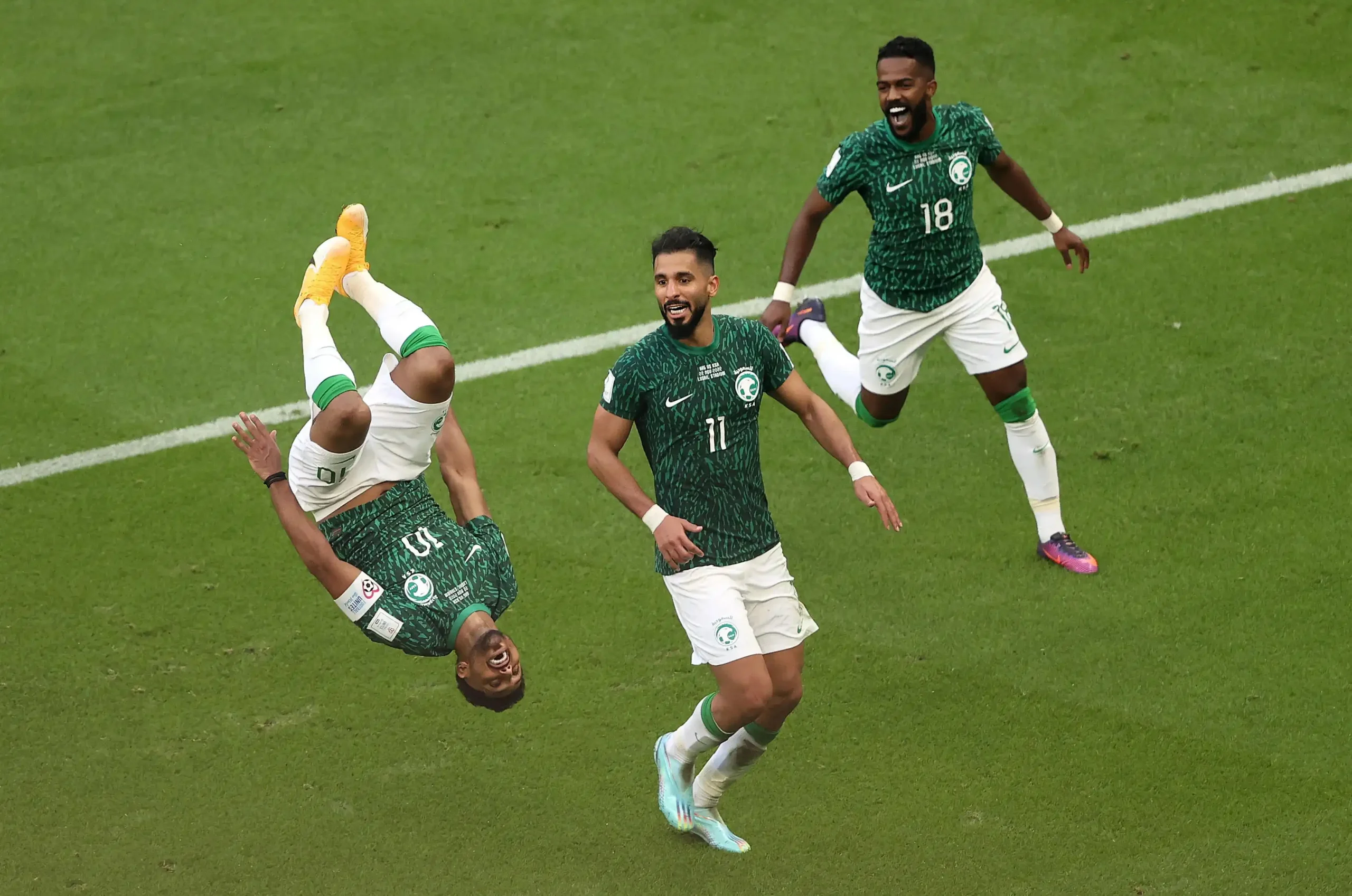
The second half brought a dramatic shift. The Green Falcons increased the tempo and attacked with renewed belief, and it soon paid dividends. Saleh Al Shehri surged into the box and finished calmly to level the score, signalling a turn in proceedings.
Just five minutes later, Al Dawsari produced one of the goals of the tournament, cutting inside and curling a superb strike into the far corner to ignite the 88,000-strong crowd.
What followed was a test of concentration and resilience. Argentina pressed relentlessly, but Saudi Arabia defended with discipline and determination, holding on for a famous 2-1 victory – one that resonated around the world and added another unforgettable chapter to the Green Falcons’ World Cup story.