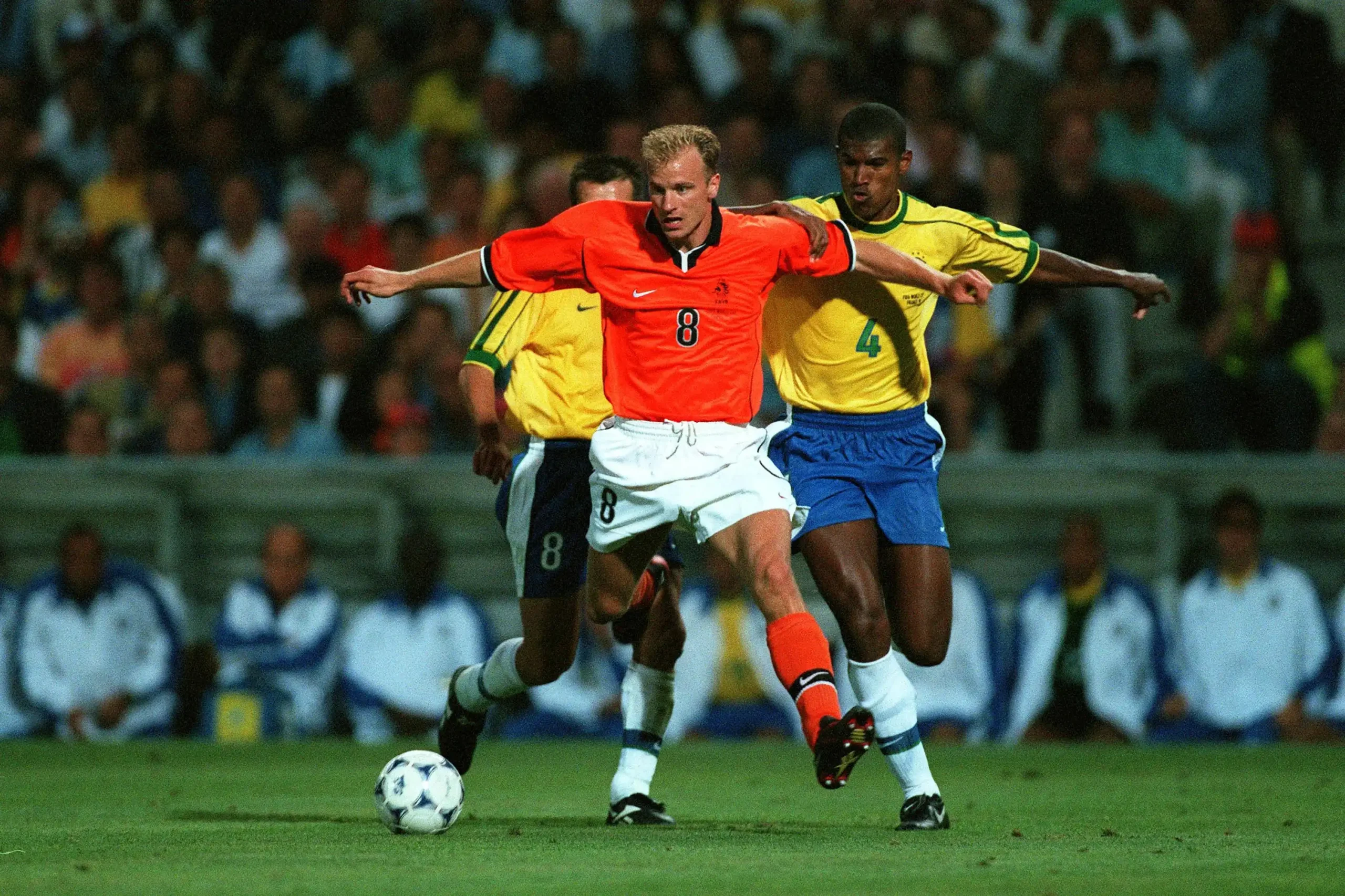
Renowned for his elegance, subtlety and ability to score extraordinary goals, Dennis Bergkamp may have never lifted the FIFA World Cup™ trophy, but he went down in its pantheon of greats. The wizard scored six goals in 12 matches, including one of the greatest in football history.
Few players embody Dutch football of the 1990s better than him – a golden era when the Oranje, blessed with immense talent, gave Brazil a strict examination in the USA 1994 quarter-finals and came agonisingly close to reaching the France 1998 final.
A graduate of the famed Ajax academy, Bergkamp netted 37 times in 79 Netherlands caps. From his international debut against Italy in 1990 to the cruel semi-final defeat to the same opponents at UEFA EURO 2000 in Amsterdam, the forward enjoyed a remarkable journey, which he revisited in an interview with FIFA.
Dennis Bergkamp: Well, funnily enough, it was the game between Holland and Argentina in the 1978 World Cup final. I don’t remember a lot from it, because I was very young. I think I was nine at the time. There wasn’t much football on television back then, but of course they showed the World Cup. My parents woke me up to watch the game.
I still remember a few flashes from it. Of course, later on, I saw a lot of footage of that final. But I’m sure that was my first memory of watching a World Cup. The memory itself was fantastic because it was the highest stage, of course, and Holland were playing there. So it was very special. The result? I don’t think I was too bothered at that age. But the image of football on television – the big stage, the big game, the final – that stayed in my mind.
The World Cup is probably the biggest stage. I played club football in Italy and in England, which were the biggest leagues at the time. But it’s always something special to play for your country. That’s a privilege.
Then you’re playing at the highest stage, which is the World Cup. That gives you a certain recognition. It’s tense as well, but it’s a good tension. You want to be part of it, you want to be there. It’s really special.
Once you’re there, you realise this is an elite group of players taking part. And afterwards, you take that with you. It becomes a confidence thing. You’re not arrogant about it, but it gives you more confidence to keep going in your career. It’s like a ladder, you make another step up.
I really enjoyed the whole tournament. I’d played EURO ’92 in Sweden before, where everything felt very close – the groups, the distances, everything was nearby. Then suddenly you’re playing the 1994 World Cup in the USA, which was much bigger.
Football maybe wasn’t the biggest sport there, but at the time it felt like it was. I’m not sure how much space there really is for football in America, because they already have so many big sports. But the MLS is obviously much bigger now than it was back then, so in that sense, you can see that things have improved.
The bad thing, of course, was the game against Brazil. But overall, the tournament was very enjoyable for me.
Yeah, I think we had a really good team, a strong collective. We had a good mix – technical players, strong players, experienced players, young players. So overall, it was a very balanced side. Brazil were a big team, a very strong team. But we were there as well. We had some bad luck in the game, maybe a few bad moments, but also good moments. It really could have gone either way.
It was just a pity to face a team like that already in the quarter-finals. You’d rather meet them in a semi-final or a final. But we went out against the eventual winner. It’s just one of those things that can happen in a World Cup.
We had a very, very good team, probably one of the best Dutch teams of all time. And it really started after a bad tournament in 1996. The Euros were more or less a disaster. From that moment on, we began to build something, with a clear plan from the coach [Guus Hiddink]. We wanted to be a real collective, focused on one thing – winning the tournament. We had a lot of confidence and we just went for it.
Personally, I started the tournament carrying an injury from the Premier League, so I came on in the first game. I was growing into the tournament and feeling better and better. There was that special moment against Argentina in the quarter-final. At that point, it felt like the whole team was thinking, ‘Okay, we’re going to do this.’ In the semi-final, we maybe missed a little bit – physically, mentally – but we were very close.
Against Brazil again, yes. It was disappointing to lose in that way but I don’t think we can blame ourselves. In my opinion, everyone performed well. There wasn’t a single player out of shape or out of form. I think we played a really good tournament. It was a lovely environment, a great stage to be part of. We peaked at the right moment, and unfortunately, it just wasn’t enough.
And in the end, we just fell a little bit short, on penalties. We felt we were a bit stronger at the time and that we should have gone to the final. At that stage, it’s often about luck. When you lose because the opponent is clearly better, you can accept it. But when it’s that close, when you miss out because of a bit of bad luck, that’s what makes it really frustrating.
Yes, because when I look at a goal – not only my own, but goals from other players as well – I always look at the stage. What kind of game was it? Who was the opponent? Which moment in the match?
When you put everything together, I was lucky enough to score some good goals during my career. But to do it at that stage, in a quarter-final, against one of the biggest teams ever, and in the way I did it that clearly makes it my favourite goal.
You dream about moments like that when you’re young, but they feel very far away. And then suddenly you’re there, and it actually happens. If you want to be remembered as a big player, there has to be something from that level that people remember you for. That was my moment and I really like it.
No, it’s definitely not only luck. We’re a very small country, but we consistently produce top players who do well abroad. You can be proud of that.
But as a team, it sometimes feels like we miss something maybe the determination to really finish the job. I played five major tournaments and four times I was knocked out on penalties. You can say penalties are about luck, but when it happens that often, maybe there’s something else behind it. It could be a mentality issue, that final step of killing the game.
The first emotion is that we should have more. But when I analyse it, I think we can be proud. We’re a small country but we produce a lot of good players and we are in those finals and semi-finals.
Of course, as a sportsman, as a footballer, you want to win things and to be successful. Even nowadays we want to win the trophy. We have to find a way to win those games and those penalty shootouts.
I think it’s a good group of players at the moment. I know Ronald Koeman well, he’s a good coach. He gives the players a lot of confidence and a lot of trust.
The Netherlands are not among the outright favourites, but they are a very strong outsider. They are a dark horse who can go all the way. If the players are fit, if they’re in form, then they can do something special.
The concern with the Netherlands has always been squad depth. In a tournament, you don’t just need 11 players, you need 16, maybe 20, or even more. Other teams can almost field two or three strong line-ups, and maybe we can’t.
So it will depend on whether, after a long season, the players are still fit enough, especially with all the travelling and extra games. That’s what makes it interesting.