He may not have known it at the time but the genesis of Graham Arnold’s latest coaching venture began more than two decades ago in the birthplace of Zeus. Given the lightning-bolt bearing deity’s connections to ancient sport, it was fitting that the seed was planted at the Games of the XXVIII Olympiad.
It was at Crete’s Pankritio Stadium where Australia, with Arnold serving as assistant coach, would clash with the nation he currently leads, Iraq, in the quarter-finals of the Men’s Olympic Football Tournament.
A year into a conflict that would span the next seven, Iraq rose from chaos at home to down the Olyroos en route to a remarkable fourth place finish at Athens 2004. The bulk of that team then went on to lift the Asian Cup three years later in the midst of the worst years of a war that touched almost every member of the squad.
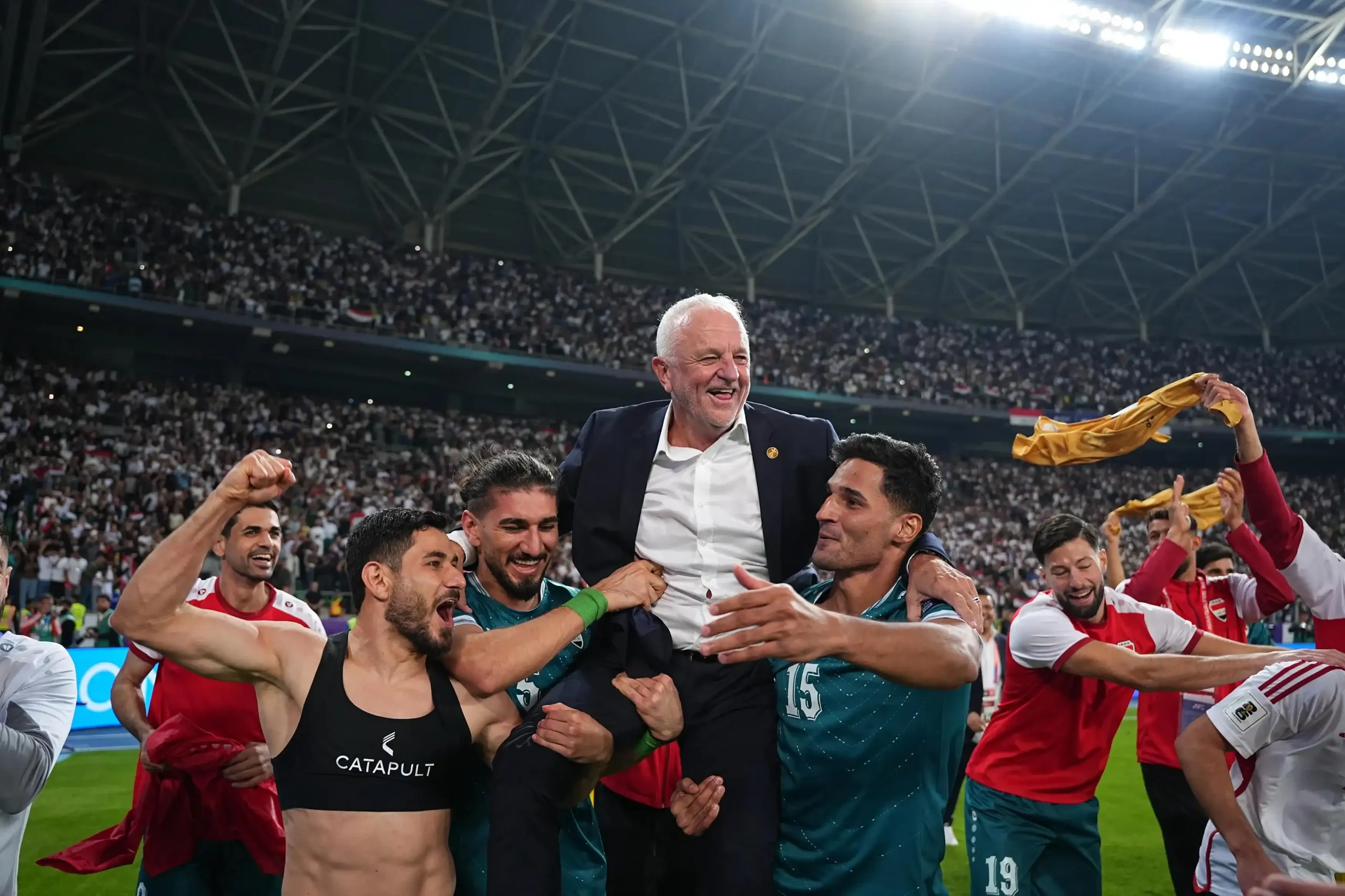
With Arnold then in charge of the Socceroos for the first of two stints at the national team helm, he saw Iraq dazzle in a 3-1 win in Bangkok. By that point he had no doubts whatsoever about the quality possessed by the Lions of Mesopotamia, as he explains to FIFA.
“It really began back in 2004 with that squad that wound up then winning the Asian Cup where it was clear what they could do. I’ve always felt though that they’d underachieved in World Cup qualification. It’s been 40 years since the nation was at a World Cup and it was that challenge that also drew me to Iraq.
“I knew from my time with Australia where, prior to 2006, we also hadn’t qualified for such a long time what that can do. Getting back to the World Cup with a country that is so passionate about football can actually change the nation.”
Having resigned from the Australia post in September 2024, Arnold quickly found himself back in the cut-and-thrust of FIFA World Cup™ qualification when he was appointed to succeed Jesus Casas at the Iraq helm in May of the following year.
A 1-0 win on the road in Jordan in his second match in charge sent Iraq through to the fourth round of the AFC preliminaries. There they only failed to secure direct qualification on goals scored, having finished level with Saudi Arabia, before a dramatic 107th-minute penalty saw the nation edge United Arab Emirates in the fifth round to reach the Play-Off Tournament.
Seeded through to the Play-Off Final, Iraq stand now just one match away from reaching what would be only a second appearance at the global finals, and a first since 1986. Either Bolivia or Suriname, who clash five days earlier, will be their opponents in Monterrey on 31 March. For Arnold, however, the focus is all on his own team.
“I really can’t tell you who I think will win between Bolivia and Suriname but the most important thing is that we get things right with ourselves. We have to make sure that our preparation is right and that the players are fit and ready.
“Then, we go for it. I can tell you that we won’t go there trying not to lose. When we get on that pitch we’ll give it full gas for 95 or 120 minutes or however long it takes to win that game.
“This squad has been on the edge four times in six months. It’s been such an intense effort to get to this point, this is the 21st qualifier we’ll have played, whereas some nations play only eight to get to a World Cup.
“Having come this far, we will leave everything on the pitch and go for it from the very first minute because I want to do this for the Iraqi people.”
With a distinguished playing career, that saw him earn 56 Socceroo caps, and an even more decorated coaching spell, Arnold has been in the game now for an almost unbroken run of four-and-a-half decades.
Four Olympics, three World Cups, continental tournaments at club and national level. A win over Argentina at Tokyo 2020 and a spell in which the Socceroos became the first nation to win 11 consecutive qualifiers in a single campaign. Across a coaching career at international level that’s spanned 253 matches, with 133 wins and 54 draws, there is little that Arnold hasn’t seen or experienced in the game.
It is that vast well of experience that helped the Sydney-born coach implement changes both on and off the field to help steer his newest charges to the brink of the global finals. Despite the challenges that still exist in places in Iraq, the 62-year-old also opted to base himself in the nation, as he explains to FIFA from his home in Baghdad.
“There’s a perception about Iraq that is, in my view, completely wrong. I’ve been living here for the majority of the time I’ve been in the role and have travelled all over the country and there are many beautiful places.
“It’s true that not many tourists come here but where I live in Baghdad things are really modern, with beautiful parks. But for me the most important thing is that I’m fully invested in the job. That means being in Iraq, going to local matches and showing people that I’m fully committed.
“In terms of the playing group, technically they have everything that is needed and I’ve been really impressed with how they’ve adapted to things tactically. We’re more compact, more disciplined and more structured than we were before. That means we have had to work on the physical and mental side of the game.
“One thing that we did straight away was make sure that from the day they get into camp to the day they leave, they have a social media ban. They need to focus on just playing and getting the result done and I think that’s had a big impact because there’s less distractions, they can sleep better and are not addicted to their phones, reading what’s happening.”
If everything goes to plan in Mexico next month there will be plenty more to read as Iraq gear up for a World Cup return. With the winner though slated to join global heavyweights France, newly-minted African champions Senegal and a free-scoring Norway side in Group I, the challenge is just about as daunting as it gets.
Not that Arnold, who would become the first AFC coach to lead two different national teams at a World Cup, appears especially bothered by it. With his trusted assistant in former long-serving Manchester United coach Rene Meulensteen by his side, he is instead bullish that, once there, Iraq can turn heads on the global stage.
“The pressure is different for me than it was with Australia because there I felt an obligation to my nation. Now though I want to do it for the Iraqi people, a nation of 46 million people, obsessed with football, who bleed the one blood and have the one dream.
“Some people may say that France, Norway and Senegal is the group of death. I say let’s go for it. All the pressure is on France to win it, the pressure’s on Norway and Senegal to get through – the pressure is not on Iraq.
“I don’t care what anyone says, there’s nothing better than going to a World Cup. When we’re there we’ve got nothing to lose so we’re going to play without fear, shock the world and enjoy it while we’re doing it.”
Images courtesy of the AFC