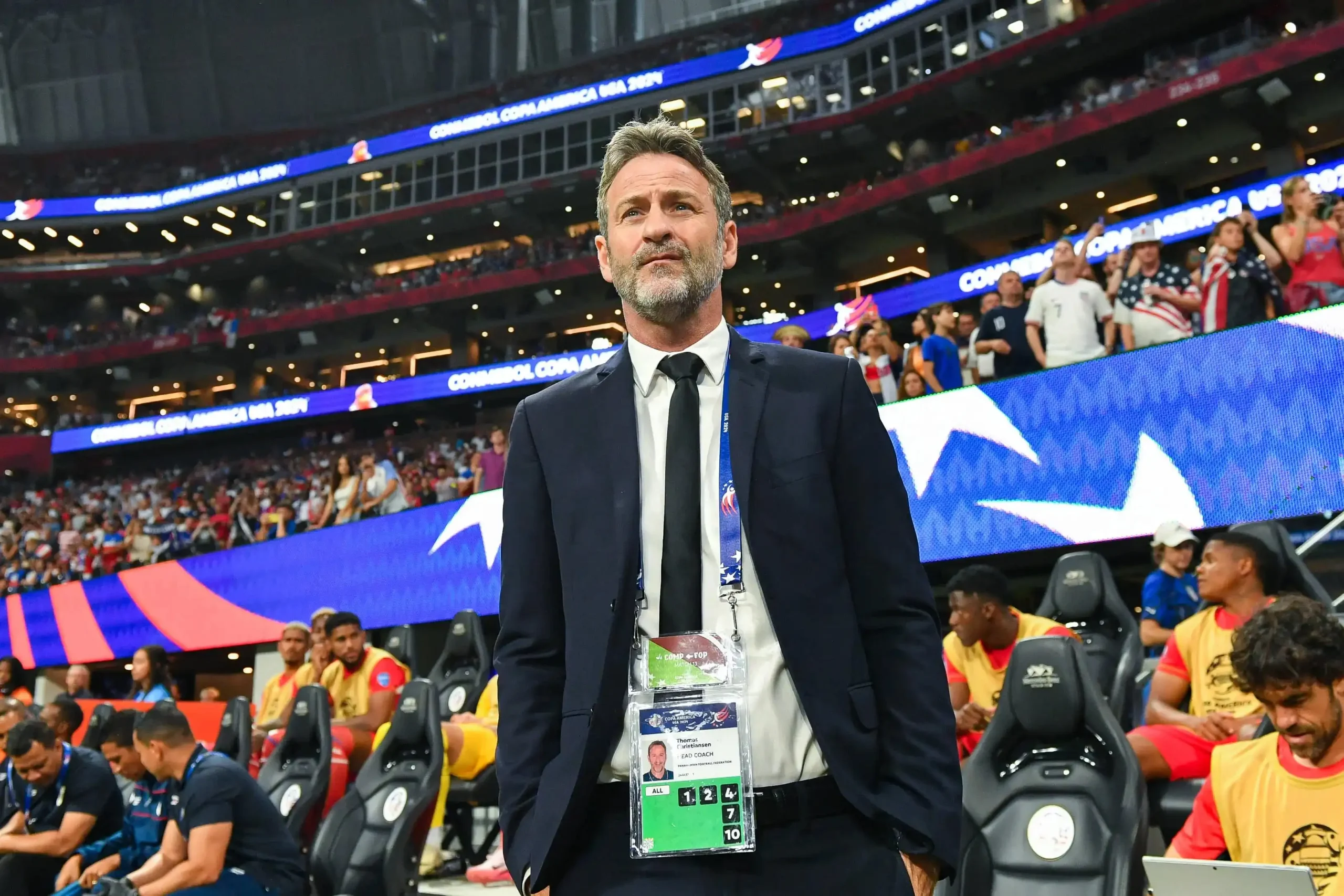
Although Thomas Christiansen was born in Denmark, his ties with the Spanish-speaking world run deep. Eligible to represent the Spanish national team through his mother, the former frontman made his debut in what proved to be a fleeting international career under Javier Clemente in January 1993. What’s more, he spent almost a decade plying his trade for various clubs in Spain, having been signed by the legendary Johan Cruyff at Barcelona at the age of 18. This was followed by spells in Greece, Denmark and Germany.
Christiansen’s transition to the touchline sent him on more globetrotting adventures, as far afield as the United Arab Emirates, Cyprus, England and Belgium before he took the reins of Panama in 2020. Since then, he has etched his name into Panamanian football folklore by leading Los Canaleros to their second FIFA World Cup™. Later this year, his charges will go head-to-head with Ghana and Croatia before renewing acquaintances with the Three Lions, whom they met in their maiden tournament campaign in 2018, in a formidable-looking Group L line-up.
The experienced tactician spoke to FIFA about his time in the Panama dugout, the task that awaits at the North American showpiece and the fans’ excitement to see their side rubbing shoulders with the world’s elite.
Thomas Christiansen: The nation has been gripped by excitement ever since we secured qualification for our second World Cup. There’s a real buzz of anticipation. It fills me with pride to see how much joy we’ve brought to people.
First and foremost, that qualifying campaign for Qatar was about getting experience under our belts. It was a great learning curve, and we shared some memorable moments. Despite enjoying a really good run, qualification would’ve come a little too soon and we fell just short. It would’ve been incredible if we’d made it through, but that wasn’t the primary focus as we’d only come on board in July 2020.
Our main aim was to qualify for this year’s World Cup. That required us to put a process in place and to undergo a period of adaptation. We approached things the right way and, over time, progress and results followed. We managed to qualify for the Copa America, in which we got out of a daunting group containing Bolivia, Uruguay and the USA. At the [Concacaf] Nations League last March, we made it all the way to the final. Then, last November, we accomplished our goal of qualifying for our second World Cup, an achievement that was every bit as special as we’d hoped.
I feel deeply connected to the country, and I’m extremely grateful for the support my coaching staff and I have received from the people, the national association and the fans. In club football, it’s quite rare to stay in one place for so long – my longest stint was three years – but that’s part and parcel of the game. When things are going well and you feel at home, it makes sense to stick around. My ties to the country are so strong that my wife and I are applying for Panamanian passports. Many people already say we’re Panamanian, but we don’t want that to be empty words – we want to show it’s genuinely heartfelt and to have it in black and white.
I knew that getting through the third round of qualifying would be a tall order. We were put through the wringer. We got off to a sluggish start last September with two disappointing draws in matches we’d expected to get more from. We showed signs of improvement in the next international window and really hit our stride last November, when we picked up a great win away to Guatemala, in which we showed our character and proved we were up to the challenge.
I was full of confidence going into our final match. I had a feeling we were going to get the job done. Then, at some point in the second half of our match, when we were already leading 2-0, we got word that Suriname were losing so we knew where we stood. Anyway, the players did what they had to do and fully deserved to qualify.
I don’t think any other match has made me happier or prouder. It’s right up there with making my Barcelona debut, earning my first cap for Spain and being the joint-top scorer in the Bundesliga. Leading not just a national team, but also a whole country, to a World Cup is a wonderful reward after so many years of sacrifice and time away from family and loved ones, which really take their toll. That makes qualification even sweeter.
I’m trying to look at it as an “interesting” group [he laughs]. Over the last five years, we’ve managed to hold our own against the big boys, and we’re no longer outclassed by Canada, Mexico and the USA. We’ve admittedly not beaten Mexico during my tenure, but we’re capable of getting the better of all three of them. We’ve come out on top against the USA several times, and we’d like to replicate that success against Ghana, Croatia and England. We know they’re tricky customers, but we want to go toe to toe with them and put Panama on the map. We’re keen for our fans to feel proud of the team. Scoring a consolation goal should no longer be a reason for Panamanians to celebrate. It’s time for us to up our game.
Anibal is an excellent captain both on and off the pitch. He knows exactly how to handle the group. One of our biggest strengths as a team is that we stick together and work hard for one another. Many of the sides we’ve faced have outperformed us, but we’ve got the better of them by playing as a unit.
I might have to pinch myself! It’ll be an incredible moment – a dream come true. I’ve been to lots of World Cups, but only as a fan. I’ll be right in the thick of things this time around. It’ll be really special to hear Panama’s national anthem and an honour, as a coach, to represent the country I love so dearly at the highest level.