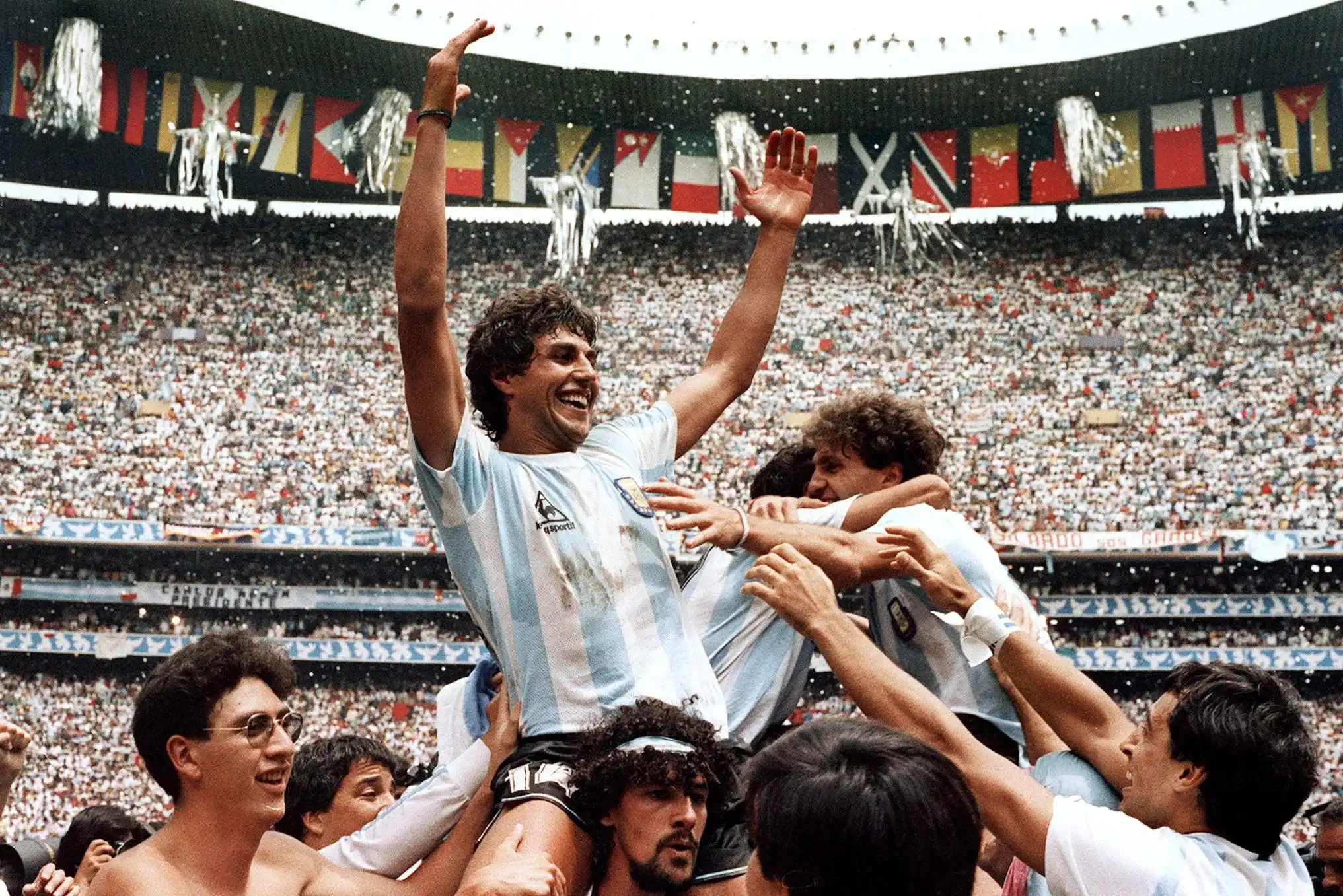
Ricardo Giusti formed the nexus between Argentina’s defensive and midfield lines at the 1986 FIFA World Cup Mexico™, covering the space, constantly offering support to his team-mates and flourishing in tight spots. He operated as a linchpin for the players in front of him: Jorge Valdano and Diego Maradona. Giusti started all seven of his side’s games at the flagship event, plying his trade in the engine room to lubricate every other component of the team crafted by coach Carlos Bilardo.
Forty years on, the midfield general points to the tactical set-up and structure of the side as the true secret to their success on the world’s biggest stage. Although we often see clips reminding us of Maradona’s sublime shimmies and dazzling dribbling, it was Bilardo who devised the master plan, with Giusti playing a vital role.
The midfielder, also a fulcrum in the all-conquering Independiente team of the 1980s, was good on the ball, but was equally willing to sacrifice himself for his team-mates and always alert to the crunch moments in games. He played in a central midfield three alongside Sergio Batista, an accomplished passer and distributor of the ball, and Jorge Burruchaga, a talented and powerful box-to-box player with an attacking threat.
Though not the original architect of the 3-5-2 formation, Bilardo was a zealous champion of this tactical blueprint, which created significant width on the flanks. This gave his charges greater freedom to build play, capitalising on the numerical advantage in their own half.
Now 69 years of age, Giusti highlights the system as a key factor behind La Albiceleste’s second run to FIFA World Cup™ glory, particularly in terms of the platform that it provided for Maradona to thrive. The legendary No10’s preceding World Cup campaign, at Spain 1982, had been a gruelling affair, earning him the distinction of being the most-fouled player (an “honour” that he would retain at subsequent editions). While the mercurial attacker displayed plenty of silky skills at that tournament, he never really managed to impose himself at the top end of the pitch.
In Mexico, on the other hand, Bilardo’s blueprint proved the perfect springboard for Maradona to serve up a masterclass and treat the world to some of the most awe-inspiring performances in the history of the competition.
Ricardo Giusti: Our success owed much to the system. I really learned a lot in that set-up, because I had always played in a traditional 4-4-2 or 4-3-3 formation.
Diego was who he was. He would have done unbelievable things in any set-up. However, at that World Cup and with that system, he really felt that all of the midfielders had his back. Even though he would drop deeper to help out, he felt like he had a lot of support, because we moved the ball around really well; that allowed him to drift into pockets of space, knowing that we could find him.
That’s one of the things we always talk about, because that’s what being a team player is all about: pitching in and being on the same wavelength as the rest. It was testament to the fact that he was hell-bent on winning the World Cup; he wasn’t there just to enjoy the ride. So, having someone with that quality playing in that system, with everything Diego offered us at the time and how hard he worked for his team-mates, gave us a huge boost.
The same goes for Valdano, who didn’t shirk his defensive duties either. In fact, if you remember Jorge’s goal against [West] Germany [to give Argentina a 2-0 lead in the final], he almost started off at right-back.
Yes, Maradona endured so much at that World Cup. I remember the game against Uruguay. The Uruguayans kicked him up and down the park, but he just picked himself up and got on with it. He wouldn’t be cowed and kept taking people on just the same to see if he could skip past them.
The one against Belgium: he put in an incredible performance, and not just because of his two absolutely brilliant goals. For the first one, he made an amazing diagonal run and then clipped the ball over the keeper [Jean-Marie Pfaff], and for the second, he went past two opponents and hit it across the goalie. I think the match against Belgium was our best all-round display. We controlled possession almost from start to finish, stopped them from creating any chances and dominated throughout.