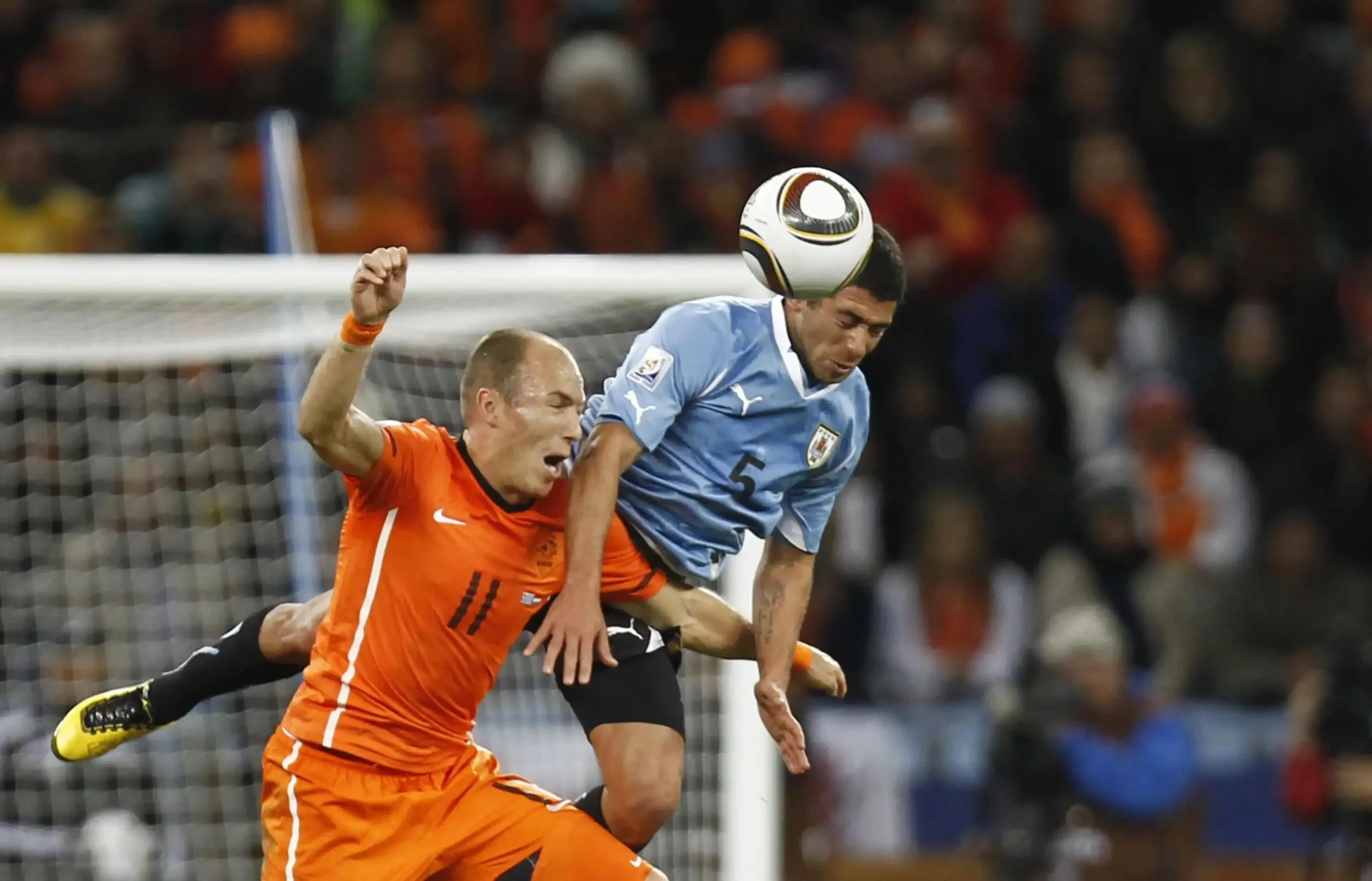
Oscar Tabarez struggled to contain his emotions on the touchline, yelling, “Come on, Uruguay!” at the top of his lungs. Diego Forlan offered yet another masterclass in shooting from range. Luis Suarez toiled tirelessly, interspersed with moments of magic, and shed tears after being handed his marching orders for clawing a header off the line. At the back, Diego Lugano ran the show in his own inimitable style.
In the cold light of day, the fact remains that Uruguay’s 2010 FIFA World Cup™ campaign ended in defeat in the match for third place. However, the enduring memories among fans tell a different story. They were a team who made their mark not just with La Celeste’s faithful, but on lovers of the game far and wide.
Walter Gargano, now aged 41, featured in the squad throughout most of the run-up to the global showpiece and during the tournament itself, deploying his customary poise, physical strength and grit in the middle of the park. Uruguay’s journey began in the qualifiers, which proved to be an uphill struggle as they scraped through by beating Costa Rica in the intercontinental play-offs, and concluded with defeat at the hands of Germany in the third-place fixture. Highlights along the way included an
action-packed quarter-final against Ghana that had it all, with Sebastian Abreu’s winning Panenka providing a fitting finale.
Forlan was the team’s leading light and was a worthy winner of the adidas Golden Ball, as the best player of the tournament. The marksman benefited from a strong supporting cast up front in the form of Edinson Cavani and Suarez. The ruthless attacking trio would go on to fire their country to CONMEBOL Copa America glory in Argentina the following year.
Tabarez’s troops were a pragmatic team of warriors, true to the Uruguayan ethos, and boasted a top-class strike force, with Cavani and Suarez putting in the hard yards to enable Forlan to shine. “Playing alongside them was so easy,” Gargano told FIFA. When he lined up on South African soil, the ball-winning midfielder was plying his trade for Napoli, where his tenacity made him a fan favourite.
Gargano took a trip down memory lane to reminisce about the Uruguay team who etched their name into the history books at the 2010 edition of international football’s premier event.
Walter Gargano: He always treated us like family, which I think was the most important thing for us as a group. When we meet up, like when we get the chance to attend an event together, it’s as if we’ve never been away from each other. There’s a really wonderful sense of harmony, just like at a family reunion. I think that togetherness explains why everyone was so fond of that team.
He knew we didn’t have all that much time when we came together as a national team. So, he looked at what each player brought to the table at their club sides and transferred that to the national team. To get the best out of each player at international level, I think you need to understand what on-field scenarios they feel most comfortable in. He instilled the right mentality in his players to enable them to perform to the best of their ability.
At the same time, he always filled his players with confidence, and that really helped them to feel at home and go out and express themselves. Even those of us who got less game time at that World Cup were really made to feel like we were a part of things.
At one point, we thought we weren’t going to make it. There were some decisive games, such as the matches against Colombia [a 3-1 win for Uruguay] and Ecuador [a 2-1 away victory for La Celeste]. After all that hard work and so many games, we managed to come up with a system that enabled us to produce our best. Many members of the squad were at their peak during that World Cup, and that really showed out on the pitch.
We based our pre-match preparations around the team we were up against and the players we’d face. We’d look at their strengths. We knew when we had to dig in or shut up shop. We were a tactically astute side.
I think they understood what kind of team we were. Whenever we cleared the ball forward, they’d hold it up. They had a great work ethic because they’re so humble, which is what enabled them to kick on in the rest of their careers. I always say that they’re different types of players, but they each displayed the very best of their individual abilities.
Yes, that was true of Luis and Edi. Diego was really smart. He was always one step ahead of the play. He saw things that others didn’t. He would get into such good positions. When you think of a player with vision, you think of Diego.
They dovetailed really well: you knew Cavani would run all day for you, battling away and fighting for every ball, and when a chance came his way, he was lethal, as was Luis.
So, I think that made us strong as a team and as a group, and it allowed them to show what they were capable of and give the national team that boost that they always gave us.
A lot of images and a whole host of other things come to mind. Initially, we were celebrating the fact that the ball hadn’t gone in; that it wasn’t a goal and that it was a penalty.
One of our team-mates on the bench, goalkeeper Juan Guillermo Castillo, started to feel ill and collapsed to the ground. That incident was about far more than just football. It really was one of those things that stay with you forever.