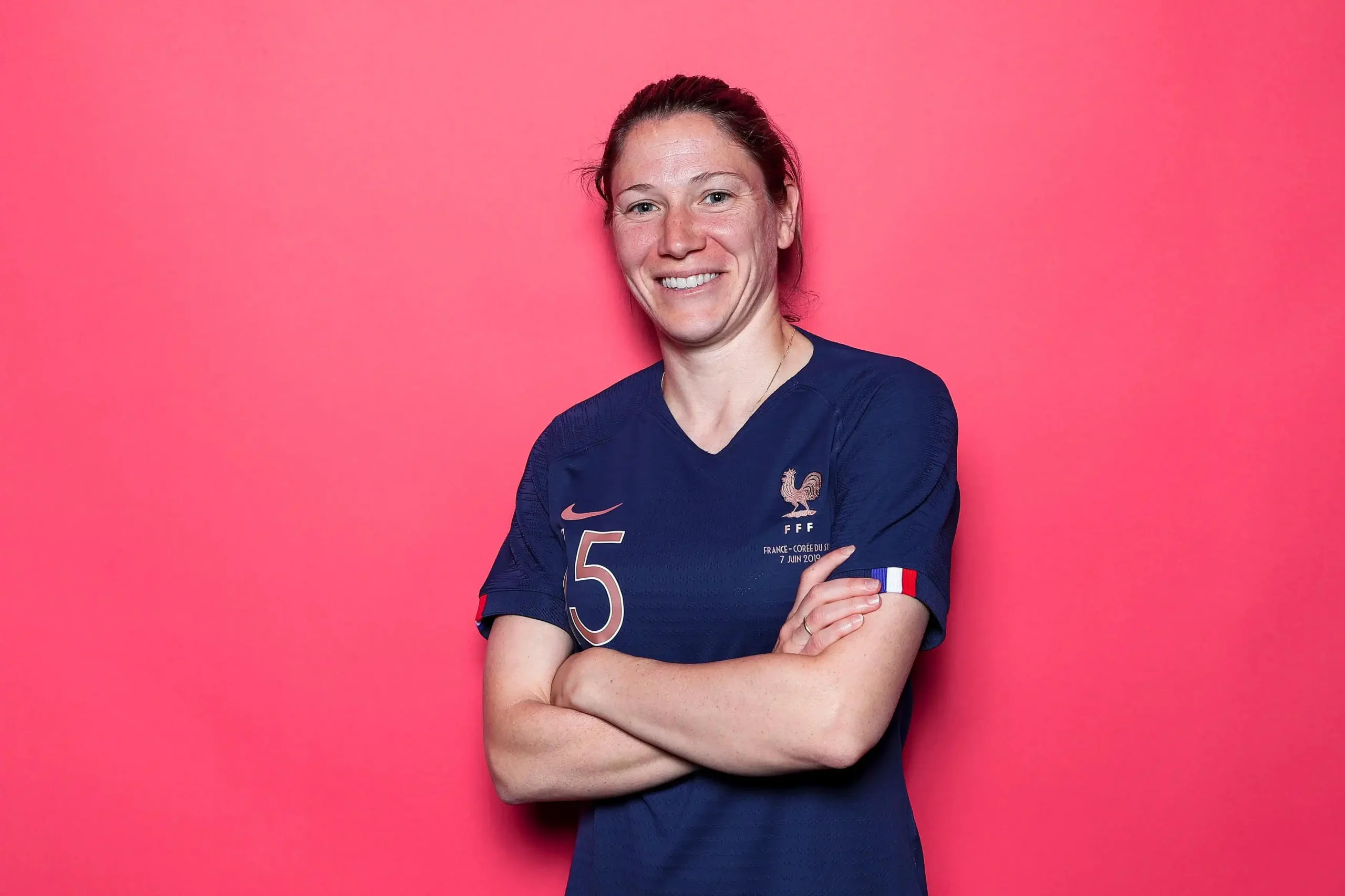
While Marinette Pichon blazed a trail in the French women’s game and Wendie Renard embodies the rewards brought by its professionalisation, Elise Bussaglia epitomises the transition that occurred between those stages better than anyone. The Sedan-born ace is the third most-capped player in the history of the French women’s national team, with 192 appearances to her name, behind only Sandrine Soubeyrand on 198 and Eugenie Le Sommer’s 200 outings. Although Bussaglia called time on her career six years ago, her legacy is still very much alive and kicking.
Now thriving as head coach of men’s sixth-tier side Sedan Ardennes, she keeps a close eye on events in the Premiere Ligue, where she cut her teeth in the senior game before flourishing into one of the division’s finest performers. Regardless of whether she is enjoying the thrills and spills of the competition as a spectator or in her role as a television pundit, the former midfield linchpin can only but marvel at the league’s enormous potential. Indeed, the landscape in the French women’s game is a far cry from the environment in which Bussaglia took her first steps at Saint-Memmie Olympique, a club pretty much unheard of amongst followers under the age of 30.
“I played mixed football for many years back home in the Ardennes. There were very few girls in my area who played football, so I trained with the boys. I played at Saint-Memmie, with my parents having to ferry me around,” recalled Bussaglia, whose on-field promise was soon spotted by the talent hunters at Clairefontaine – the national breeding ground for budding stars – where she continued her development before joining FCF Juvisy, one of the jewels in the crown of the domestic women’s game who now compete under the Paris FC banner.
When Bussaglia made her French top-flight debut as a fresh-faced teenager back in 2005, pioneering clubs Lyon and Montpellier had only just started laying the foundations of professionalism in the female game. “In those early days, I combined my studies with part-time jobs here and there to pay my bills, the rent and for everything else. Although I received travel expenses from my clubs, I wasn’t professional or even semi-professional.
“In the end, my routine involved working during the day and training in the evenings. It was so physically demanding that I don’t know if I’d have been able to hack it for that many years.”
The turning point in Buss’s career came in 2012, when she swapped Paris Saint-Germain for Lyon – now Lyonnes – where she was finally able to earn a living from the game. The former Montpellier, Wolfsburg and Barcelona pass master shared her satisfaction that things are now far easier for top-flight players in an era in which professionalism has become the norm – rather than the exception: “Part of me thinks, ‘At long last!’ Although things aren’t fully professional yet, an increasing number of players have gone pro. But I think it’s been too long in the making.”
Alongside the improvements to the female footballer’s lot, Bussaglia has witnessed a major transformation in the media coverage that the women’s game receives in her homeland. While France’s maiden appearance on the FIFA Women’s World Cup™ stage in 2003 attracted little in the way of attention, the run that Bussaglia and Co put together to reach the semi-finals of the global finals in Germany eight years later marked a genuine turning point.
“I think the Women’s World Cup in 2011 was a watershed moment in France, both in terms of fan interest and media attention. In one sense, that tournament took us to new heights.”
The 2011 edition of FIFA’s flagship women’s event propelled the members of the French squad into the limelight, with the likes of Soubeyrand, Laura Georges, Gaetane Thiney, Louisa Necib and, of course, Bussaglia shooting to prominence virtually overnight. The feel-good factor surrounding the French ladies’ game was subsequently strengthened by the national team’s campaigns at the Women’s Olympic Football Tournament London 2012 and the 2015 and 2019 instalments of the FIFA Women’s World Cup, with France’s versatile virtuoso, who parked her teaching career to focus on football, starring at all three events.
A year after the global showpiece on home soil in 2019, while Bussaglia was plying her trade for Dijon, the COVID-19 pandemic brought her retirement plans forward by several months. Yet the former engine-room orchestrator’s enduring love for the beautiful game meant that she was unable to walk away from it completely. When the Sedan native was offered the chance to take charge of the men’s team at her hometown club in July 2024, she didn’t give it as much as a second thought as she became one of the few women to occupy a dugout in the French men’s game.
“I’m staying true to myself,” affirmed Bussaglia, who is fully focused on the club’s quest to achieve promotion to the fifth tier after having guided them to the sixth rung last term. “I try to adopt the same approach to coaching as I did when was playing: always giving 110 per cent and doing whatever it takes to succeed.”
Having strutted her stuff on amateur pitches in her early days before gracing the breathtaking arenas of the elite game, Bussaglia has not only witnessed the rise of French women’s football, she has been one of its leading figures. With the current crop of Les Bleues stars vying for World Cup qualification and poised to write the next chapter, her story is a reminder that the progress made to date in the women’s game has, in itself, been nothing short of a resounding triumph.