Every drill in every Argentina training session at the 2006 FIFA World Cup™ in Germany demanded total focus. Whether a rondo, a possession game, a full-sided match or a finishing exercise – the standard was so high that any imperfection stood out. That is how Maxi Rodriguez remembers it.
Despite a wealth of talent, however, Jose Pekerman’s side fell short of glory. Their quarter-final defeat on penalties at the hands of Germany – following a 1-1 draw in a match La Albiceleste had seemed to have under control – left a deep sense of frustration.
One factor that made it sting was the timing: the tournament marked 20 years since Diego Maradona had inspired the Argentinians to their second World Cup title in Mexico, and there was a genuine belief that the 2006 crop of players could emulate that achievement.
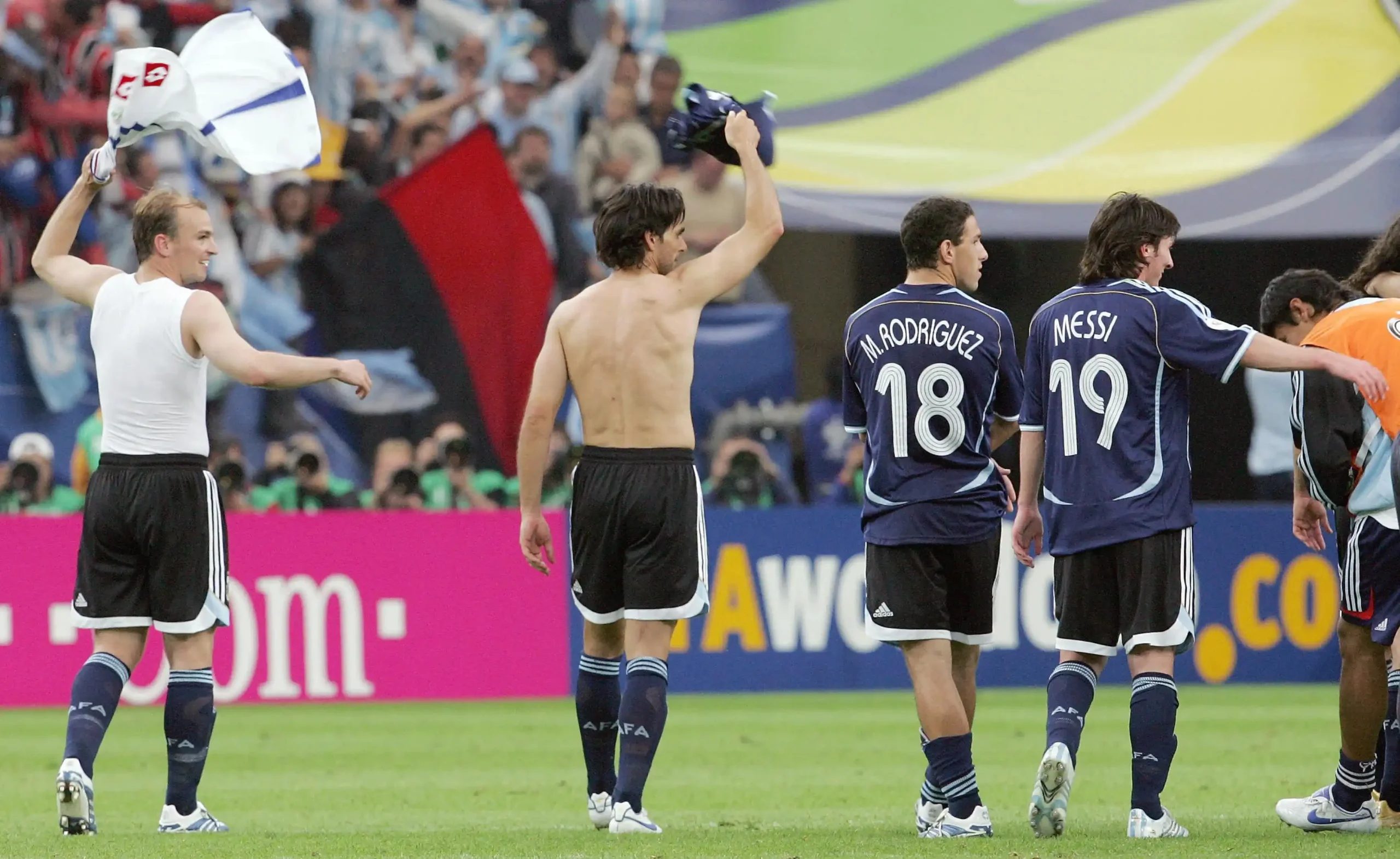
On paper, it was one of the most formidable squads in Argentina’s history, including the likes of Roberto Ayala, Juan Pablo Sorin, Javier Mascherano, Esteban Cambiasso, Juan Roman Riquelme, Pablo Aimar, Carlos Tevez, Javier Saviola, Hernan Crespo… and Lionel Messi. The latter’s own remarkable World Cup journey was just getting started, but despite dazzling in group-stage encounters with Serbia and Montenegro and the Netherlands, he remained an unused substitute against Germany.
Now aged 45, Rodriguez remains convinced that the 2006 roster was a cut above the others in which he featured, even if Germany proved Argentina’s undoing in all three of his World Cup campaigns. The winger suffered exits to Die Mannschaft in the last eight in 2006 and 2010, and the final in 2014.
“Everyone arrived [in 2006] at the peak of their powers, at just the right age. It was incredible,” Rodriguez tells FIFA. “Football can be like that: sometimes things don’t turn out the way you want, but that generation was exceptional. Playing with players of that calibre always brings out the best in you. They rarely made mistakes, so when someone did, you noticed. You had to be switched-on all the time.”
The Newell’s Old Boys legend was an all-action attacker of real distinction, who blended technical quality with tireless running, defensive discipline and a natural eye for goal. He also scored one of Argentina’s most fondly remembered World Cup goals. Until La Albiceleste’s triumph at Qatar 2022, his Round-of-16 strike against Mexico in 2006 remained one of their defining World Cup moments this century, rivalled only by some of the goals from their run to the final in Brazil in 2014.
In the first period of extra time against Mexico, with the match all even at 1-1, Rodriguez chested down Sorin’s cross-field pass and let fly with a thunderous left-footed volley that rocketed into Oswaldo Sanchez’s top-right corner. The goal sent Argentina into the quarter-finals, where their campaign would end with the feeling that this team still had far more to offer.
“That goal against Mexico was one for the ages,” smiles Rodriguez, who had already bagged himself a brace against Serbia and Montenegro at the 2006 tournament. “It was a very tight game and it looked as though it was heading for a shoot-out.”
Argentina had advanced into El Tri’s half on the right-hand side of the pitch before moving it across to Sorin on the left. The full-back then spotted Rodriguez’s run into space down the right. “Sorin was not really known for playing those long switches,” Rodriguez recalls. “But he always told me he could hear me calling for it, so he played it.”
Pulling the trigger so soon wasn’t part of the plan. The then-Atletico Madrid winger’s initial thought was to get the ball under control and bring it onto his favoured right foot to work a shooting chance or perhaps whip in a cross. Once he saw the full-back covering that space, however, he improvised.
“I adjusted my body and already knew roughly where the goal was,” he explains. “It sat up nicely for me – side-on to goal, but in a position where I could hit it. I caught it with my laces, watched the ball arc towards goal and saw it go in. It was an incredible feeling.” The strike was voted as the Hyundai Goal of the Tournament.
Rodriguez was one of several gifted players to come through La Albiceleste’s youth ranks under Pekerman’s guidance. Alongside Andres D’Alessandro and Saviola, he played a starring role in the team that won what was then the FIFA World Youth Championship – now the FIFA U-20 World Cup™ – on home soil in 2001. One piece of advice from his coach still resonates.
“He told me that if I wanted to stand out, I had to do things differently, and that wingers like me had to score goals, get into the opposition box and hurt teams. For a player, there’s nothing quite like scoring – once you get used to it, you want more and more. I wasn’t a traditional striker, but I had that poacher’s instinct.”
For many fans, Messi’s absence from that decisive quarter-final against Germany 20 years ago remains etched in the memory. “It’s difficult to talk about after everything that happened, knowing the player Leo would go on to become and the influence he’d have,” Rodriguez explains “But coaches often have to make tough decisions with no time to think twice.”
Several members of that squad would suffer further World Cup heartbreak in the years that followed, but only one would eventually emerge victorious. In 2022, Messi helped heal those wounds – especially for those who had shared the journey with him.
“We’d been part of it as players and, by then, were experiencing it as fans, so it was unbelievable,” Rodriguez reflects. “Leo was finally able to fulfil his dream. It was the one thing missing from his career: lifting that trophy, the most beautiful of all.”