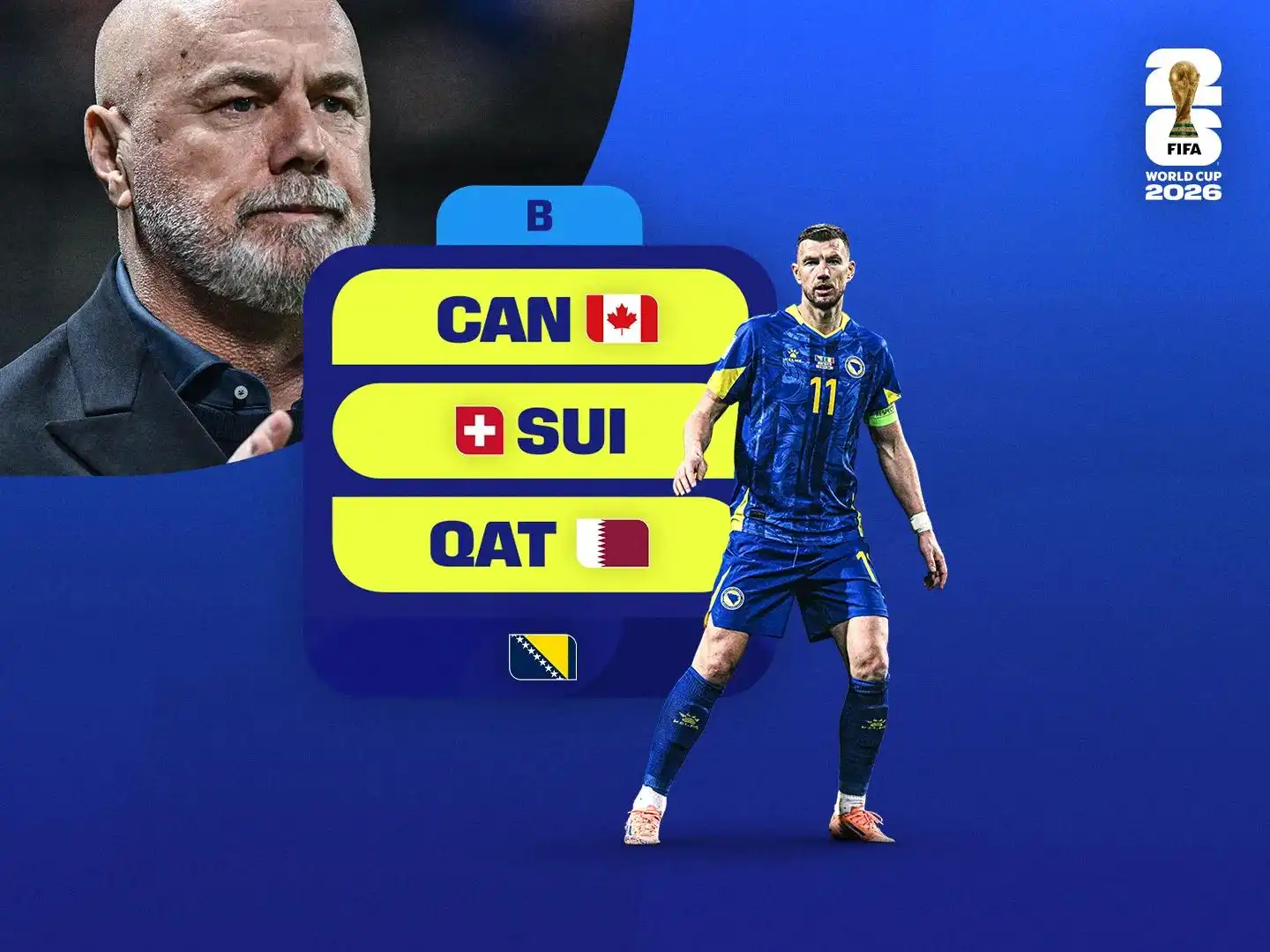
“I am from Bosnia, take me to America,” sang the fans in Zenica during the play-off final against Italy. Their prayers were swiftly answered, as Bosnia and Herzegovina will indeed be at the FIFA World Cup 2026™ in Canada, Mexico and the United States. After overcoming Wales on penalties in the semi-finals, they repeated the feat against the Azzurri to seal qualification for just their second World Cup, following their debut at the 2014 edition in Brazil.
Formed in 1993 after the break-up of Yugoslavia, the national team had previously reached the play-offs for South Africa 2010, where they came up short against Portugal. They then secured direct qualification for Brazil 2014, even rising as high as eighth in the FIFA/Coca-Cola Men’s World Ranking at the time.
Led by coach Sergej Barbarez and inspired by captain and record appearance holder Edin Dzeko, Bosnia and Herzegovina head to the global showpiece with renewed ambition.
Bosnia and Herzegovina coach: Sergej Barbarez
Barbarez began his playing career in Mostar, but he made his name in the Bundesliga. A creative and unconventional No10, he remains the foreign player with the most appearances (330) in German top-flight history, representing the likes of Union Berlin, Borussia Dortmund, Hamburg and Bayer Leverkusen.
At international level, he netted 17 goals in 47 caps between 1998 and 2006. He was appointed national team coach in 2024, marking his first major managerial role. A strategist off the pitch as well, the 54-year-old is a professional poker player, a pursuit that he took up after hanging up his boots.
Using a 4-4-2 system that blends emerging talents with experienced figures, Barbarez guided Bosnia and Herzegovina to second place in Group H of the European qualifiers, collecting 17 points from eight matches.
Bosnia and Herzegovina’s World Cup 2026 fixtures and group
Full World Cup 2026 match schedule
How Bosnia and Herzegovina qualified for World Cup 2026
Inspired by six goals from the evergreen Dzeko, Bosnia and Herzegovina impressed throughout their qualifying campaign, which began with an away win against Romania, followed by victories at home to Cyprus and San Marino. They finished two points behind Austria – who picked up four points against Barbarez’s charges – and ahead of Romania, who ended on 13 points. Barbarez’s side stood out for their attacking play out wide, where youngsters Esmir Bajraktarevic and Kerim Alajbegovic played pivotal roles by getting on the scoresheet and consistently creating threatening overloads.
Bosnia and Herzegovina were placed in Path A of the UEFA play-offs, where they overcame Wales in a dramatic semi-final. The towering Dzeko’s late header at the end of regulation time restored parity and belief before they triumphed on penalties at the Cardiff City Stadium.
The final against Italy followed a similar script: 1-1 after 90 and 120 minutes, with Haris Tabakovic finding the net in Zenica. Shoot-out misses by Pio Esposito and Bryan Cristante handed the decisive opportunity to Bajraktarevic, who duly converted with his left foot past Gianluigi Donnarumma to spark wild celebrations across the nation.
Bosnia and Herzegovina’s World Cup history
Bosnia and Herzegovina’s first World Cup
Bosnia and Herzegovina made their bow in 2014, crowning a talented generation that included Miralem Pjanic, Sead Kolasinac, Dzeko and Asmir Begovic. Coached by Safet Susic and driven by the former Manchester City striker’s goals, they won their qualifying group, sealing top spot with a crucial victory over Lithuania thanks to Vedad Ibisevic’s tap-in.
In Brazil, they opened their campaign against Argentina at the Maracana, losing 2-1 but celebrating their maiden World Cup goal, registered by Ibisevic. A subsequent defeat to Nigeria extinguished their hopes of reaching the last 16, while a 3-1 win over IR Iran ensured a respectable conclusion to the tournament.
Bosnia and Herzegovina’s memorable World Cup moment
The European side’s most memorable moment came when they signed off with a 3-1 victory over IR Iran in their final group match in 2014. With the pressure lifted following elimination, the team delivered one of their most fluid and convincing performances, spearheaded by the creativity of Pjanic and the leadership of Dzeko, who opened the scoring. Avdija Vrsajevic added the final goal in a success synonymous with national pride and the quality of what is still regarded as Bosnia and Herzegovina’s golden generation.
Bosnia and Herzegovina’s World Cup top scorers
Dzeko will be aiming to move clear at the top during this year’s tournament, but four players share the record for now, all of whom found the net at Brazil 2014: Ibisevic against Argentina, and Pjanic, Dzeko and Vrsajevic against IR Iran.
Bosnia and Herzegovina players with most World Cup appearances
Six players featured in all three matches in Brazil: goalkeeper Begovic, defenders Muhamed Besic and Emir Spahic, midfielder Pjanic, and forwards Ibisevic and Dzeko, who will be vying to head out in front in North America.