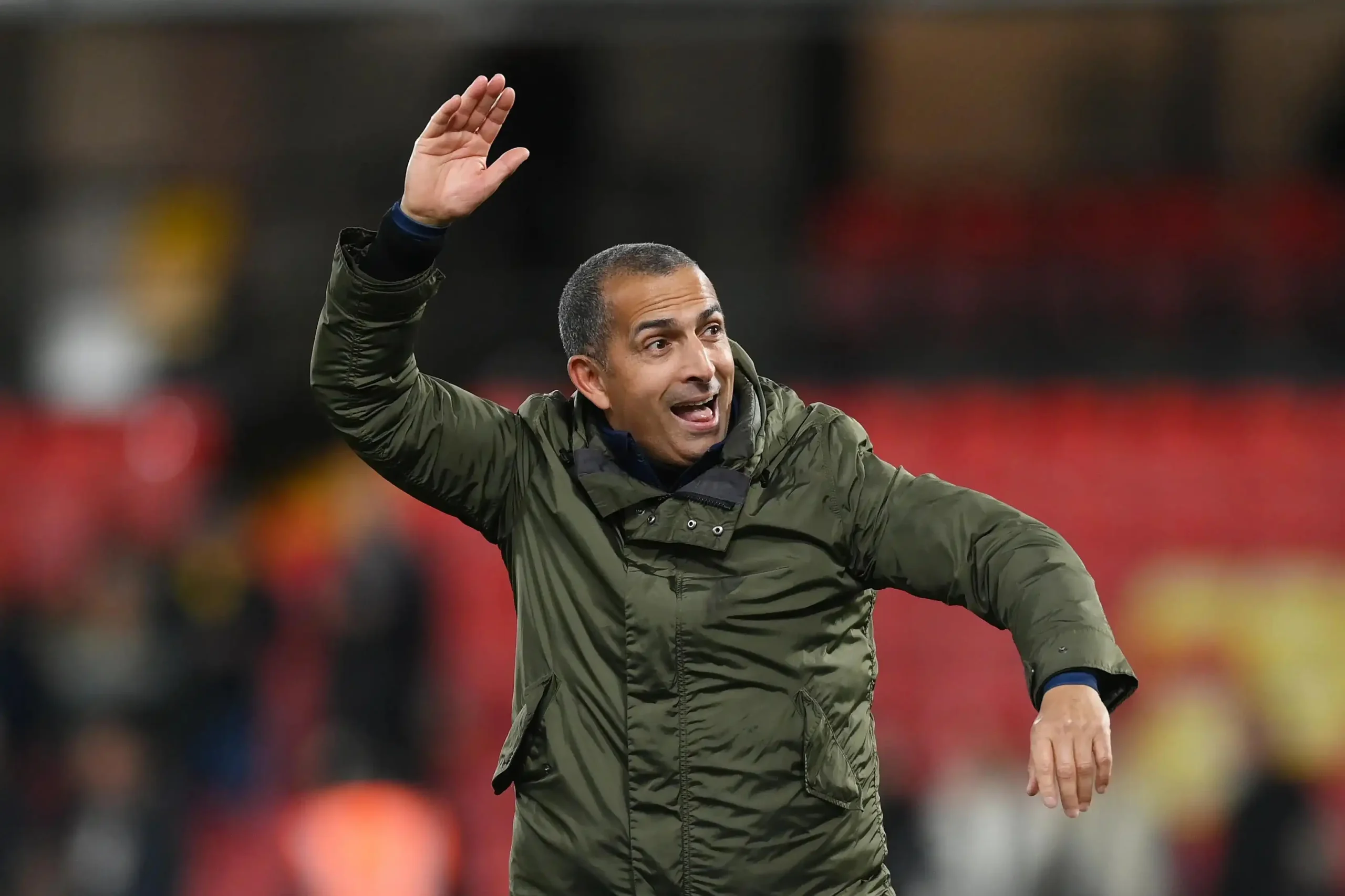
Scour the managerial landscape in world football and you may not find a pair with careers as aligned as the Frenchman of Tunisian heritage Sabri Lamouchi and the Moroccan Walid Regragui. These are two parallel journeys that began on the pitches of France and led to the dugouts of two African football powerhouses
Attention will turn to Lamouchi this summer as he leads Tunsia into the FIFA World Cup 2026™, with the burning question being whether he can reproduce the epic run Regragui and Morocco made in Qatar.
Lamouchi’s appointment as the new Tunisia boss on a two-and-a-half-year deal follows a disappointing showing by the Carthage Eagles at the 2025 Africa Cup of Nations, where their campaign ended in the Round of 16 against Mali and Sami Trabelsi was relieved of his duties.
Lamouchi arrives with a CV packed with notable roles, having coached the likes of Rennes, Nottingham Forest, Cardiff City and Al-Riyadh, not to mention his international experience with Côte d’Ivoire at the 2014 World Cup in Brazil, where they bowed out in the group stage.
As World Cup 2026 looms, the big question is whether Lamouchi can draw on the template for success that Regragui established, given the similarities in set-ups and wider circumstances.
Lamouchi and Regragui: French beginnings and nomadic pro careers
Lamouchi and Regragui are both children of the 1970s, and both got their start in French football. Those early days exposed them to a range of influences and diverse experiences that shaped their personalities as players and coaches.
Born in Lyon in 1971, Lamouchi made his name with major French clubs such as Auxerre and Monaco before heading to Italy with Parma, Inter Milan and Genoa, then returning to France via Olympique Marseille.
Lamouchi later made the jump to Gulf football, playing for Al-Rayyan, Umm Salal and Al-Kharitiyath in Qatar, before finally hanging up his boots in January 2009.
Regragui, meanwhile, was born in Corbeil-Essonnes on the outskirts of Paris in 1975. He started out with clubs such as Ajaccio and Toulouse before a spell in Spain with Racing Santander. He later returned to France to play for Dijon and Grenoble, eventually finishing his playing days with FC Fleury in early 2012.
These wide-ranging experiences furnished both men with a strong technical base, instilling tactical discipline and a deep understanding of the modern European game, meaning the two share very similar footballing DNA.
From Al-Duhail to football’s biggest stage
The year 2020 marked a shared turning point, as both men had spells in charge of Qatar’s Al-Duhail, bringing them into direct contact with Asian and Arab football.
Regragui was at the helm from 22 January to 3 October 2020, a stretch in which Al-Duhail played 18 matches and claimed the Qatar Stars League title. Lamouchi took over from 18 October 2020 to 9 August 2021 and oversaw 35 matches across all competitions but left without securing a trophy.
Another similarity is apparent on the international front: Regragui took over Morocco just months before Qatar 2022 – the scenario Lamouchi now finds himself in as he prepares to lead Tunisia in North America.
Despite these mirrored paths, a clear divergence appears when it comes to international caps, with Regragui choosing to represent Morocco, while Lamouchi opted for France, featuring at UEFA Euro 1996
Can Regragui’s success serve as inspiration?
Regragui wrote a chapter of Arab and African football history like no other in Qatar, leading the Atlas Lions to first place in a group including Croatia and Belgium, before knocking out Spain and Portugal to reach the semi-finals.
Regragui’s added value lay in his knack for managing the dressing room and figuring out in record time what made his players tick emotionally and mentally, having taken charge just three months before the tournament.
Throughout the campaign, he relied on a rock-solid defence that conceded just a single goal before the last-four showdown with France.
Although the Atlas Lions went down 2-0 to Les Bleus and then lost 2-1 to Croatia in the third-place play-off, Regragui’s men won admirers across the global. Morocco’s feat went beyond the results themselves – it became a beacon for Arab and African football.
Since then, every African and Arab side has dreamed of following in Morocco’s footsteps, now that Regragui and his squad have showed that nothing is impossible.
Lamouchi’s challenge
Regragui’s historic run to the semi-finals has undoubtedly set a new benchmark for coaches of Arab teams.
Lamouchi now has a genuine chance to emulate that feat, backed by an arsenal of serious talent like Hannibal Mejbri, Ellyes Skhiri, Ferjani Sassi, Hazem Mastouri and Mohamed Ali Ben Romdhane.
Mejbri is one of Tunisia’s standout young prospects, combining technical and physical strengths that make him essential in any system relying on a high press and quick transitions.
Skhiri, meanwhile, is the quintessential modern midfielder, the quiet engine who brings balance to any side he plays for, and much the same can be said of the veteran Sassi.
Ben Romdhane ranks among the most complete midfielders of Tunisia’s current generation, who offers a manager both attacking and defensive solutions, giving Lamouchi tactical breathing room in the forward line.
Up front, Lamouchi can turn to Mastouri, striker with a poacher’s instinct that puts him in the right place at the right time to finish crosses and rebounds.
The biggest challenge, though, is whether Lamouchi can tap into Regragui’s pragmatism and uncanny ability for firing up his squad mentally. If he can spark that same fighting spirit, Tunisia certainly have the tools and big names to be a dark horse at the biggest-ever World Cup.