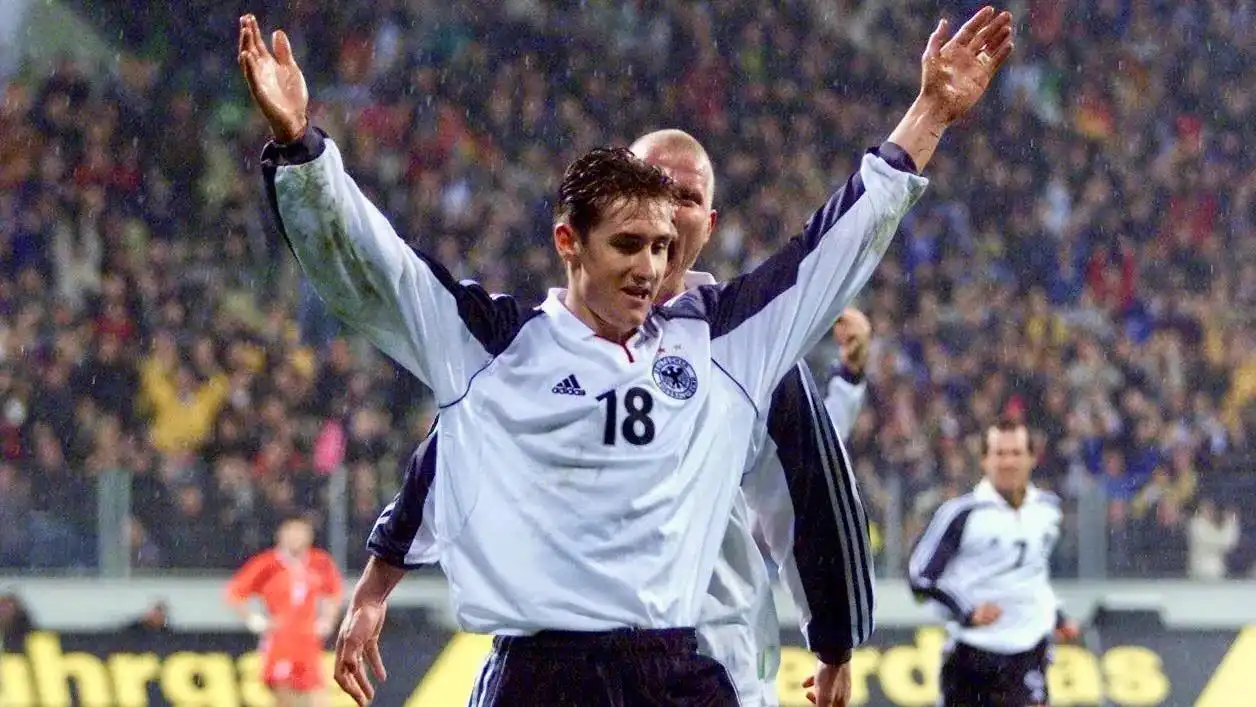
On 24 March 2001, a 22-year-old Polish-born striker by the name of Miroslav Klose stepped out in a Germany shirt for the first time, launching one of the most remarkable careers in international football.
Little did anyone know that the man who came on as a substitute for Oliver Neuville in a 2002 FIFA World Cup™ qualifier against Albania 25 years ago would go on to break Germany and FIFA World Cup™ goalscoring records.
Klose’s path to the national team was anything but routine. Although he was born into a sporting family – his father played football for Auxerre, among others, and his mother was a Poland international handball player – Klose did not go through the academy route. Instead, he worked his way up through the lower leagues at SG Blaubach-Diedelkopf and FC Homburg before joining the reserve team of top-flight outfit Kaiserslautern. He broke into the Red Devils’ first team in April 2000 and established himself as a reliable Bundesliga marksman in the following campaign, notching nine times in 29 appearances.
His qualities did not go unnoticed by Germany head coach Rudi Voller, who had taken over the national-team reins after a disappointing UEFA EURO 2000 campaign under Erich Ribbeck. The new man in charge was on the lookout for more power in attack, and he certainly found it in the form of Klose’s uncompromising style of play, aerial prowess and predatory instincts in and around the penalty area.
Klose could not have wished for a better debut for Germany. After entering the fray as a substitute against Albania with the score locked at 1-1, he headed home in the 87th minute, a goal that would come to epitomise his career. Just three years earlier, Klose had been plying his trade in the seventh-tier district league, but now he had scored the winner in a crucial international fixture.
He would announce himself to the world just over a year later on the biggest stage of all, scoring five goals – all headers – as Germany reached the final of the 2002 FIFA World Cup. It was the international breakthrough of a striker who would go on to be known for his efficiency and trademark somersault goal celebration.
Subsequent years saw him make his mark at elite club level too, his goals firing Werder Bremen, Bayern Munich and Lazio to silverware, including two Bundesliga crowns and two German Cups with the Bavarians. In total, Klose scored over 250 competitive club goals.
His record with the national team is even more impressive. His 71 goals in 137 appearances remains a German record, and at the 2006 FIFA World Cup™ on home soil he claimed the adidas Golden Boot as top scorer with another five-goal haul. Later that year, he was also named Player of the Year in Germany.
The highlight of his career undoubtedly came in Brazil in 2014, however, as he broke Ronaldo’s record with his 16th World Cup goal as Germany swept all comers aside to claim the title. It was just reward for a player who always stood out with his lethal finishing, timing and all-round intelligence. Klose played no fewer than 24 World Cup matches in total, behind only Lionel Messi (26) and Lothar Matthaus (25).
In addition to his success on the pitch, Klose is still remembered fondly by fans for his down-to-earth nature, and he received two fair play awards from the German FA in recognition of his positive attitude and sportsmanship. Now 47, Klose is head coach at second-division outfit Nuremberg, where he is passing on his experience to the next generation. His 21-year-old twin sons, Noah and Luan, are also following in their father’s footsteps as strikers, with Noah recently making his debut for 1860 Munich in Germany’s third division.
Now, with 25 years having passed since Klose’s first steps on the international stage, it is fair to say that 24 March 2001 heralded the start of a new era for German football. His was a career that was never loud or extravagant, but rather one built on consistency, discipline and unwavering dedication to his craft. Klose may have been a late bloomer, but he became a legend who left a lasting imprint on German football, both on and off the pitch.