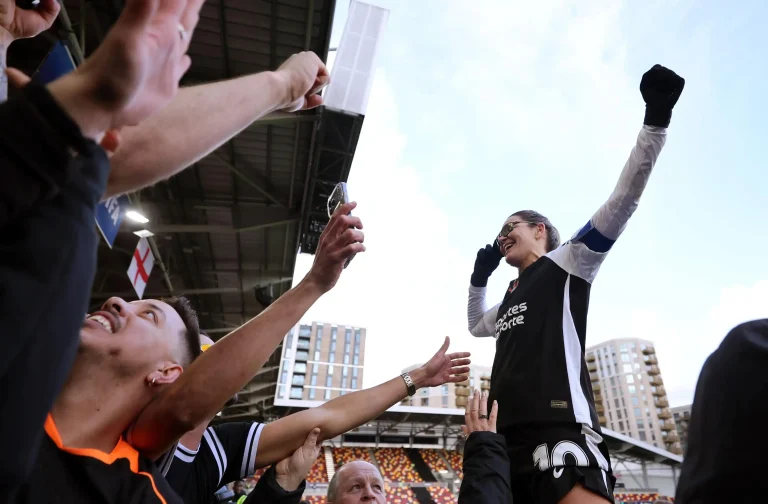
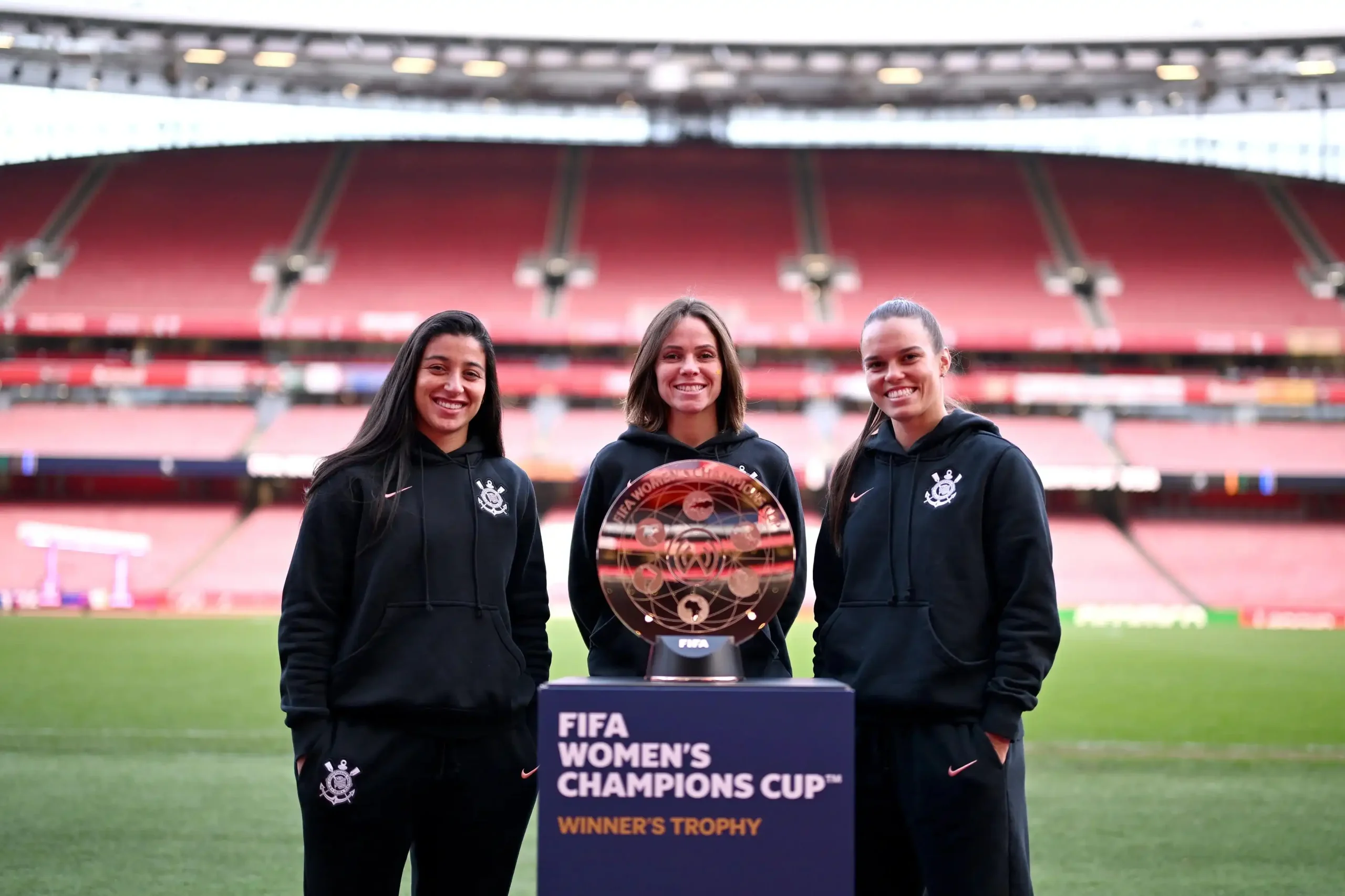
Arsenal will have the luxury of playing the FIFA Women’s Champions Cup 2026™ final at their own stadium on 1 February. “We’re very happy, obviously. We’ll be playing at home, in front of our fans, so reaching the final was important,” said Mariona Caldentey of the Gunners. Officially, however, the match will be played on neutral ground. In reality, Corinthians are also expected to feel somewhat “at home”. The Fiel [the Faithful], as their supporters are known, are prepared to transform the English grandstands into a home away from home.
“It doesn’t matter what the competition is. When we wear this shirt, we represent the ‘Bando de Loucos’ [Crazy Gang], and a passionate fan base that supports us wherever we are,” said captain Gabi Zanotti, who netted the winner against Gotham FC last time out. Veteran Tamires agreed: “There are Corinthians fans all over the world, and they really know how to party and sing.”
It is unknown which team will lift the inaugural trophy, but the Brazilian club will take to the pitch surrounded by a mystique that goes beyond the passion of its supporters.
The origin of a champion’s name
The 1910 tour of Brazil by Corinthian Football Club gave Corinthians their name. “The arrival of the English Corinthian did not prompt the founding of Corinthians, which had already been in preparation for months, but it did inspire the club’s name,” explained club historian Fernando Wanner to FIFA. One week after thrashing Fluminense 10–1 in Rio de Janeiro, the English team arrived in Sao Paulo on 31 August 1910.
At that time, a group of workers from a Sao Paulo railway had already laid the groundwork for the creation of a club, but they were still without a name. Due to financial constraints and the timing of the game, not all of them were able to attend the match at the Velodromo field in the city centre to watch the English Corinthians play – but those who did left captivated.
According to Wanner, this detail reveals a less romanticised layer of the relationship: although many of these workers were employed by the Sao Paulo Railway – known as “The English Company” – they did not have direct access to British circles of power. As such, the founders of the Brazilian Corinthians were not sitting at the table with their European employers, listening to stories about Corinthian FC and the other English clubs.
Even so, the match at the Velodromo had a major impact, and some of its highlights were shown the following day at the Teatro Radium. That following day was, naturally, 1 September 1910 – the official founding date of Sport Club Corinthians Paulista. The date was chosen for numerological reasons, as the sequence 1/9/10 can also be read as the year 1910, but as Wanner noted, “there are no coincidences in the history of Corinthians”.
On that day, founder Joaquim Ambrosio suggested that they draw inspiration from what was considered “the best team in the world” during the reign of Queen Victoria. As a result, the fact that the English Corinthian played in Sao Paulo the day before ultimately defined the name of one of the biggest clubs in the world – which is now also competing for the women’s world title at the Women’s Champions Cup.
From brotherhood to reunion in London
Corinthian Football Club had planned to return to Brazil four years after the original tour, but the First World War put paid to that, as many of its players fought in the war and were killed. Decades later, the connection took on a new dimension following the English club’s merger with Casuals in 1939, to form Corinthian-Casuals. Since 1988, friendly matches with Corinthians began to celebrate this symbolic brotherhood, with icons such as Socrates and Danilo turning out in both shirts.
That bond came back to life just days before the Women’s Champions Cup final. On 24 January 2026, the Corinthians women’s team – known as the Brabas [the fierce ones] – were honoured at the match between Corinthian-Casuals and Abbey Rangers at King George’s Field in Tolworth, near London. Welcomed by the Fiel Londres supporters’ group, players Erika, Leticia Monteiro, Leticia Teles and Tamires swapped shirts with the English players and received a letter that deeply moved the group.
In the letter, Corinthian-Casuals recalled the 1910 tour and the loss of life during the war, while also expressing their pride in being represented by the Brazilian Corinthians. “It means a great deal to all of us that 116 years after the original tour, you have come to England to compete to become the first women’s world champions (officially intercontinental champions), with the chance to see the club crowned in FIFA intercontinental competitions in both the men’s and women’s game,” the message read.
“Thanks to you, seeing the name Corinthian remain at the top of world football fills us with pride, and we wish you every success in the tournament. We will be with you, supporting you every step of the way. You fill us with pride. Vai, Corinthians!”
Central defender Erika summed up the moment. “It was sensational, something that I will never ever forget. As we arrived, you could already hear the beat of the drums, and then we saw all those people welcoming us,” she recounted. “It’s really special to know that we’ve become part of their history and that they are certainly part of ours.”
A piece of Itaquera in England
On the pitch, Corinthians know the sporting challenge will be immense, but off the pitch, there is a support that crosses borders. Their coach, Lucas Piccinato, recalled the surge of emotion he felt from the fans ahead of the semi-final against Gotham FC. “I arrived at the stadium one hour and 40 minutes early, and I could already hear the Corinthians fans singing the anthem. I told the players it would feel like being on the pitch at Itaquera,” he said. “For our supporters, we are always the favourites.”
That passion found a new symbolic image during the match against Gotham, as English children in the stands jumped around and sang alongside Brazilian fans, imitating the poropopó celebration of the Coringão supporters. The touching and heartwarming video quickly went viral on social media. For historian Wanner, that moment encapsulated what Corinthians have represented throughout their century-long history.
“Corinthians embodies the culture of all ethnicities,” he said. “The core ethos of Corinthians is to influence people through the ‘Corinthianism’, and to be open to all peoples, all beliefs and all cultures. That is the Corinthians Spirit. Seeing English children copying the Corinthians supporters is a lesson to those people who are just rediscovering football as a healthy form of entertainment. It is a deeply symbolic scene.”
“The ‘poropopó’ celebration is captivating. It can really drive us forward on the pitch,” Tamires added, before chanting: “Aqui é Corinthians!” [This is Corinthians!]