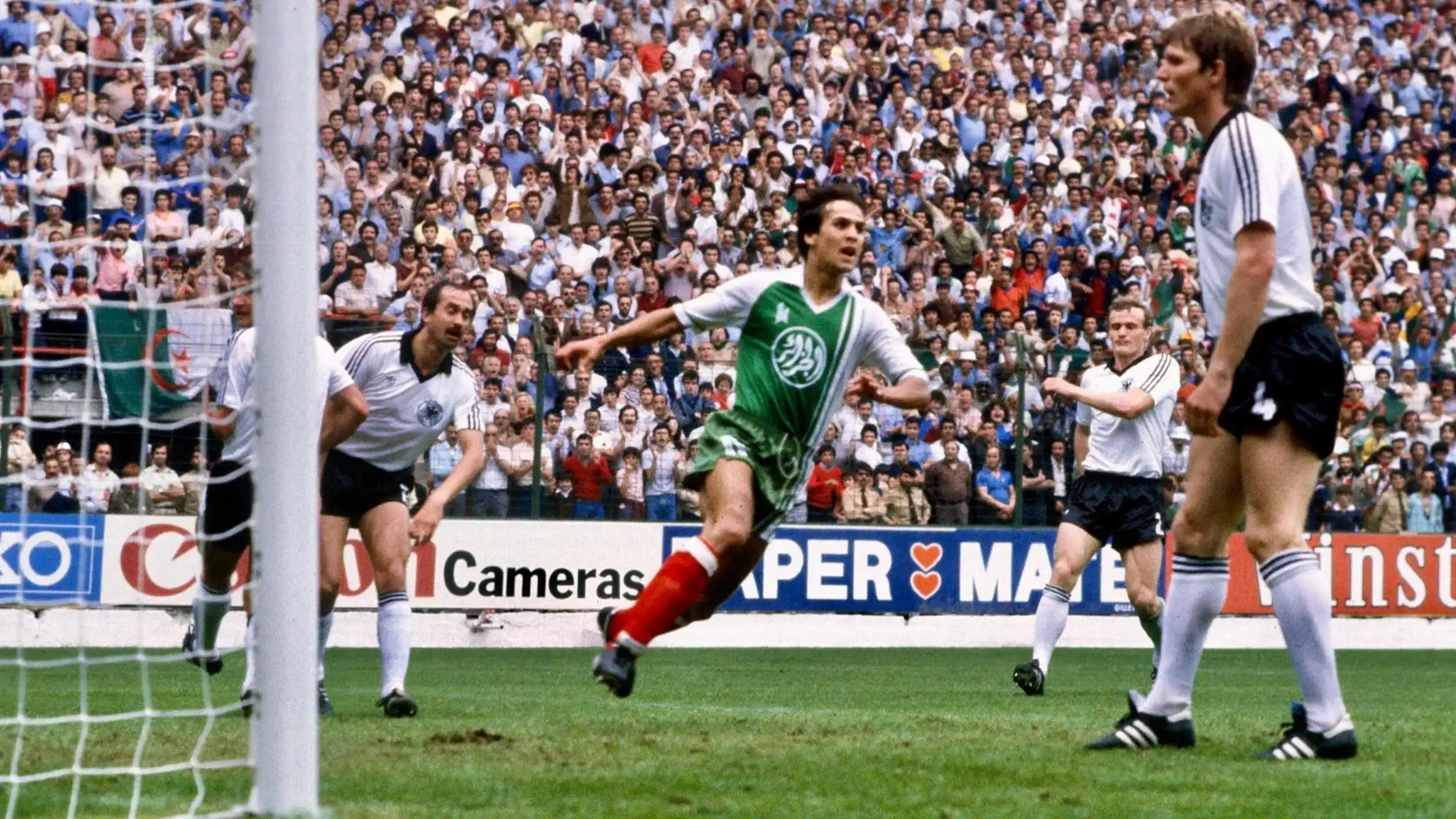
West Germany 1-2 Algeria
Spain 1982 | First group stage
Estadio El Molinón, Gijón
Attendance: 42,000
West Germany goal: Karl-Heinz Rummenigge (67)
Algeria goals: Rabah Madjer (54), Lakhdar Belloumi (68)
Teams
Coach: Jupp Derwall
Starting XI: Harald (Toni) Schumacher; Hans-Peter Briegel, Karlheinz Förster, Uli Stielike, Manfred Kaltz; Wolfgang Dremmler, Paul Breitner, Felix Magath; Pierre Littbarski, Horst Hrubesch, Karl-Heinz Rummenigge
Substitutions: Klaus Fischer for Magath (83)
Coach: Rachid Mekhloufi
Starting XI: Mehdi Cerbah; Faouzi Mansouri, Mahmoud Guendouz, Noureddine Kourichi, Chaâbane Merzekane; Mustapha Dahleb, Ali Fergani, Lakhdar Belloumi; Salah Assad, Djamel Zidane, Rabah Madjer
Substitutions: Tedj Bensaoula for Zidane (64), Salah Larbes for Madjer (88)
Hitherto head-to-head record
0 (West) Germany wins
0 draws
1 Algeria win
Going into the game
Jupp Derwall’s West Germany team were regarded as one of the favourites heading into the 1982 FIFA World Cup™. Captained by Karl-Heinz Rummenigge, the reigning European champions employed a tried-and-tested system that boasted a group of leaders with extensive experience at the highest level. The Germans expected to crush the outsiders from Algeria in the Group 2 curtain-raiser, wondering only how wide the margin of victory would be against the competition debutants.
While 1982 marked a tenth campaign for (West) Germany at the World Cup finals, reaching the global stage for the very first time was a truly momentous footballing achievement for the Algerians. The technically gifted team, packed with players capable of breaking at pace, had more than earned their World Cup spot after triumphing in the CAF qualifiers. Rabah Madjer and Co would now have the opportunity to see how much progress they had made, having been handed a baptism of fire against the then two-time world champions in their first-ever match at the tournament.
The game
As expected, West Germany were full of attacking intent, taking control of the encounter in the early stages and patiently probing for gaps in the Algerian backline. However, their opponents refused to drop deep, preferring to defend on the front foot and launch swift breakaways after gaining possession.
Derwall had selected his two best strikers, pairing skipper Karl-Heinz Rummenigge with reigning Bundesliga top goalscorer Horst Hrubesch. However, his team lacked penetration and precision in the first period and the game remained scoreless at half-time, with Algeria never threatening to break the deadlock despite mounting a series of counter-attacks.
The North Africans finally converted one of those breakaways in the 54th minute, as a sweeping end-to-end move put Lakhdar Belloumi through on goal. The onrushing Toni Schumacher blocked his shot, but Madjer reacted quickest to slot in the rebound and open the scoring.
Pierre Littbarski tested Mehdi Cerbah with an angled drive as West Germany immediately picked up the pace. Their efforts were rewarded in the 67th minute when Rummenigge pounced in front of the defence to stab home a low cross fired in by Felix Magath.
However, any expectations that the favourites would grab the game by the scruff of the neck were quickly dashed. Just a minute after conceding, the Algerians produced another slick passing move, releasing the overlapping Salah Assad down the left. His perfectly weighted cross found the unmarked Belloumi, who slammed in from close range to put the Fennec Foxes back into the lead.
West Germany chased an equaliser throughout the closing exchanges but a Rummenigge header that crashed off the crossbar was the closest that the European champions came to drawing level. The disciplined Algerian team were able to celebrate a hard-fought and historic win when referee Enrique Labo Revoredo finally brought proceedings to an end.
Quotes
“This match was like a second independence celebration, a repeat of 1962. When we were on the pitch, we had to thrill the crowd, the Algerian people. Of course, I dedicated my winning goal against West Germany to the Algerian nation. There was an extra dimension to this in the Arab world: seeing our performance, the Arab countries became aware of their own potential. Saudi Arabia, Morocco and Tunisia followed in our footsteps and made history for themselves. The Arab world thanked us.”
Algeria match-winner Lakhdar Belloumi (from dzfoot.com)
“Alongside Brazil, West Germany were the big favourites for that World Cup. Before the match, the German coach [Jupp Derwall] said that he would walk home if his team lost, and some of their players pledged to dedicate the sixth or seventh goal to one of our family members. We felt like they were underestimating us, unlike the Austrians. In the tunnel and in the opening minutes of the match, we realised that the Germans were overconfident.”
Algeria captain Ali Fergani (from jeuneafrique.com)
“No German national team has ever been in quite such a mess as we are now.”
Germany captain Karl-Heinz Rummenigge (from tagesspiegel.de)
“Ladies and gentlemen, I have watched and commentated on many Germany matches – and I have never been more disappointed.”
German TV commentator Rudi Michel (from t-online.de)
Stats
1
Algeria’s win against West Germany did not just represent the nation’s maiden World Cup match and triumph. It was the very first victory for an African country against European opposition at a World Cup tournament.
9
Algeria are currently one of only nine countries to have a winning record against the (West) German national team. In 1964, the Fennecs prevailed in a friendly, while Germany needed extra time in 2014 to claim a slender 2-1 victory in a World Cup Round of 16 encounter. The other nations on the list are Argentina, Brazil, East Germany, England, France, Italy, Japan and the United Arab Republic.