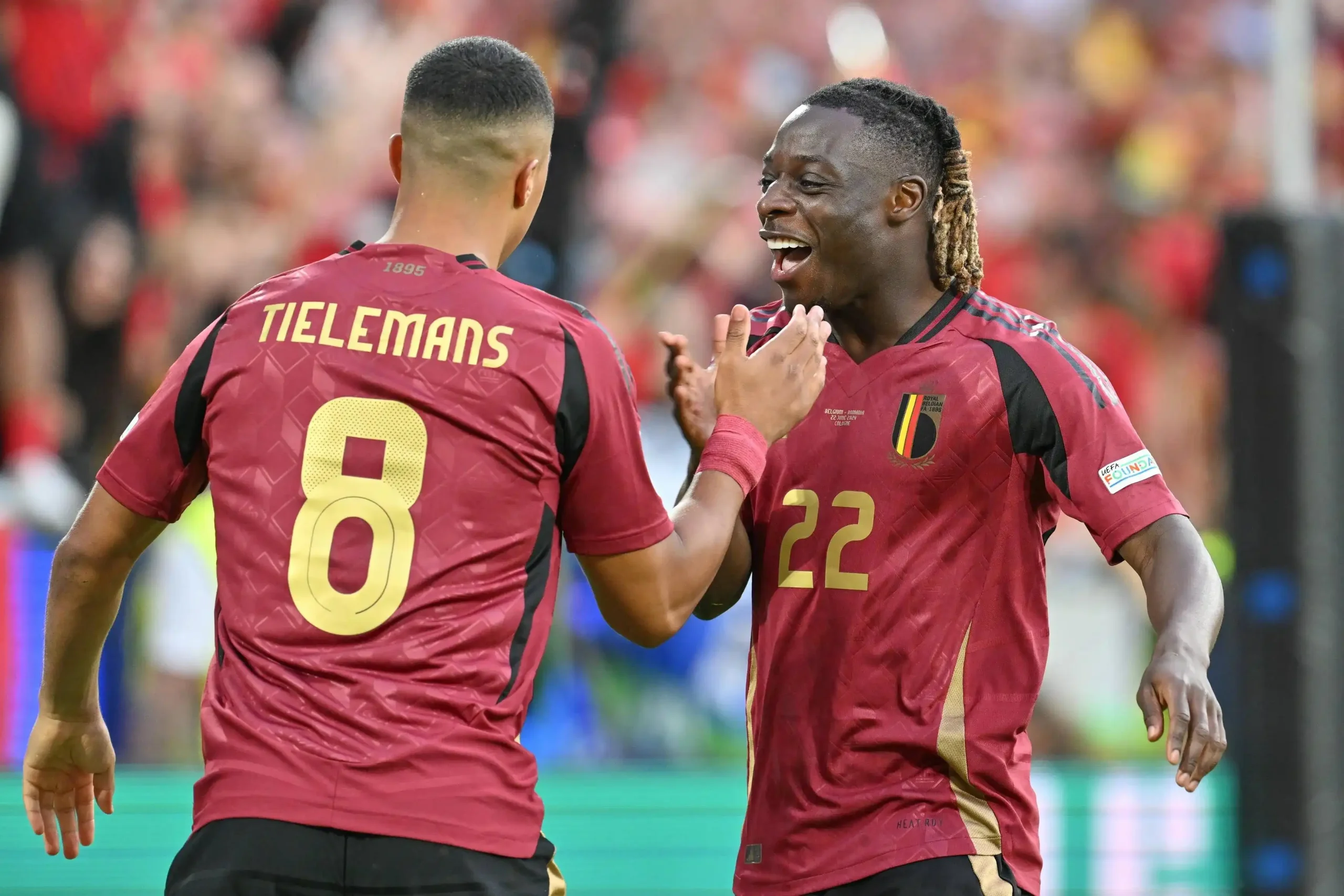
There is more than just an age gap between 28-year-old Youri Tielemans and Jeremy Doku, five years his junior. They reflect a Belgium side in transition, one that is still shaped by the fabled golden generation but now looking ahead to a new cycle.
As the FIFA World Cup 2026 fast approaches, where Belgium will compete in Group G, Rudi Garcia’s team will travel to North America driven by a squad balancing experience and fresh faces.
The roots of this transition can be found as far back as the Russia 2018 campaign where the nation reached the semi-finals, powered by a generation at the peak of its powers. It was one though that came unstuck against eventual champions France in a frustrating 1-0 defeat that left a lingering sense of disappointment.
Tielemans, an unused substitute on that day, retains clear memories of the match. “I was warming up for most of the second half, and I just remember the intensity, the pressure – you could feel the pressure inside the stadium,” he recalled.
“No-one wanted to make a mistake, and I didn’t feel like we did [make a mistake]. I felt like their goal [a header by Samuel Umtiti] was just a moment, and I don’t think we could have or should have done anything differently on that day.”
Four years later, the contrast at the FIFA World Cup 2022™ was stark. Despite being among the pre-tournament favourites, Belgium bowed out at the end of the group stage, unable to impose their game and caught out by the intensity of opponents Canada, Morocco and Croatia. “I think we just weren’t ready for it,” admitted Tielemans. That disappointment marked the end of a cycle and accelerated the emergence of a new generation.
It is against this backdrop that Doku has soared to new heights. At Qatar 2022, Doku, still a raw talent at Rennes, played just 18 minutes, but much has changed since then. Whether at Manchester City or with the national team, Doku has established himself as a dynamic winger, one who invariably leaves his mark on big showdowns.
He now commands a different status, that of a player expected to carry Belgian hopes on his broad shoulders. “We know that those losses and those mistakes will help us learn,” said Doku, underlining his shift from promise to responsibility. “Now we’re hungry for more, hungry to do better.”
Tielemans, however, is the linchpin of this team in transition. Together with Kevin De Bruyne, the Aston Villa star represents the golden generation that went agonisingly close to reaching the pinnacle of the global game.
He is also full of praise for his experienced compatriot, describing him as a natural footballer, someone to look up to in moments of pressure. “Kevin is a world-class player, and you know that when you give him the ball, something can happen at any moment, so, obviously, when there is pressure or when the team might be struggling at some point, you look for your best players and he’s one of them.”
In North America, however, it will be Tielemans wearing the captain’s armband. It is a role entrusted to him by coach Rudi Garcia, one that he has embraced without changing his habits, but with greater attention to the collective. “Personally, it doesn’t change anything in terms of my personal preparation other than I’m four years older,” he explained. “I would say to the squad that it’s just a case of being more focused, making sure that everyone’s switched on and ready to go from the start.”
Doku also embodies this new energy, bringing blistering pace and boldness to a side undergoing a revamp. He too believes the key will be mental. “Our mentality is that we’re not overawed by any team. We will pay attention to the details. To go far, you have to be hungry and take your chances.
“We want to do our best for those players who are reaching an age where they’re thinking about retiring from the national team, for ourselves, but especially for our country,” explained Doku. “Even though it’s not the biggest country, a lot of people still really take us doing well at these types of tournaments to heart.”
With that in mind, Belgium are not looking to compare themselves to anyone, but rather to forge their own path. “Let’s just express our quality and show the world what we can do on the pitch,” implored Doku. “We will go there to perform at our best and to go as far as possible.”
That approach is shared by his captain, who is realistic about the competition but confident in his team’s potential. “I think we have a chance, just like other countries do. We just want to perform well at this World Cup, to show ourselves as a team and not have any regrets.”
Belgium will kick off their Group G campaign against Egypt on 15 June before squaring off against New Zealand and IR Iran. These fixtures could lay the foundations for the team’s revival and serve up three opportunities to prove that the 2022 setback was merely a blip, given that this crop of players, bridging past legacy and future promise, still has its own memorable story to write.