
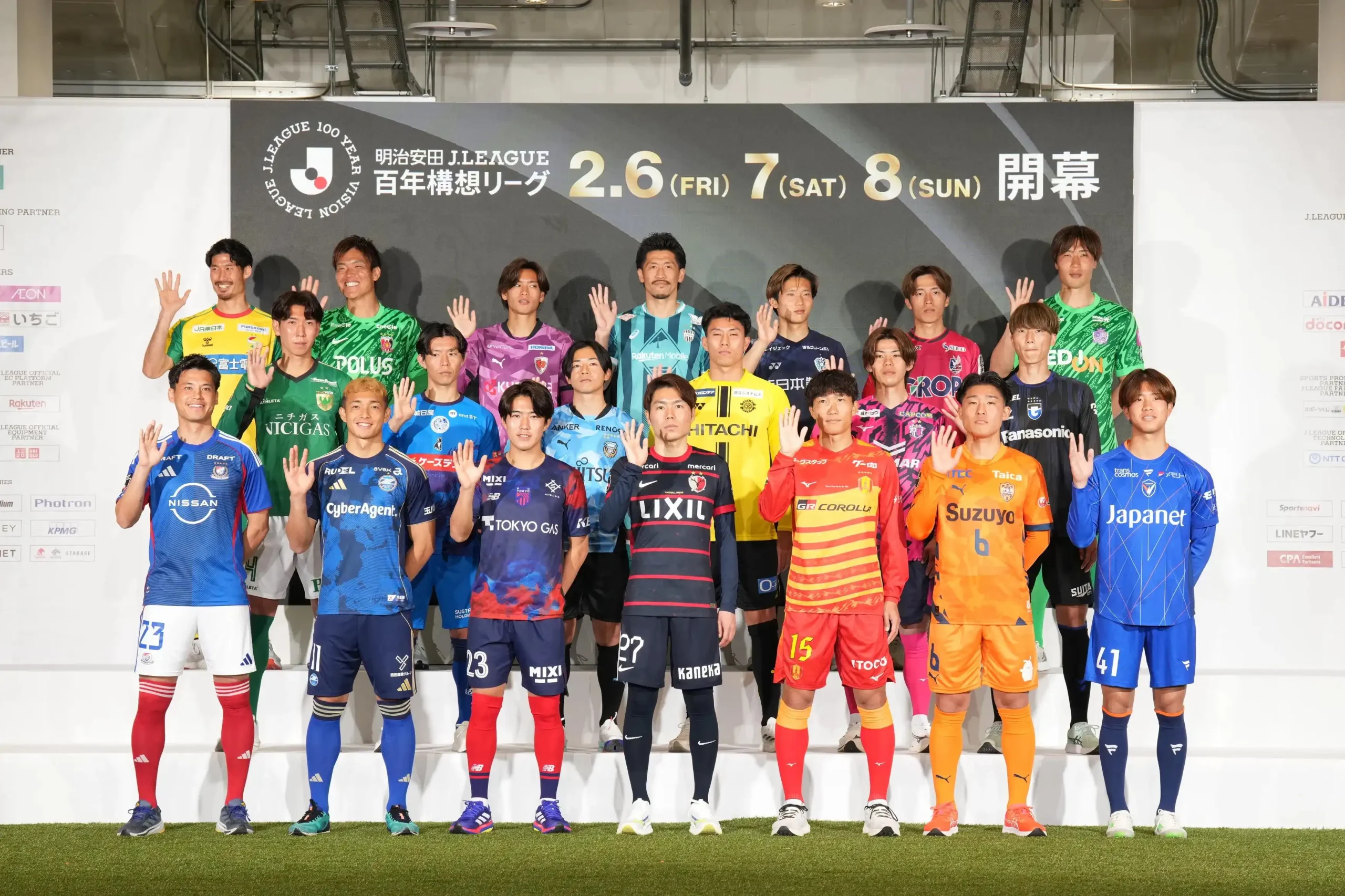
More than three decades after the J.League was launched, a major overhaul is coming to Japanese club football. What began in 1993 with just ten teams has now sprawled to a pyramid with 60 fully professional sides, stretching the length of the archipelago. Long gone are some of the quirky rules from the early years, including golden goals and penalties to settle matches, with the league now widely regarded as Asia’s strongest.
Fuelling that rise has been the development of a wave of talented young players, technically outstanding and with a growing tactical awareness, that has in turn helped power the national side. It’s little coincidence that, having never previously graced the game’s greatest stage prior to the league’s inception, Japan has been to every edition of the FIFA World Cup™ from 1998 onwards.
With that growth has come challenges for a league that has traditionally run on a spring-autumn format that saw an increasing number of players being poached by European clubs in the middle of the domestic season. Aligning with the European calendar, as well as that used in Asian continental competitions, was a major factor in deciding to switch to the new August-May schedule from 2026 onwards.
The immediate challenge was how to fill the gap from the previous season’s conclusion in December to the new August start. That was especially relevant in a World Cup year in order to ensure that clubs could still play competitive football while domestic candidates for Hajime Moriyasu’s squad had a chance to press their North American claims.
The solution was a one-off tournament, running from February-June, that kicks off this weekend. The curiously titled 100 Year Vision League sees clubs split along regional lines and is tipped to be a showcase for some of the nation’s brightest young talents.
While Japan’s World Cup squads have been increasingly populated by foreign-based stars, Moriyasu has never been shy to hand those starring in the domestic game a chance. The 100 Year Vision League then presents an ideal setting for both emerging and established talents to create one last impression and vie for a spot in the final squad that will play group-stage matches in the cities of Dallas and Monterrey.
FIFA profiles half a dozen players who could be in the World Cup frame with a strong showing in this one-off tournament.
Even without the ongoing injury issues surrounding presumptive first-choice goalkeeper Zion Suzuki, there is a furious battle being waged to make the three-player list for the trip to North America. Hiroshima’s Keisuke Osako, Machida’s Kosei Tani and Cerezo Osaka’s recently returned Kosuke Nakamura will all look to press their claims but standing near the top of the domestic-based bunch is Hayakawa. Last year, in his third season as Kashima’s starter, he was named the league’s overall Player of the Year, just the second keeper to claim that honour. With good reflexes, command of his area and one-on-one abilities he’s in a prime position to make the Japan squad, despite having earned only three caps previously.
Once earmarked as the man set to lead the line for Japan in North America, Hosoya has instead gone to being an uncertain starter at club level – and with the rise of Ayase Ueda into one of Asia’s most in-form strikers – perhaps now scrapping for a squad spot. Having only started once for the national team since early 2024, hopes are that he can earn a starting role at Kashiwa and make his case over the next four months. Even coming off the bench, as he frequently did in 2025, the 24-year-old managed to score 11 goals, a mark bettered by just five others.
A lively dribbling forward, 23-year-old Nakamura burst on to the scene last season in his first year as a professional, having previously starred at university level. A versatile attacking threat who will likely line up as one of the two No10s in Hiroshima’s 3-4-2-1, he’s just as capable of playing out wide or further forward. He earned a call-up for Japan’s domestic-based EAFF Championship squad last year and his willingness to run at defenders and that positional flexibility could make him a wild-card for Moriyasu off the bench in North America.
When 19-year-old Sato left FC Tokyo, the club where he had spent his youth career, for a loan spell at promoted J1 debutants Okayama last year, few could have foreseen just what a success that would have been. Playing as both a left and right-sided wing-back in a 3-4-2-1 set-up, as well as in a more advanced central role, he ended up being named as the J.League’s Best Young Player. Having also starred in Japan’s recent title-winning triumph at the U-23 Asian Cup, where he was the tournament MVP, he could well be the youngest player named in Moriyasu’s squad.
Part of Japan’s Qatar 2022 squad, Soma has drifted out of the national team frame in recent times. Featuring in only seven of the past 29 squads named by Moriyasu, this looms as a vital period for the pint-sized playmaker. Coming off a season where he scored nine goals and provided ten assists for a Machida side that are also involved in Asian Champions League Elite action, if he maintains that rate of output then his case for World Cup inclusion will be hard to ignore.
One of the major off-season transfers was Taniguchi’s departure from his boyhood club, Tokyo Verdy, for a move to a heavyweight Kawasaki side. The 26-year-old central defender had a superb league campaign last season and in addition to being assured in his own box, he is a serious threat from set-pieces in the opposition half. Equally comfortable in either the three central defender set-up that Moriyasu prefers, or a four-man backline, he’s yet to earn a senior Japan call-up but is in an ideal situation now to shine at Frontale.