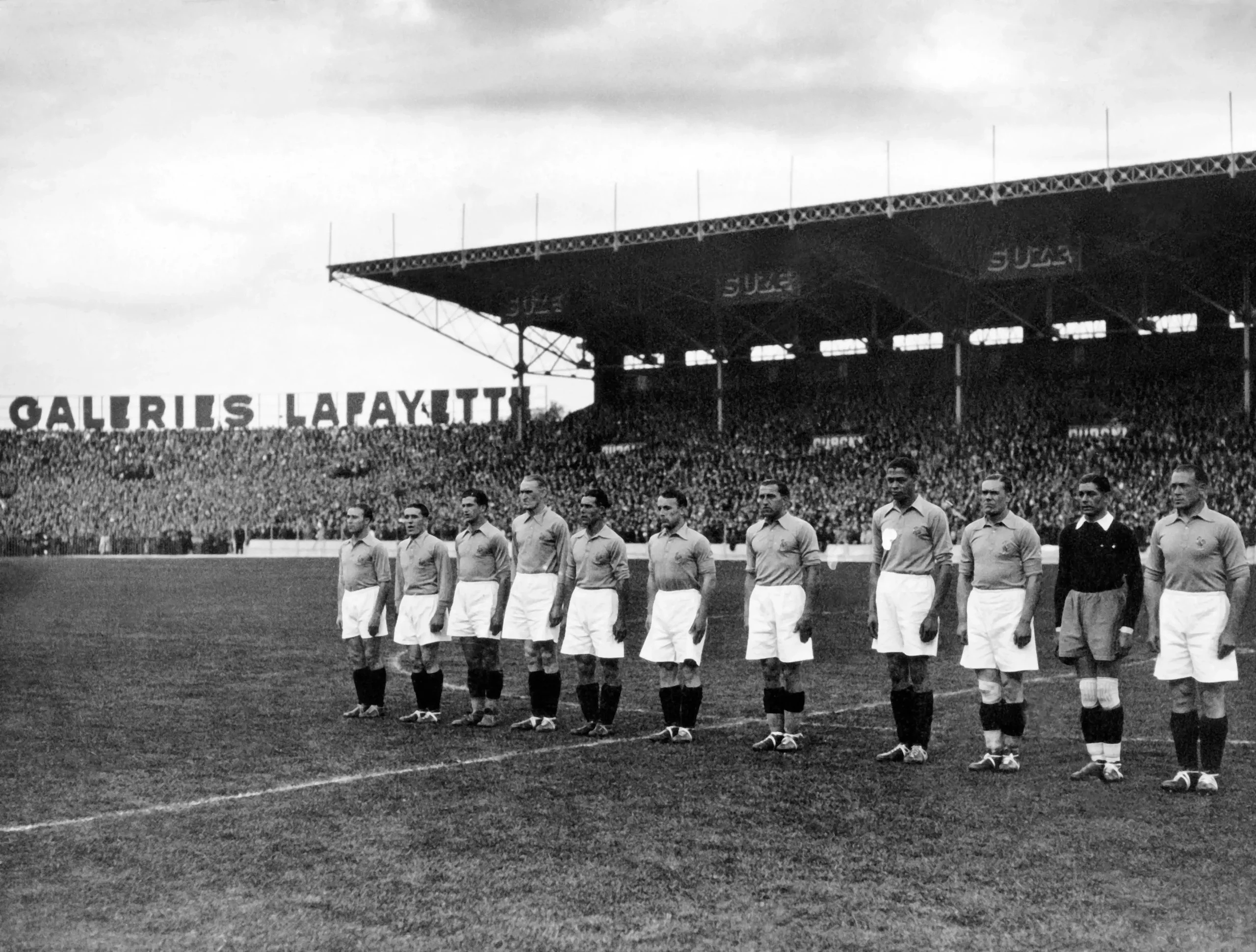
After Uruguay had claimed the crown on home soil at the inaugural FIFA World Cup™ in 1930 and Italy had replicated that feat four years later, France harboured high hopes of following suit in 1938. Selected to host the third edition of a tournament that was beginning to capture the world’s imagination, the European nation – the birthplace of the competition’s “father”, the then FIFA President Jules Rimet – was swept up in a wave of palpable excitement.
While the world was on the brink of sliding into darkness and Europe would plunge into a devastating war the very next year, the 1938 global extravaganza brought a welcome sense of joy, particularly for the French people, who were able to savour a festival-like two weeks between 4 and 19 June.
Despite having fallen at the first hurdle at the previous two instalments (the group stage in 1930 and the last 16 in 1934), France fancied their chances of making it third time lucky with the benefit of home comforts and a crop of talented players. Chief among them was goalkeeper Laurent Di Lorto, a freshly crowned French champion with Sochaux. They also had Rouen striker Jean Nicolas in their ranks and, of course, their ever-present captain Etienne Mattler, one of only five players to have taken part in the first three editions of the World Cup, with countrymen Edmond Delfour and Emile Veinante also belonging to that exclusive club (albeit the latter was an unused reserve in 1934).
As had been the case four years earlier, but unlike in 1930, the 1938 tournament did not begin with a group stage, instead going straight into the round of 16. France faced familiar foes in their opener in the shape of neighbours Belgium, with the French Football Association sparing no expense for the occasion. As part of a wide-ranging stadium redevelopment programme, it bolstered the capacity of the Stade Olympique Yves-du-Manoir in Colombes from 35,000 to 65,000. Les Bleus kicked off the tournament buoyed by an unparalleled atmosphere.
A few days before the start of the competition, coach Gaston Barreau took a gamble by arranging a friendly against England, who were not participating in the tournament, with Francois Bourbotte, Oscar Heisserer and Auguste Jordan all emerging from the match worse for wear. The latter two nevertheless recovered in time to lock horns with the Red Devils, while Veinante struck from close range inside the first minute to fire France into the lead. An unplayable Nicolas added another 15 minutes later. “Gosh, we were overjoyed at that precise moment,” the Rouen forward later told the press. “We couldn’t have wished for a better start.”
France were briefly unsettled when Hendrik Isemborghs halved the deficit, but they bounced back after the interval and a second Nicolas strike sealed a 3-1 victory and a quarter-final berth.
French football, which was enjoying rapid growth after five years of professionalism, could draw on players who were more technically refined than ever before and in excellent physical condition. Legend has it that as they left Colombes on 5 June, many euphoric France supporters were on cloud nine, convinced that their side had one hand on the glittering Jules Rimet Trophy. Reality would soon bring them back down to earth.
Despite the nationwide enthusiasm for the sport, from Marseille to Le Havre via Strasbourg, and attendances never previously seen for a sporting event in the country, including the Olympic Games staged in Paris in 1924, the French campaign in 1938 was to falter for a number of reasons. Notably, the refresh instituted by Barreau after the 1934 tournament did not prove as effective as hoped, with the new blood injected for the 1938 competition – such as Sochaux’s prolific goalscorer Roger Courtois – failing to make the expected impact.
France were also undone by an unforgiving draw. Overcoming holders Italy, led by Giuseppe Meazza, in the quarter-finals was always going to be a tall order. Although 50,000 France fans packed into the stands in Colombes on 12 June, the Azzurri were also backed by significant support, with an estimated 10,000 Italians inside the stadium to get behind their team as they ran out 3-1 winners in a tie that was ultimately relatively comfortable. “An entirely unsurprising elimination,” as certain French newspapers dubbed it at the time.
In spite of having overhauled virtually 70 per cent of his own squad, Italy coach Vittorio Pozzo once again succeeded in fulfilling the potential of a team that, alongside Meazza, featured experienced heads such as Giovanni Ferrari and Eraldo Monzeglio, fellow veterans of the 1934 final. It was, however, Silvio Piola who almost single-handedly extinguished French dreams, netting twice, as he would also do in the 4-2 victory over Hungary in the final.
“He really was a force of nature and master goalscorer,” was the appraisal of a defeated Delfour. “Physically, he was the epitome of the modern centre-forward. His close control and ability to create shooting positions out of nothing were extremely difficult to contain. If Piola had been playing for us, I’m convinced we would’ve reached the next round, but he was an Italian god…”
Contemporary accounts suggest that not even the weather gods were on France’s side that day, with a fierce westerly wind blowing across Paris, which was said to suit the Italians’ more technical style of play. Despite Luigi Colaussi opening the scoring in the ninth minute, Les Bleus hit back immediately through Heisserer, but were unable to maintain their intensity level.
Battle-hardened after being given a run for their money in the round of 16 by Norway, whom they beat 2-1 after extra time thanks to Piola, the Azzurri possessed an edge and individual quality that France lacked. Barreau’s side were missing a magician of Piola’s calibre, or that of Hungary’s Gyula Zsengeller or Brazil’s Leonidas, who was widely considered the best player and finished as the tournament’s top scorer with seven goals. History has shown over the decades that it is rare for a team to lift the trophy without producing a little magic along the way.
For the first time ever, the hosts failed to win the World Cup and, from that point on, it became more common to stumble at home than to triumph. Since 1938, only England in 1966, West Germany in 1974, Argentina in 1978 and finally France in 1998 — 60 years after the disappointment in Colombes — have been crowned champions of FIFA’s flagship men’s competition in their own backyard.
Source: 1930-1982 – La France et ses 12 Coupes du Monde – De Montevideo a Madrid (“France and their 12 World Cups – from Montevideo to Madrid”) by Guy Kedia, Roger Dries and Just Fontaine