
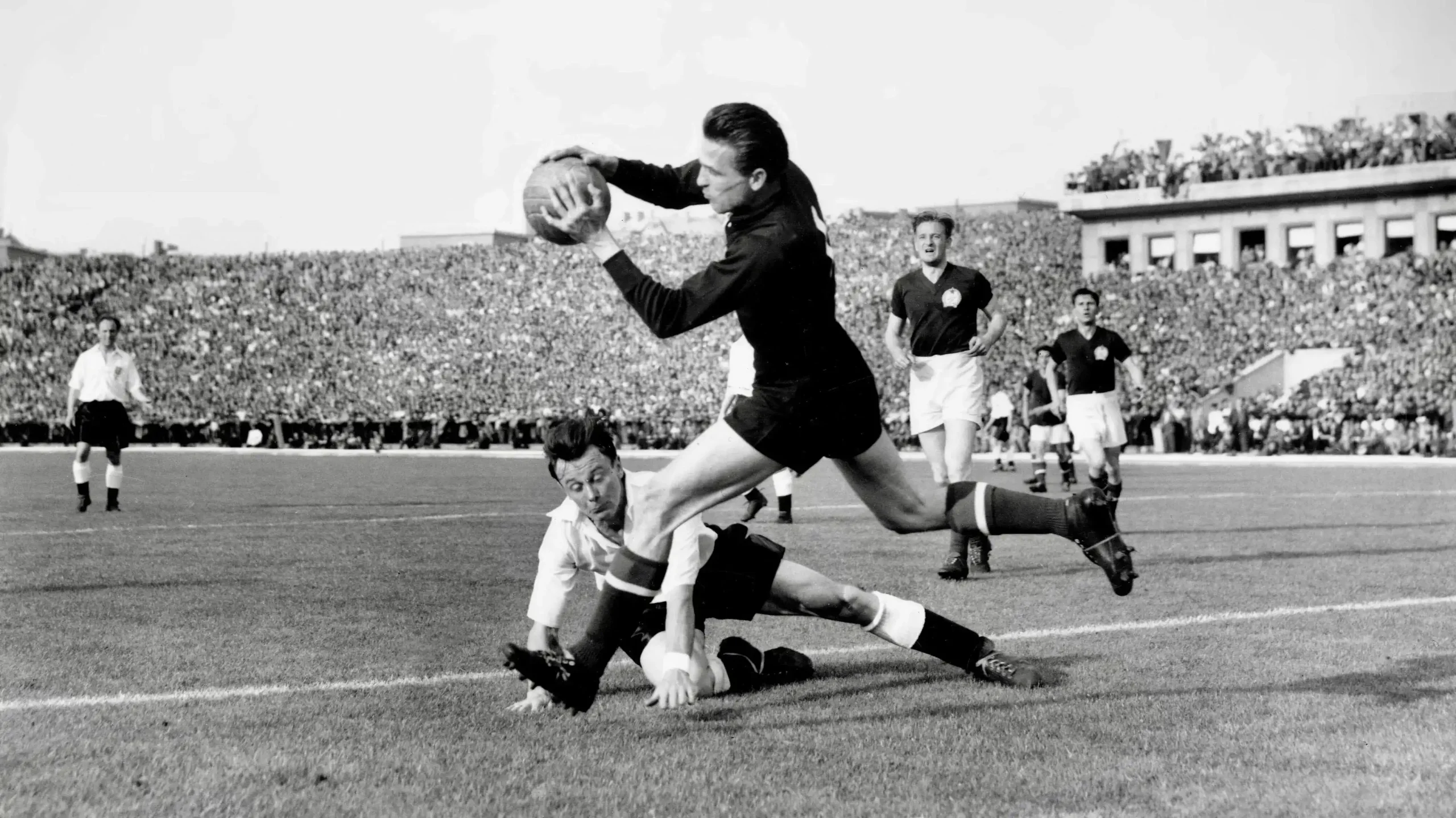
Ball-playing goalies and sweeper-keepers are a staple of modern football. One of the most emblematic masterclasses in the art of forward-thinking goalkeeping was served up by Germany’s Manuel Neuer against Algeria in the last 16 of the 2014 FIFA World Cup Brazil™.
During an all-action display, the Bayern Munich star regularly surged far from his goal – even outside his penalty box – to snuff out danger and initiate build-up. Yet while the German was hailed for having set a gold standard with a seemingly revolutionary showing, Neuer was in actual fact standing on the proverbial shoulders of another goalkeeping giant: Gyula Grosics, who lined up for Hungary at three editions of the global showpiece, most notably in 1954.
Grosics took international football by storm under the stewardship of Gusztav Sebes, who envisioned the goalkeeper as an active contributor to his team’s play rather than a passive net-minder occasionally called on to stop shots. A tally of 86 caps is a testament to the influence and stature of a linchpin of the Hungary team that dominated world football for several years in the early 1950s, only to go home empty-handed on the biggest stage of all after a heartbreaking defeat to West Germany in Bern.
Bright lights and sporting glory would have seemed a remote prospect to a young Grosics, who was born on 4 February 1926 in Dorog, a mining town. Indeed, his humble upbringing and his parents’ wish for him to join the clergy meant that he initially played the game just for fun, but it transpired that his calling was to grace footballing cathedrals rather than regular churches.
After the Second World War, Grosics joined his local club, Dorogi Banyasz (now Dorogi FC) and didn’t take long to catch the eye. What really set him apart from the average goalkeeper of the day was his proficiency with the ball at his feet, which was to propel him to prominence far beyond his hometown.
Following a stint at MATEOSZ (later renamed Teherfuvar), during which he made his national-team debut in 1947, Grosics took another step up at the turn of the decade, moving to the newly rebranded Budapest outfit Honved. Their name translating as ‘Homeland Defence’, the Hungarian army outfit were the centrepiece of a plan aimed at forging closer links between club football and the national team in the 1950s. It it small wonder, then, that they supplied the spine of the Hungary side at the time.
This proved an ideal platform for Grosics to perfect his style of play, which was practically unheard of in European football and involved repeated forays outside his penalty box to intercept long passes and through-balls, as well as to launch attacks for his side. He soon earned the nickname ‘Black Panther’ as a nod not just to the colour of the jersey that he sported – in which he cut an imposing figure as he prowled his area – but also to his astounding athleticism and agility.
These attributes certainly came in handy for a Hungary team that verged on all-conquering with Grosics between the sticks – or emerging from between them, as the case often was. During a period of unprecedented success, the Central Europeans embarked on a record-breaking unbeaten run from June 1950 onwards, as part of which they struck Olympic gold in 1952. They also notably secured an emphatic 6-3 victory at Wembley in 1953 that made them the first nation from outside the British Isles to overcome England on the latter’s soil and forever changed the face of football, reshaping perceptions across the globe.
Against this glorious backdrop, the Hungarians went into the 1954 FIFA World Cup Switzerland™ as overwhelming favourites. The squad that made the trip to Switzerland was jam-packed with top-class talent, including some of the very best players on the planet in their respective positions, from Grosics himself to the likes of Ferenc Puskas, Nandor Hidegkuti, Sandor Kocsis, Zoltan Czibor and Jozsef Bozsik.
As the tournament unfolded, the Mighty Magyars certainly looked set to vindicate their billing – and their nickname. Sebes’ side hit the ground running by easing past Korea Republic and West Germany 9-0 and 8-3 respectively in the group stage. They then registered back-to-back 4-2 wins in the knockout phase, fighting past Brazil in the so-called ‘Battle of Bern’ in the quarter-finals and then outlasting Uruguay in extra time in the semis.
Bern was also the venue for the final on 4 July 1954, which has gone down as one of the most legendary World Cup encounters ever. The game seemed to be following the script for Grosics and Co. when they raced into a 2-0 lead, only for the West German underdogs to roar back and seal a sensational 3-2 upset. It was a double whammy of epic proportions for the Hungarians, who not only missed out on the biggest title of all, but also surrendered their historic undefeated streak in the process.
“I’ll carry the bitterness with me until the day I die,” Grosics told German broadcaster NDR 50 years on. “I never imagined that one goal could be so life-changing.”
The devastating defeat was to have major ramifications both on and off the pitch. The Hungarian national team had become a highly charged political symbol under the country’s communist regime, which did not take kindly to their failure to live up to expectations.
Grosics was among those who bore the brunt of the backlash, being detained a few months later, interrogated and placed under house arrest for a spell. He was eventually forced to join provincial club Tatabanya Banyasz, while the fallout was also felt by his family, with his father losing his job as a miner. Already an icon because of his innovative approach to the game, the goalie now stood as the embodiment of the social undercurrents that threatened to engulf his generation’s triumphs and tribulations at any moment.
However, Grosics was one of the few players from the Golden Team to stay put in Hungary for good beyond the Bern bombshell, and he would return to the international fold in 1956. Remarkably, the keeper went on to feature at the next two instalments of the World Cup and ultimately took his overall tally of appearances at the competition to 11 in 1962, where he was the only representative of his country’s 1954 vintage left in the squad.
After hanging up his gloves, the erstwhile custodian turned his hand to coaching and, following the transition to democracy in the 1990s, he entered politics. In his latter years, he relished his role as an elder statesman, never baulking at requests to talk about his experiences and always providing a thoughtful and nuanced perspective.
Grosics passed away at the age of 88 in Budapest on 13 June 2014, being survived by only one other member of Hungary’s line-up from the 1954 World Cup final. His death was untimely inasmuch as it came just a day after the 2014 tournament kicked off in Brazil, meaning that he did not have the chance to feast his eyes on Neuer’s much-acclaimed performance against the Algerians later in the competition.
Yet the legacy of the Hungarian’s exploits 60 years earlier lived on in the German’s swashbuckling example. A trailblazing ball-playing goalkeeper who had a unique career and was a fixture for one of the finest teams in international football history, Grosics remains one of the all-time greats, and his story continues to strike a chord to this day.