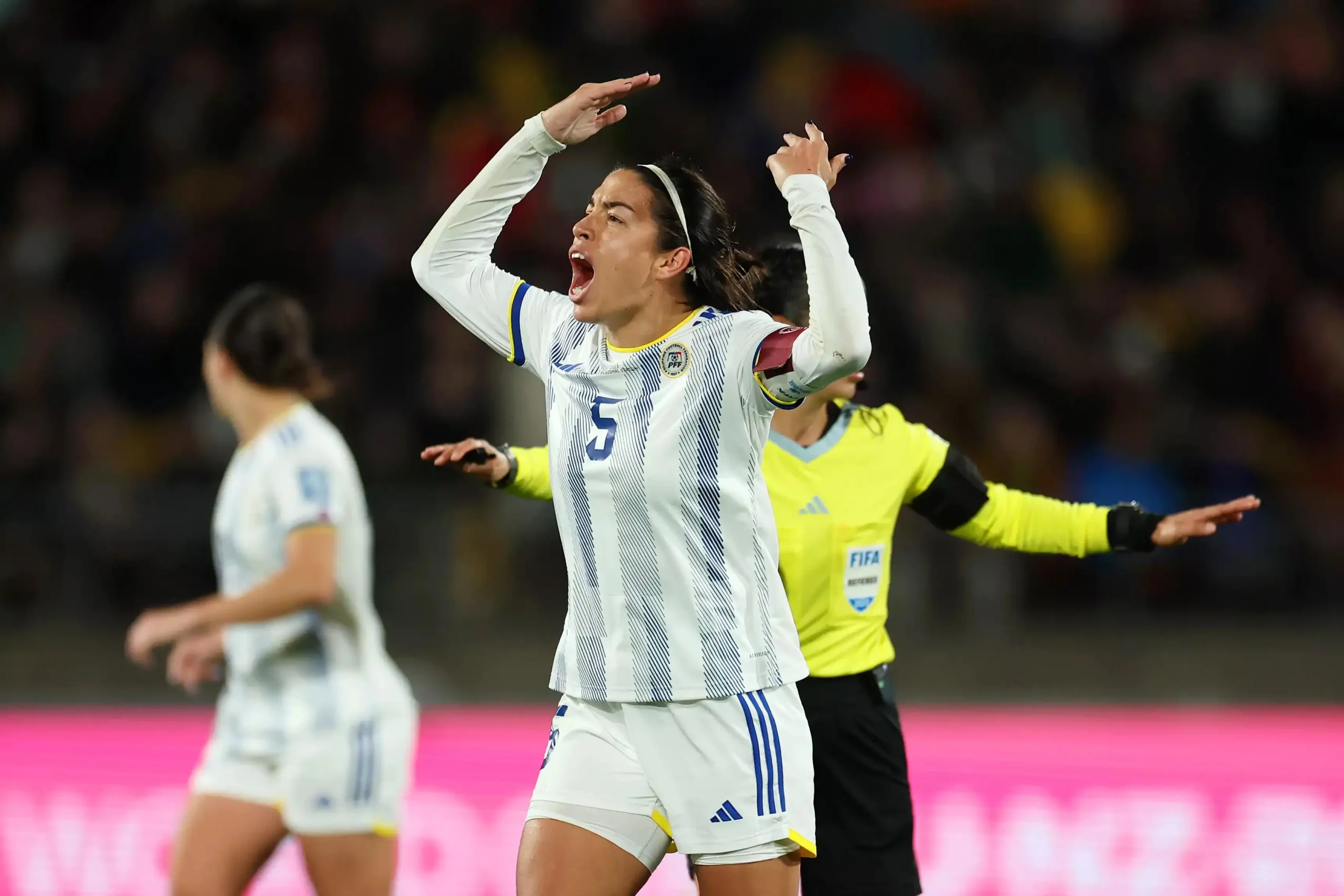
For Hali Long, wearing the Philippines jersey has never been just about football. It is about family, identity, sacrifice, and, ultimately, legacy.
Born in Cape Girardeau, Missouri, Long grew up geographically distant from the Philippines, yet deeply rooted in her heritage. Raised by a single mother alongside her two sisters, with her lola (grandmother) and tita (aunt) living under the same roof, her childhood home in the United States felt unmistakably Filipino.
“There were basically six Filipina women in our house in America, so I never felt it was different,” Long told FIFA. “Our home was very Pinoy – it just happened to be in America.”
Those early years quietly shaped her sense of belonging. Only later did simple memories take on deeper meaning – bringing sinigang, tinola or green apples with bagoong to school, things she never considered unusual at the time. “I only realised much later that I was the kid at school bringing the ‘smelly food’. Back then, it was completely normal to me.”
That same sense of normality carried into football. The sport was her passion, but never something she ever took for granted as her future. When the first opportunity to attend a Philippines women’s national team camp arose during her teenage years, Long declined, prioritising education out of respect for her mother’s sacrifices.
When she eventually joined the national team in June 2016, it was anything but glamorous. Long’s early international years were defined more by hardship than spotlight. Limited resources, modest facilities and constant personal sacrifice were part of the team’s foundation.
“We didn’t have training kits and we washed our clothes by hand,” recalled the now 31-year-old. “I went back to America to work while being a full-time student and athlete, just so I could attend camps.”
Time, money and comfort were sacrificed for belief. And that belief gradually became something stronger than infrastructure alone. “I sacrificed a lot to play. But every sacrifice was worth it. I would do it time and again because of everything the national team has given me.”
The breakthrough arrived in 2022, when the Philippines hosted, and won, the AFF Women’s Championship. It marked the team’s first appearance in a final, and achieving it at home made the moment even more powerful.
“It was the first time we reached a championship final, and doing it on home soil was incredible,” Long said. “Physically and emotionally, it was one of the toughest challenges I’ve ever experienced.”
A packed schedule, long travel and mounting expectations tested the squad. They emerged not only as champions, but as serious contenders.
Momentum carried into the SEA Games, where an opening defeat and health issues within the squad once again tested the team’s resilience. “We lost the opening match, and that was hard because we knew we should have won. But that spurred us on.”
Late goals, defining moments and a refusal to settle ultimately led to a gold medal – and a shift in mindset. “We’ve moved past just being grateful to be there. We have to believe that we belong at this level.”
Then came the turning point: the FIFA Women’s World Cup Australia/New Zealand 2023™. For Long, the experience brought a mix of pride, pressure and reflection. “It was full of emotion, both good and bad. I think you could see it in the photos and videos. Sometimes those emotions took over.”
History followed, with the Philippines’ first appearance, first goal and first victory at a Women’s World Cup. Yet those achievements only drove the team further. “We achieved many ‘firsts’, but deep down, we didn’t fully achieve what we set out to do.”
Now with more than 100 international caps, Long’s journey spans generations of the national team. Asked about her personal growth, she deflects attention from individual milestones. “My career… I don’t really like talking about myself. I look more at how I’ve grown within the team. As a person, of course physically too.”
As one of the senior figures, a centre-back and captain, her focus is on consistency and responsibility. “I’m one of the older players now. I just want to set the kind of example my older team-mates once set for me. The team looks very different now, but my role is to pass on what I’ve learned. That’s what it means to be part of the national team.”
That sense of responsibility frames the next challenge. The Philippines will compete at the AFC Women’s Asian Cup from 1–21 March, drawn in Group A alongside Australia, Iran and Korea Republic. The tournament once again serves as a qualification pathway to the FIFA Women’s World Cup Brazil 2027™.
This time, however, the Philippines arrive with history behind them. In the previous edition, they achieved their best-ever finish, reaching the semi-finals – the highest placing in their Asian Cup history.
Long, now playing in Thailand with College of Asian Scholars, approaches the task with realism and quiet conviction. “I can’t even sit still thinking about it because it’s always such a tough assignment. The Asian Cup has so much variation in style. East Asia, West Asia, Southeast Asia – everyone competing for the same prize.”
For Long, Asia’s diversity makes the competition uniquely demanding. Each match presents a distinct challenge, and every point must be earned. “It’s extremely tough. Every team is working hard, and of course we want to return to the World Cup.”
For young Filipina players watching from Manila, Mindanao or diaspora communities around the world, Long’s journey stands as proof that sacrifice can shape success and belief can carry a nation further than expected.
“I’m incredibly grateful for this opportunity. To represent my country, my family and all our kababayan [fellow Filipinos] around the world.”