
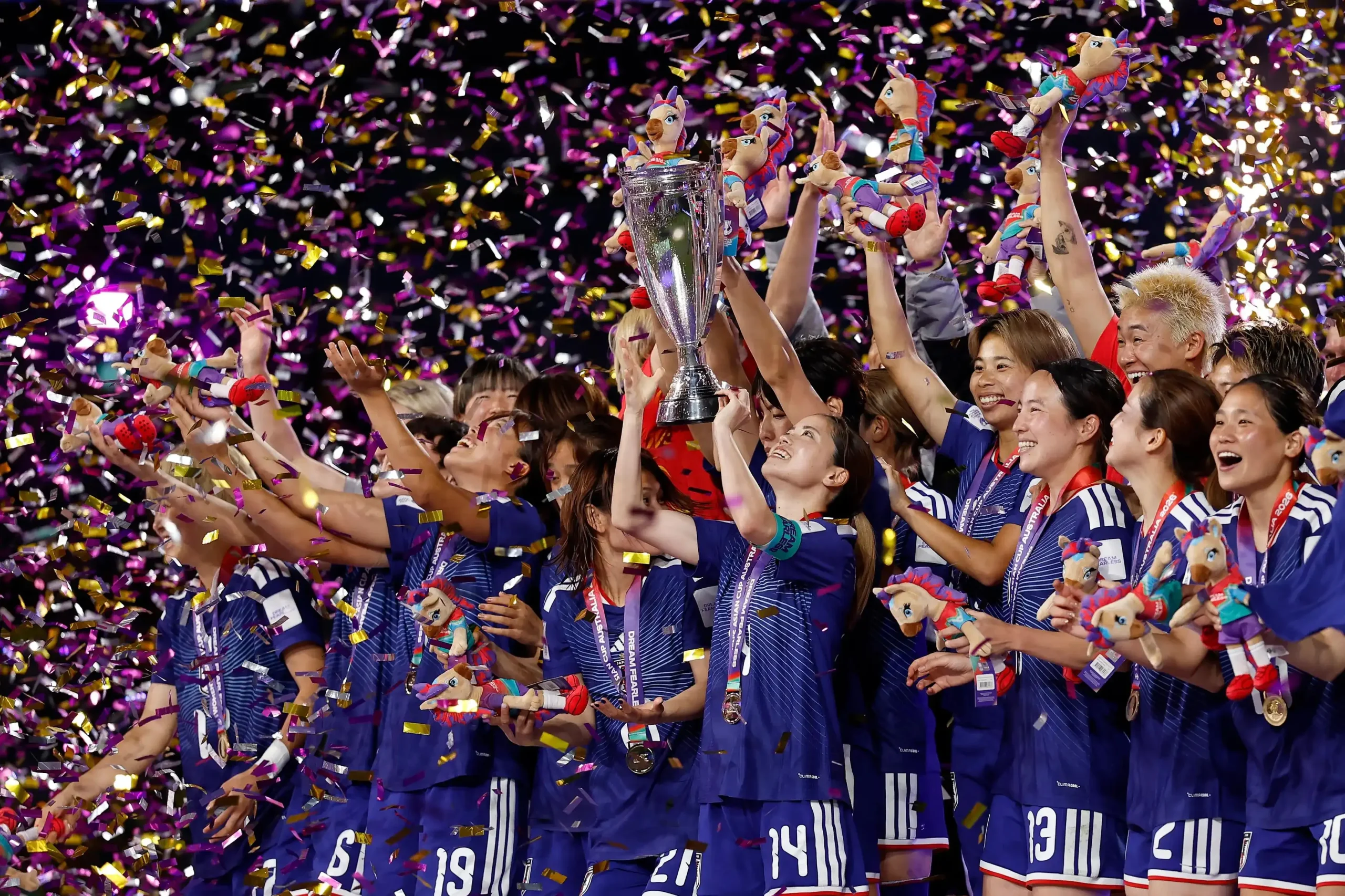
A week after they qualified for a tenth edition of the FIFA Women’s World Cup™, Japan saw off Australia 1-0 in the final of the Women’s Asian Cup to claim a third continental crown.
For the final time, the continental showpiece was used as the qualification tournament for the global finals, where the AFC’s six direct berths were settled. Australia and Japan will be joined by China PR, Korea DPR, Korea Republic and Philippines after they impressed at the Asian Cup.
There could be a further two nations flying the Asian flag next year with Chinese Taipei and Uzbekistan qualifying for the Play-Off Tournament.
Japan 1-0 Australia
Japan goal: Maika Hamano (17)
Across the past three weeks there’s been little doubt as to who the most dominant nation has been Down Under. What they started with a straightforward victory over Chinese Taipei in their group opener in Perth, the Nadeshiko finished with a 1-0 win over Australia in Sydney.
Six matches, six wins, 29 goals scored and just the one conceded speak volumes as to Japan’s dominance at the continental finals. It also sends a clear warning that they will be among the leading contenders for the global crown in a little over a year.
Once they’d gone ahead early in the decider, via a sumptuous Maika Hamano strike, Japan were rarely challenged. Pushing high up the pitch, probing in tight spaces and playing with control and patience, it wasn’t until late on when an increasingly frantic Australia started to have some rare goal glimpses.
On those few occasions they were denied by either wayward finishing or impressive defensive blocks by a watertight Nadeshiko rearguard led by the present and the future, in the shape of 35-year-old Saki Kumagai and her central defensive partner, 20-year-old Toko Koga.
Japan have now won the continental title for a third time in the past four editions.
East Asian nations dominate
Along with Japan, four other East Asian nations reached the quarter-finals in further evidence of that region being the clear guiding light for women’s football on the continent. Southeast Asia (Australia, Philippines) and Central Asia (Uzbekistan) were the other regional zones with representatives in the last eight.
Building on the growth of Australia/New Zealand 2023
The previous edition of the Women’s World Cup set new benchmarks for the tournament with record attendance and revenue and the success of the Women’s Asian Cup demonstrated that the legacy from Australia/New Zealand 2023 is very much intact.
A crowd of 60,279 turned out to witness Australia face Korea Republic during the group stage; that mark was the highest ever for any group stage fixture, either men’s or women’s, in the history of the Asian Cup.
Starlets emerge
While a galaxy of stars enhanced their reputation over the past three weeks in Australia, several others burst onto the stage. Lively Philippines winger Jael Guy, Japanese central defender Toko Koga, China’s midfield controller Wang Aifang and Korea DPR’s thread weaver Kim Song-gyong are among those who dazzled in the embryonic stage of their international careers.
Tournament overview
Champions: Japan (Third title)
Runners-up: Australia
Most Valuable Player: Alanna Kennedy (Australia)
Top Scorer: Riko Ueki (Japan), 6 goals
Best Goalkeeper: Ayaka Yamashita (Japan)
Fair Play Award: Japan
Attention now turns to the Play-Off Tournament where Chinese Taipei and Uzbekistan will face nations from CAF, CONMEBOL and OFC at a centralised venue in November and December.
Selected images courtesy of the AFC