
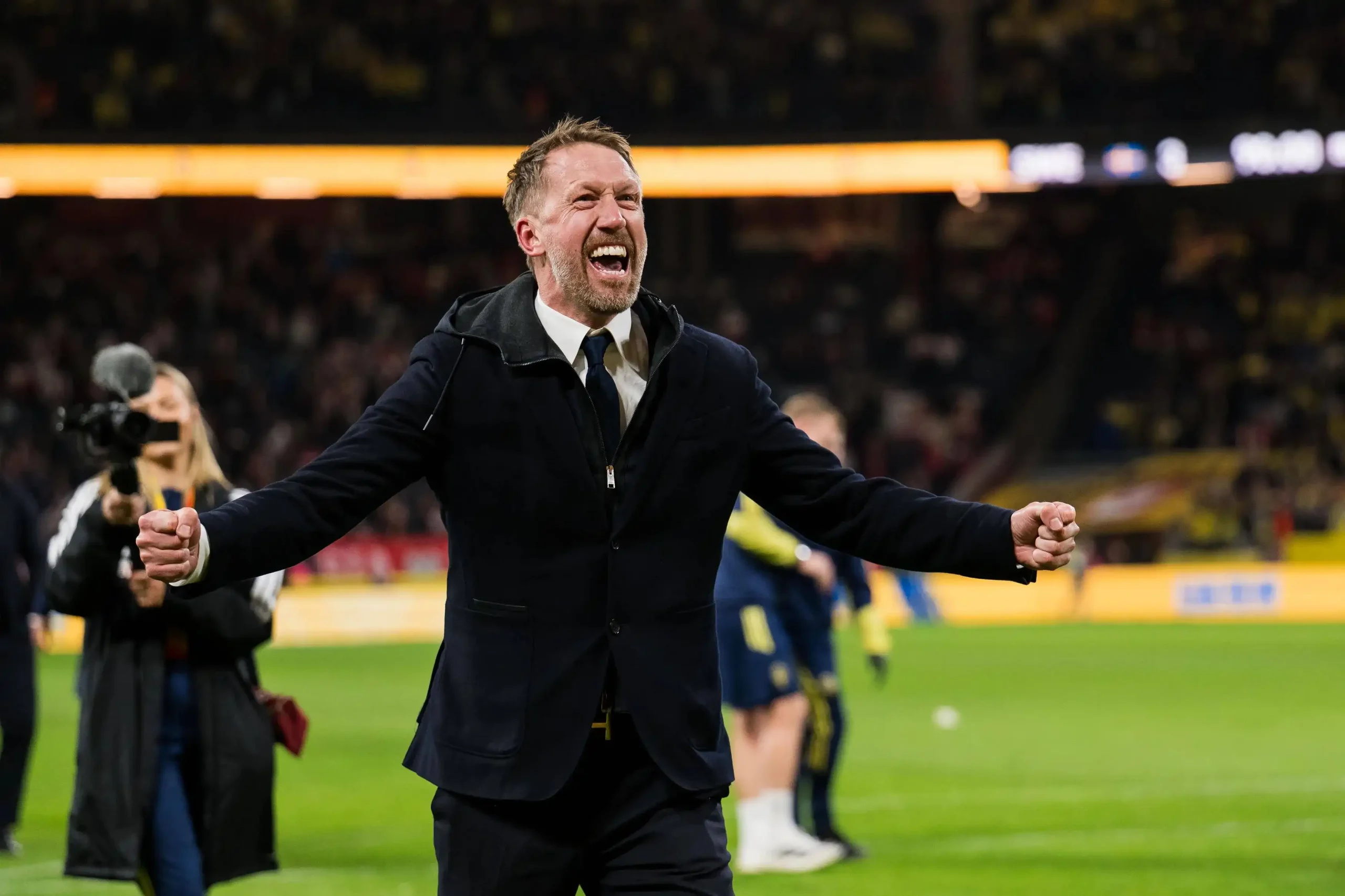
“I’m going to have a beer and then think, ‘Wow, we’re going to Dallas’,” declared an exuberant Graham Potter after sealing Sweden’s improbable FIFA World Cup 2026™ qualification on Tuesday. “I’ll have to dust off my cowboy hat, won’t I?”
After being given an unlikely lifeline thanks to their UEFA Nations League performance, Potter revived a faltering campaign by guiding the Swedes through the European play-offs with thrilling victories over Ukraine and Poland to ensure a return to the global stage after an eight-year absence.
The Englishman, who replaced Jon Dahl Tomasson in October initially on a short-term contract, is now preparing for a Group F campaign against Japan, the Netherlands and Tunisia, with the team basing themselves at FC Dallas’ facility in Frisco, Texas. It remains to be seen if Potter will indeed wear a cowboy hat during his time in the Lone Star State.
“We weren’t perfect, but who cares?” Potter said after the topsy-turvy 3-2 victory over Poland which punched their ticket to the global showpiece. “We’re going to the World Cup, baby. Wow!”
Notably, Potter is not the first Englishman to lead Sweden to the World Cup. He is following in the legendary footsteps of George Raynor, who guided the Swedes to the 1958 final on home soil — a full eight years before Alf Ramsey at England 1966 — as well as a third-place finish in 1950. In a golden era, Raynor also guided the Scandinavians to Olympic gold in 1948 and then bronze four years later.
There are some stark similarities between the careers of the compatriots, who both went onto coaching success abroad after moderate playing stints in the English lower leagues. Potter secured his break in Sweden with fourth-tier Ostersund after struggling to secure coaching work in his home country. It was a similar story for Raynor, who obtained a position with the Swedish national team thanks in large part to the help of Football Association secretary Sir Stanley Rous after departing Aldershot reserves.
Inspired by the ‘Holy Trinity’ of Gunnar Gren, Gunnar Nordahl and Nils Liedholm – colloquially known as Gre-No-Li – Raynor had immediate success as he guided Sweden to Olympic gold in London in 1948, with the team scoring an incredible 22 goals in four matches.
In an age of strictly amateur football in Sweden, Raynor continued to work wonders as he earned qualification for the World Cup two years later in Brazil, where they finished third despite the absence of a number of players who had turned professional, namely Gre-No-Li who all moved to AC Milan. Raynor’s magic touch showed no signs of ending as he then led Sweden to bronze at the 1952 Helsinki Olympics with another much-changed team.
The Yorkshireman put the world on notice with his extraordinary feats, securing coaching roles at Juventus and Lazio. After Sweden failed to qualify for the 1954 World Cup, Raynor returned to his spiritual home in March 1957 ahead of a home World Cup a year later.
Thanks to Raynor’s encouragement, the Swedish FA finally allowed professionals in the national team, a decision which transformed the programme. Sweden cruised through the group stage with victories over Hungary and Mexico as well as a goalless draw with Wales. In the knockout stages, Fiorentina forward Kurt Hamrin and Agne Simonsson continued where they left off as they inspired victories against the Soviet Union and West Germany on the road to the final.
In the decider against the mighty Brazil, which included the 17-year-old phenom Pele, Sweden took the lead in the fourth minute through Liedholm. But the South Americans fought back in style to win a classic encounter 5-2. Despite the loss, Raynor sealed his place in football folklore, an achievement Potter will no doubt tip his hat to.