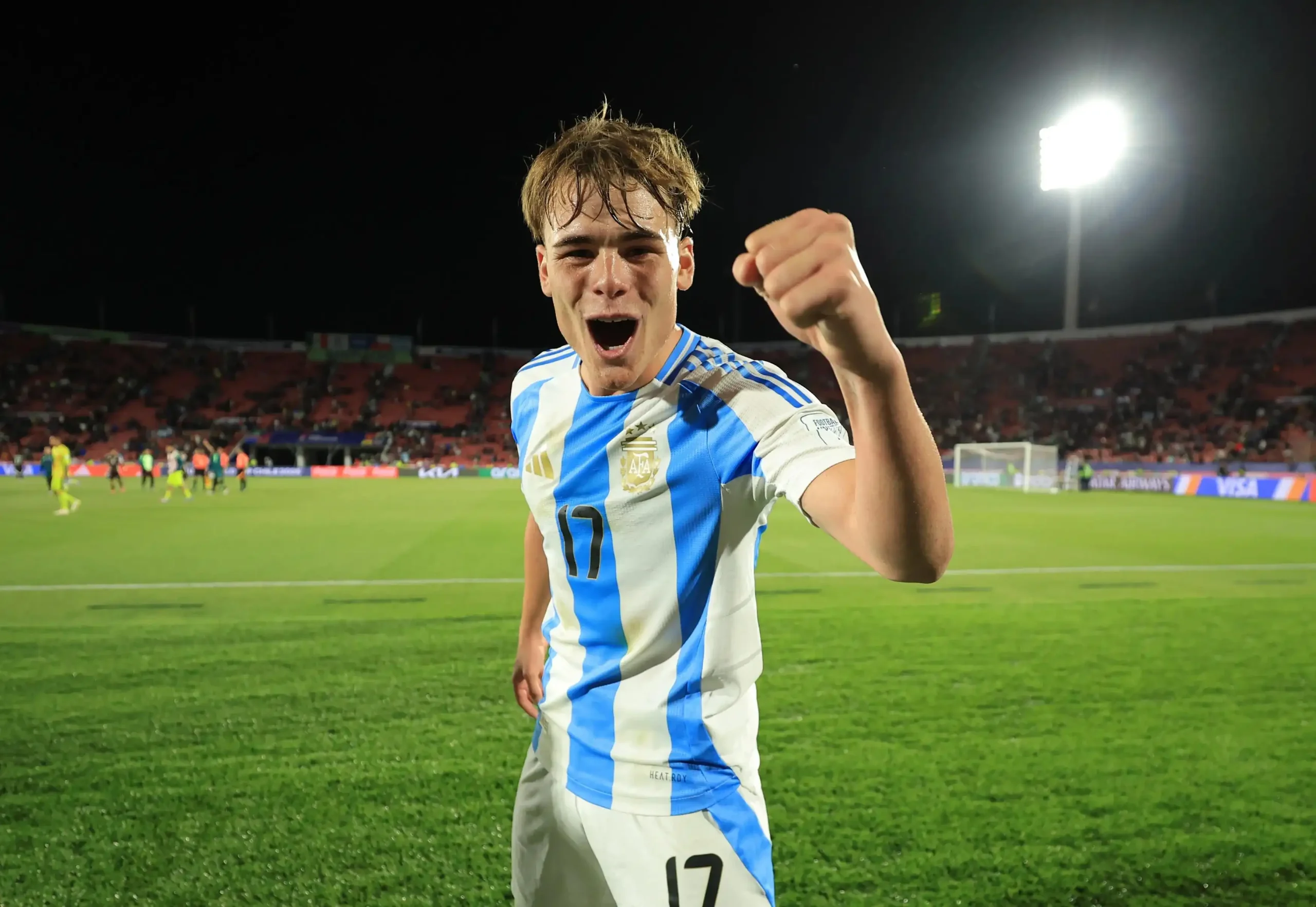
It was a brilliant play that was started by full-back Juan Manuel Villalba. He dribbled the ball from the left wing toward the centre, crossed the halfway line and noticed team-mate Mateo Silvetti’s rapid movement. The Argentinian forward was facing away from goal, just three metres ahead. He then turned with great speed in pursuit of the through-ball.
At the moment that Villalba made the pass, Silvetti stood level with three Mexican defenders, not to mention Everardo Lopez and Cesar Bustos who were even further ahead,
But ultimately, it was Silvetti who reached the ball first thanks to an impressive burst of speed. Then, with great composure, he slotted the ball past goalkeeper Emmanuel Ochoa to confirm Argentina’s 2-0 victory in the quarter-finals of the FIFA U-20 World Cup Chile 2025™.
This was the second consecutive match in which Silvetti has found the net after coming off the bench in the second half, having also done so in Argentina’s round of 16 tie against Nigeria.
“Coming off the bench is never easy, especially in tough matches like these, which are decided by fine margins,” Silvetti told FIFA. “You have to constantly pay attention to what’s happening on the pitch. But thankfully it’s working out, and we managed to win and progress to the next round, so let’s keep it going.”
The build-up to his goal against Mexico displayed the best of Silvetti’s abilities, not just for his explosive acceleration, but also for the intelligence of his movement. He gave Villalba the chance to play the pass, and showed his skill at reading what was about to unfold, as though he could foresee every move.
“Playing with team-mates like these always makes things easier,” he said. “Juanma is an excellent player. He recovered the ball brilliantly and delivered a fantastic pass. In that brief lull in play, I managed to take advantage of the space and go for goal. It feels great to be able to score these goals.”
Silvetti’s depth and bursts of pace have been stretching opposing defences at this tournament. His goals in the knockout stage have combined explosive pace with composure in front of goal. But they have not just been the result of direct runs, they’ve also come from the player’s quick decision-making in crucial moments. His ability to make decisive runs that can change the course of a game have made him a valuable asset to his coach.
Silvetti’s performances underline just how tough it will be for opponents to stop this Argentina side in the final stages of the U-20 World Cup. Coach Diego Placente is armed with a wealth of quality options in attack. Silvetti started the tournament as something of a secret weapon, a player few were talking about in this ultra-talented squad. But not anymore.
Curiously, Silvetti has also been something of an unknown quantity in the world of club football. A product of Newell’s Old Boys, he transferred to Major League Soccer (MLS) outfit Inter Miami this past August, signing a contract until 2029.
He made his professional debut at the Rosario-based club in 2024 and by the time he signed for Miami, he had made 37 appearances, contributing six goals and two assists.
Rosario is where a young Lionel Messi learnt much of his trade, a man who Silvetti now counts among his team-mates in Florida. At his first press conference at Inter Miami, Silvetti spoke about the prospect of playing alongside his idol, something made even more special by their shared roots.
“My first meeting with him was particularly special because I’m from Rosario and a Newell’s supporter, and he means so much to Newell’s, so it was an honour, and we talked for a while,” he said.
Messi began his development at Newell’s Old Boys, playing in the youth ranks until the age of 13, when he was taken to Barcelona. Despite having long left Newell’s, Messi has maintained his links to his boyhood side, declaring himself to be a supporter of the club and attending matches and events whenever possible.
Silvetti’s signing by Inter Miami carried a certain air of mystery, given he was relatively unknown outside of Argentina. Nevertheless, he was well known to coach Javier Mascherano, who worked with him in his days as Argentina’s U-20 coach.
Now it is his successor Placente who is making the most of Silvetti’s talent, with the youngster emerging as a knockout-stage assassin. If he can replicate these flashes of brilliance consistently, Silvetti could well develop into a world-class player, further cementing Rosario’s place in footballing history.