Spain are preparing for their 17th FIFA World Cup™ and looking to make amends after crashing out in the Round of 16 at the previous instalment in Qatar. Now the European powerhouses have their sights set on the FIFA World Cup 2026™, which will be the first global showpiece staged across three host nations: Canada, Mexico and the USA.
Luis de la Fuente’s squad will arrive at the tournament in high spirits and among the favourites for the title, having won UEFA EURO 2024 and reached the final of the 2024-25 UEFA Nations League. They also produced an almost perfect qualifying campaign in which they went into the final matchday knowing that they only had to avoid a heavy defeat against Türkiye to qualify. The next challenge is to lift the World Cup for the second time, following in the footsteps of the country’s trailblazing golden generation.
The coach: Luis de la Fuente
De la Fuente entered the hotseat in December 2022, having been promoted from within following successful stints in charge of the U-19s and U-21s. His tenure began upon the conclusion of Qatar 2022™, after Luis Enrique’s team had been knocked out by Morocco in the last 16.
The tactician has stayed true to the core principle of playing on the front foot, while adding greater versatility to his side’s approach by combining a possession-based style with the ability to counter-attack and transition quickly. The former full-back has also harnessed a highly talented crop of youngsters, headed by the likes of Pau Cubarsi, Dean Huijsen, Nico Williams and Lamine Yamal, many of whom he worked with at youth level, to propel Spain back to the top of the game.
Spain’s World Cup 2026 fixtures and group
Spain will discover their group-stage opponents when the Final Draw for the FIFA World Cup 26 takes place at the prestigious John F. Kennedy Center for the Performing Arts in Washington DC from 12:00 local time (18:00 in Madrid) on Friday, 5 December.
Full World Cup 26 match schedule
How Spain qualified for the World Cup 2026
La Roja were swift to put their Qatar setback behind them and enjoyed an almost flawless road to North America, doing the double over both Bulgaria and Georgia. Their only dropped points came at home to Türkiye, against whom they closed out their campaign with a 2-2 stalemate in Seville to book their ticket to the 2026 showpiece, having previously crushed the Crescent Stars 6-0 away in Konya.
Spain’s World Cup history
Spain’s best World Cup
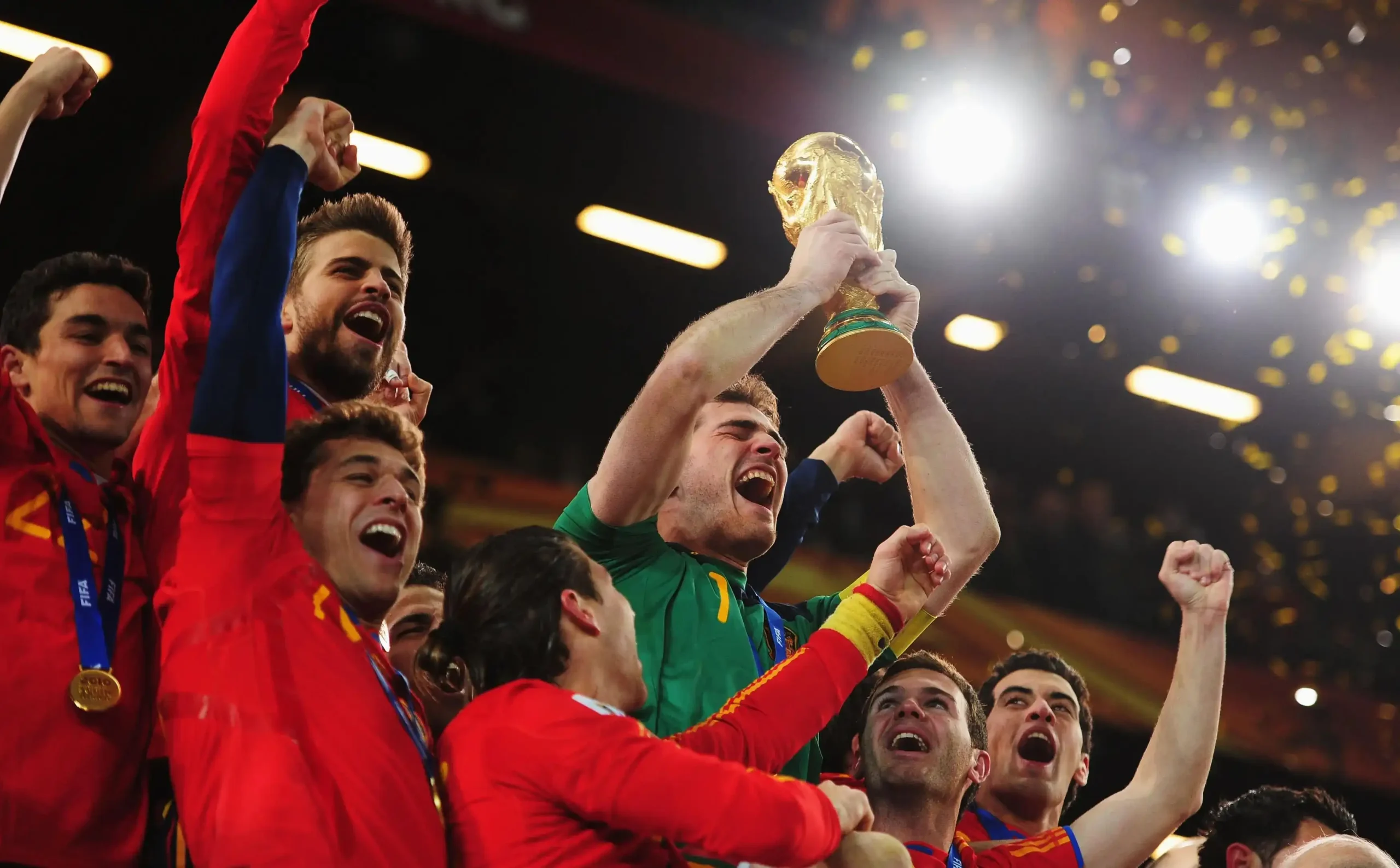
La Roja’s run to glory in 2010 encapsulated a side that set a gold standard with their tiki-taka style of play. Guided by legendary tactician Vicente del Bosque, the squad was dominated by El Clásico greats, including Barcelona’s Carles Puyol, Xavi, Sergio Busquets, Gerard Pique and Andres Iniesta and Real Madrid’s Iker Casillas, Xabi Alonso and Sergio Ramos. These heavyweights were joined by a host of other stars, such as Arsenal’s Cesc Fabregas, Liverpool’s Fernando Torres and Sevilla’s Jesus Navas, to name but a few. Setting club rivalries aside, a richly gifted group of players came together to claim the title in both classy and pragmatic fashion, barely conceding a goal after an initial hiccup against Switzerland.
Spain’s last World Cup
Qatar 2022 has gone down in the Spanish football history books as a case of what could have been. Luis Enrique’s much-fancied team had a very distinct style, bordering on obsession: prioritising possession, applying extreme pressure and building up slowly from the back. Having captured the imagination and established themselves as contenders at the start of the tournament, they flattered to deceive when it mattered most.
La Roja’s campaign began with a resounding 7-0 thrashing of Costa Rica, which was followed by a hard-fought draw with Germany and a 2-1 loss at the hands of Japan. The toothlessness that had cost Luis Enrique’s charges against the Japanese came back to haunt them once again in the last 16, where the Spaniards proved no match for Morocco’s robust low block. The encounter finished goalless following 120 gruelling minutes, after which the North Africans celebrated victory in a penalty shootout.
Spain’s first World Cup
The Spaniards certainly gave a fine account of themselves in their World Cup debut in 1934. In their opener, they beat none other than Brazil in the Round of 16. They followed that up in the quarter-finals by holding hosts Italy 1-1 after extra time in the competition’s first-ever draw. As penalty shootouts had not yet been introduced, a replay was required. The Azzurri prevailed 1-0 and went on to be crowned world champions.
Spain’s World Cup top scorer
Spain’s all-time leading World Cup marksman is David Villa, with nine goals. The Asturian striker lined up at three editions of the World Cup (Germany 2006, South Africa 2010 and Brazil 2014) and, although he did not score on the magical night of 11 July when Spain lifted the trophy in Johannesburg, he played a crucial role in La Roja’s triumphant 2010 campaign.
Four players lie in joint-second place, with five goals each. Emilio Butragueno amassed all of his tally in 1986 and then failed to find the net in 1990; Fernando Hierro likewise went goalless in 1990, registering once in 1994 and twice apiece in 1998 and 2002; Fernando Morientes also notched on two occasions in 1998, before going one better in 2002; and Raul struck once in 1998, three times in 2002 and once again in 2006.
Another quartet sit one further goal and position back in the Spanish standings. Estanislau Basora and Telmo Zarra were both in prolific form at their sole World Cup in 1950, firing Spain to fourth place; Michel bounced back from a blank in 1986 to bag four times in 1990; and Fernando Torres spread his strikes across the same three tournaments graced by Villa (three in 2006, none in 2010 and one in 2014).
Spain’s record World Cup appearance-maker
Several figures from the iconic side coached by Vicente del Bosque feature in Spain’s overall top ten for World Cup outings. Most members of that team played at multiple tournaments and are fondly remembered by Spaniards as some of the greatest ever.
Top spot is shared by three such stalwarts, who all laced up their boots in 17 matches across four editions of the World Cup: Iker Casillas (Korea/Japan 2002, Germany 2006, South Africa 2010 and Brazil 2014), Sergio Ramos (Germany 2006, South Africa 2010, Brazil 2014 and Russia 2018) and Sergio Busquets (South Africa 2010, Brazil 2014, Russia 2018 and Qatar 2022). Goalkeeper Andoni Zubizarreta comes next with 16, while Xavi completes the top five with 15.
Spain’s memorable World Cup moments
Although South Africa 2010 undoubtedly represents the pinnacle of the Spanish men’s national team’s history to date, it is far from their only high point on the global stage.
The importance of Andres Iniesta’s extra-time goal against the Netherlands cannot be understated. The power of that moment was only magnified by the pureness and last-gasp nature of the winning strike, as well as the poignance of Iniesta’s celebration paying tribute to the late Dani Jarque. Looking beyond the results, however, it is clear that Del Bosque’s team played with an elegant attacking style that defined an era.
Prior to that, the country most notably secured a highly regarded fourth-place finish at Brazil 1950. This included topping Group 2 with a clean sweep of victories: 3-1 against the USA, 2-0 against Chile and 1-0 against England. Despite bowing out on a low – after drawing 2-2 with eventual winners Uruguay in their first final-round match, La Roja were outclassed in a 6-1 defeat by hosts Brazil before succumbing 3-1 to Sweden – Guillermo Eizaguirre’s charges could ultimately be proud of their showing.
Spain’s biggest World Cup victory
Costa Rica were the fall guys as Spain put on a masterclass to triumph 7-0 in the Qatar 2022 group stage on 23 November 2022. Luis Enrique’s side demonstrated their full potential in their curtain-raiser, showcasing their signature passing style while also proving to be clinical in front of goal.
The floodgates opened in the 11th minute, when Dani Olmo played a one-two with Gavi, took a brilliant first touch while swivelling around a defender and chipped an oncoming Keylor Navas. Ten minutes after that, orchestrator supreme Busquets found Jordi Alba out on the left and the full-back’s subsequent cross was met by Marco Asensio to double the Spaniards’ lead. Alba also played his part in the third and final goal of the half by being brought down in the area, with Ferran Torres stepping up to convert from the spot.
Luis Enrique’s men could have been forgiven for taking their foot off the gas after the break, but instead they went for the jugular. Torres completed his brace in the 54th minute to make it 4-0. Having already been involved in so much of the build-up play for previous goals, Gavi finally got his name on the scoresheet 20 minutes later by executing an exquisite trivela on the volley to make it 5-0. Substitutes Carlos Soler and Alvaro Morata each scored in the dying minutes of the match to seal La Roja’s biggest-ever World Cup win.