
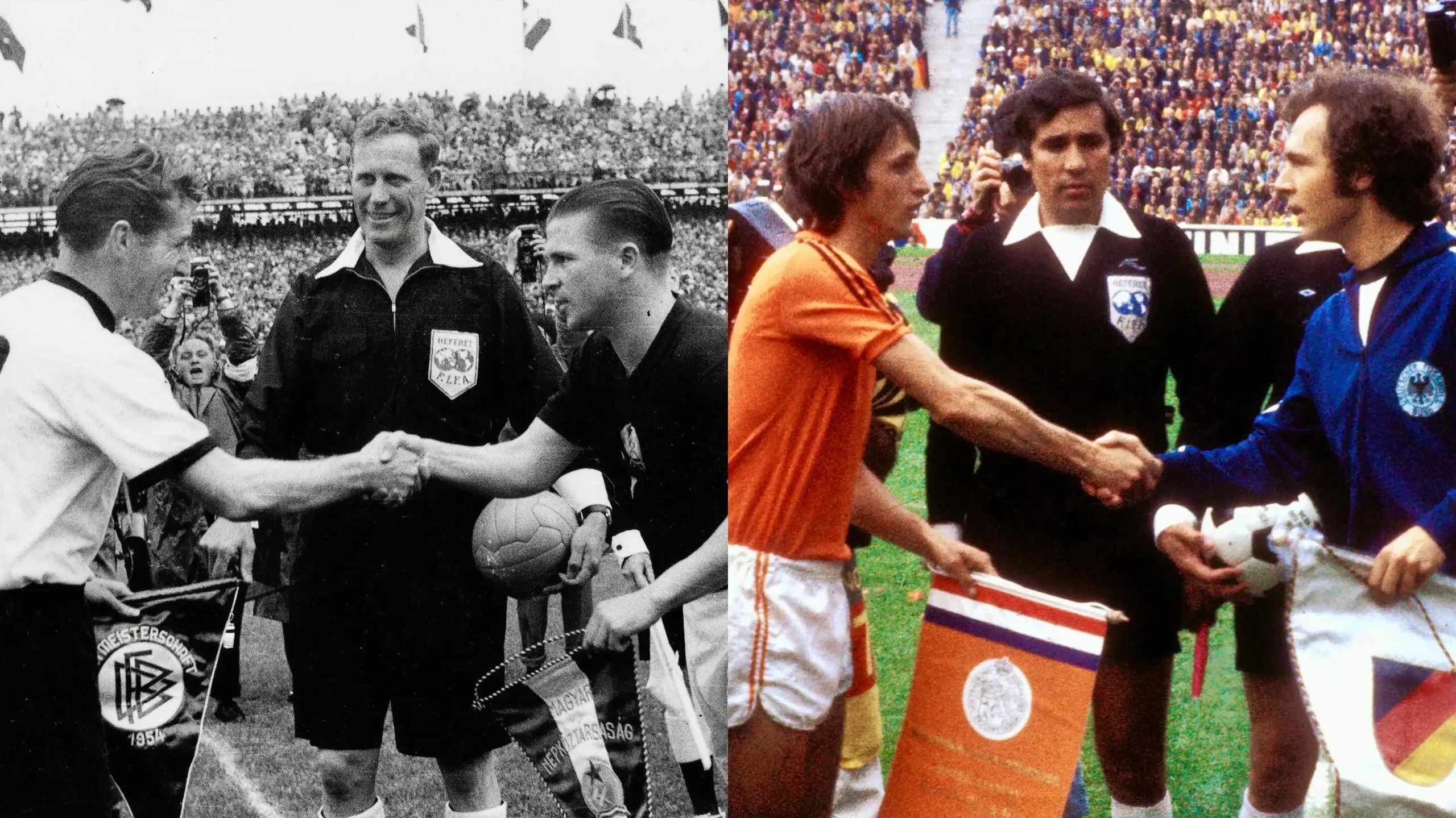
When the German national team face Curaçao in their opening Group E match at the FIFA World Cup 2026™ on 14 June, their shirts will feature four stars sparkling above the logo of the German Football Association. Each one represents a FIFA World Cup™ title, each with its own unique story behind it. The German teams of 1954, 1974, 1990 and 2014 triumphed under specific conditions, with every global conquest having been a different ball game.
The extent of these differences is epitomised by the sea change in the eventual titlists’ status between the 3-2 success against Hungary in the 1954 final and the 2-1 victory over the Netherlands in the 1974 trophy decider. West Germany had travelled to Switzerland as rank outsiders, relying on collective discipline and a pragmatic approach, but 20 years later they hosted the World Cup as European champions who harboured realistic expectations of winning the whole tournament.
Yet, despite the fundamental differences at the outset of each edition, it is possible to discern a string of remarkable similarities between the finals in Bern and Munich, with three standing out in particular.
Slaying of generational giants
Going into both the 1954 and 1974 finals, the West Germans were heavy underdogs up against a team that had left their mark on international football. In 1954, a Hungary side boasting numerous world-class players headed to the global showpiece in Switzerland on the back of an unbelievable four-year unbeaten run.
The Mighty Magyars had already faced West Germany in the group phase, sweeping their final opponents aside in an 8-3 romp. Coach Gusztav Sebes employed tactics that were light years ahead of their time, including a high-octane approach underpinned by his charges’ peerless technical prowess and understanding of the game. Before a ball had even been kicked, many observers were convinced that a Hungarian win was the only conceivable outcome.
The Netherlands were also hotly tipped for glory 20 years later, albeit with a far less pronounced gulf in quality between themselves and the German team. However, the Dutch ‘total football’ system represented a revolution. The team coached by Rinus Michels had reached the summit of world football and dominated the tournament for long periods with a reinterpretation of the game based on fluid off-the-ball movement and positional interchange.
There is therefore a particular historical significance to the fact that Germany managed to claim victory in both finals. On both occasions, they triumphed over teams that defined the football of an era; these victories were not born of on-field supremacy but had their roots in the ability to wrench control of the game away from supposedly superior opponents.
Recovery from an early setback
West Germany made the worst possible start to both finals. Hungary needed only eight minutes to race into a 2-0 lead in Bern and there appeared to be no way out of this nightmare scenario against a juggernaut-like adversary. Conceding two goals so early in the game suggested that Sepp Herberger’s troops could be faced with a drubbing similar to their group-stage result against the same opponents two weeks previously. A team with virtually no experience on the world stage were now required to display major mental fortitude.
The 1974 final opened in a similar fashion: not one West Germany player had even touched the ball before Johan Neeskens converted a second-minute penalty to put the Netherlands ahead. Falling behind at home, combined with a dominant display from their opponents, also demanded the highest levels of resilience and application from the German players.
What made the difference in 1954 and 1974 was the composed reaction from the West German teams. Rather than panic and capitulate with their backs against the wall, they were galvanised and rose to the challenge on both occasions, drawing level in under ten minutes in Bern and equalising in the 25th minute in Munich.
Neutralising the opposition orchestrator
Concentrating on the most instrumental player in the opposing team proved to be a crucial tactical ploy employed by the West German coach in each final. Herberger had pinpointed centre-forward Nandor Hidegkuti, who regularly dropped deep in a manner akin to a modern false No9, as the linchpin for the 1954 Hungary team. The task of man-marking him was assigned to Horst Eckel. The youngest player in the German line-up leapt at the chance to put Hidegkuti under pressure and prevented him from dictating play, robbing the Hungarian system of precision and penetration.
West Germany adopted a similar approach in 1974: Helmut Schon had instructed right-back Berti Vogts to stick with Johan Cruyff, the playmaker in the Dutch set-up, for the entire match. The dogged defender harried Cruyff from the word go, forcing him time and again into duels in less dangerous zones. The result was subtle, yet effective: the Dutch continued to exert control over the match, but their creative genius was unable to call the shots and cut a peripheral figure for extended spells.
In both finals, focusing on taking the opponents’ chief string-puller out of the game wound up being pivotal: discipline, concentration and endurance, not moments of individual brilliance, were the key to success.