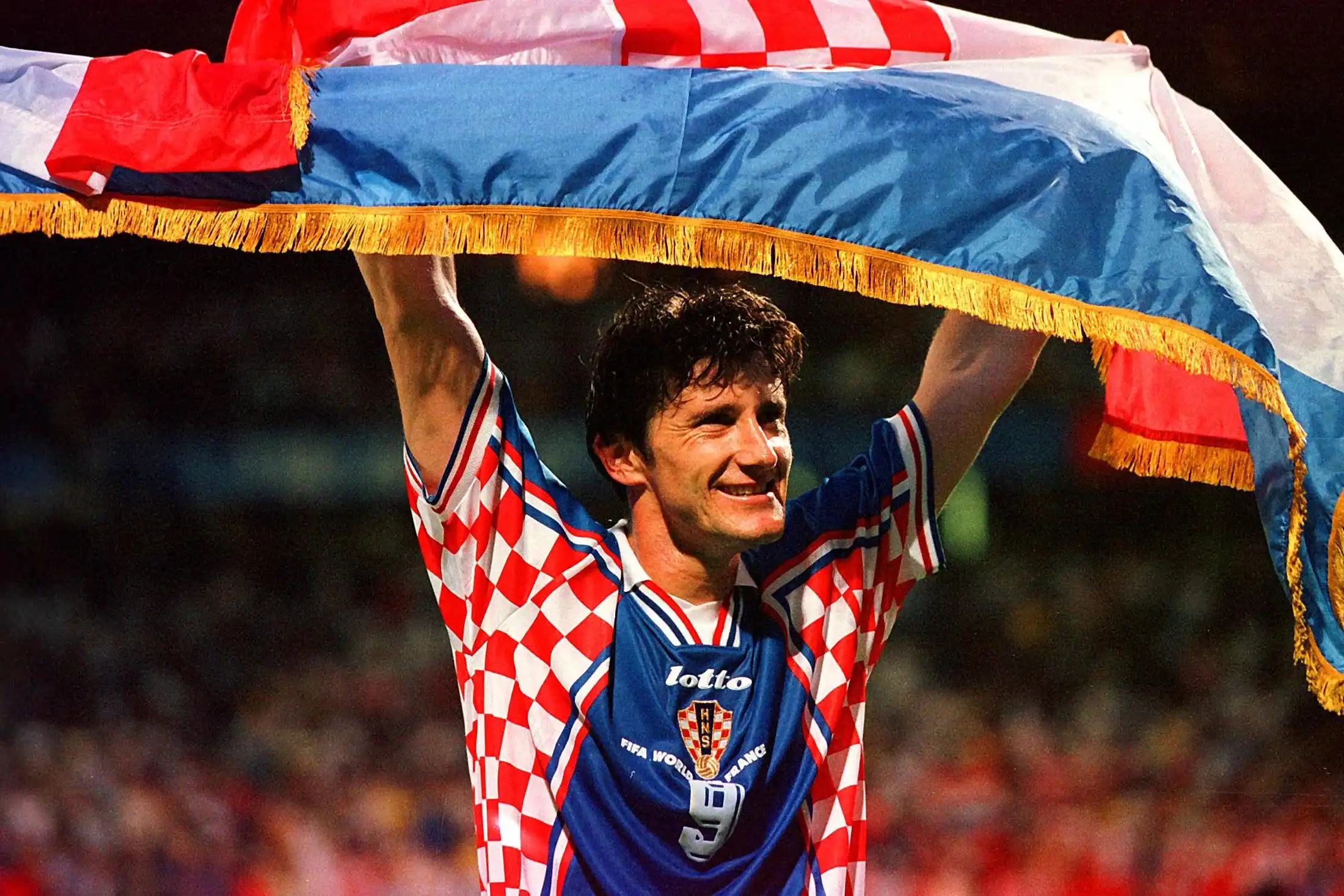
Nestled in the beating heart of what was once one of France’s most productive coalfields, Lens witnessed generations of miners extract “black gold” from deep under its surface. However, on 14 June 1998, to the widespread astonishment of the watching world, a very different kind of treasure would be unearthed at the city’s iconic Stade Felix-Bollaert: a dazzling goalscorer by the name of Davor Suker.
Ahead of that evening’s match, the streets of the northern French city were awash with the unlikely combination of Jamaica’s green and yellow and Croatia’s red-and-white chequerboard, as fans created a unique carnival atmosphere. While the encounter between the FIFA World Cup™ first-timers promised to serve up a party mood in the stands, nobody had dared to imagine that one of the sides would still be in contention for the ultimate prize three weeks later, let alone that one of the target men on show that night would end the campaign as the tournament’s top scorer. And yet that’s exactly how things panned out.
“France ’98 isn’t just a tournament in my memory, it’s something stitched into my soul,” Suker revealed in an exclusive interview with FIFA.
One of the standout performers at the 16th instalment of the global competition added: “When I think back to that World Cup, I don’t just remember my goals. I recall our dressing room being full of belief, a nation barely seven years old announcing itself and a group of players who felt like we were writing the first chapter of a football fairy tale.”
Alongside Suker, the fledgling country, which declared its independence in 1991, was able to call on some established names such as Zvonimir Boban, Robert Prosinecki and Slaven Bilic to lead their campaign in France. Their run to the quarter-finals at UEFA EURO 1996, where Suker had showcased a healthy appetite for goals, proved they were ready to compete at the highest level. However, believing they could go on and conquer the world was another matter entirely.
“In our first-ever World Cup match, against Jamaica, we could feel the weight of history on our shoulders,” recalled Suker.
The Croatians could have been forgiven for being overwhelmed by the magnitude of the event, but they more than rose to the occasion. Miroslav Blazevic’s men emerged 3-1 victors and the ex-Real Madrid marksman wasted little time in opening his World Cup goalscoring account.
“It was at that point that we knew we were no longer there just to take part,” said Suker. “We belonged.”
The wheels of history had been set in motion.
Croatia sent shockwaves through world football by reaching the last eight on French turf, inspired by a striker who had hit the back of the net three times in four matches.
However, many expected that to be the end of the road for the tournament rookies. Standing between them and a place in the semi-finals were reigning European champions Germany, who had edged them out 2-1 at the same stage en route to claiming the continental crown. Croatia exacted revenge in emphatic fashion in Lyon, with Blazevic’s troops running out 3-0 victors and Suker wrapping up the scoring on an unforgettable night for those of a Croatian persuasion.
“To play a World Cup quarter-final against Germany – one of football’s great powers – and beat them 3–0 was incredible,” recalled Suker, who hails from the eastern Croatian city of Osijek. “When you make it 3–0 against Germany in a World Cup quarter-final, you feel history shifting under your boots.”
Croatia then found themselves squaring up against the hosts, France, in a semi-final showdown. Although the eventual champions proved too strong for them, coming from behind to win 2-1, the outsiders nevertheless headed home with a bronze medal that felt like a real triumph.
While the likes of Ronaldo, Roberto Baggio, Alan Shearer, Gabriel Batistuta and Dennis Bergkamp were widely expected to top the scoring charts, Suker outshone them all and his unmatched six-goal haul earned him the adidas Golden Boot.
“Winning the Golden Boot was never about personal glory,” he said. “It felt like planting the Croatian flag on the biggest stage in the world. And even now, almost three decades later, it still gives me goosebumps.”
Despite the fact that the forward burst on to the global stage at that World Cup, he was far from an unknown quantity when he lined up on French soil. Indeed, the Croatian had proved his goalscoring pedigree during a sensational five-season stint at Sevilla that persuaded Real Madrid to shell out to secure his services in 1996 – and he headed into the World Cup on the back of winning the UEFA Champions League with the Spanish heavyweights.
Nevertheless, it was his outstanding display at FIFA’s flagship men’s event that won him lasting admiration from football fans all over the globe.
Suker, who will always remain the figurehead of his nation’s brilliant breakthrough, called time on his international career following the 2002 World Cup, where Croatia failed to build on their earlier success and bowed out after the first round. Suker started and skippered the side in their opener – a 1-0 defeat to Mexico – which turned out to be his swansong in national-team colours as he did not get off the bench in their other two group outings.
“At the 2002 World Cup, wearing the captain’s armband was an honour heavier than any trophy,” he said. “Ending my international career as captain felt like a beautiful full stop.”
Although he would no longer represent his country on the pitch, his influence on the national game endured off it. He went on to serve as President of the Croatian Football Federation from 2012 to 2021 and, under his leadership, the nation continued to exceed all expectations by reaching the World Cup final in 2018, succumbing once more to Les Bleus, this time in a 4-2 defeat.
It would seem that Suker has a habit of being at the centre of fabulous feats.
“It’s a tremendous privilege to have experienced the greatest moments in Croatian football from both sides,” he said. “First as a player wearing the shirt, later as president of the federation. Different roles, different responsibilities, but the same feeling inside. Wherever you stand, that badge on your chest never feels lighter.”
When asked which of the two roles he preferred, the former forward replied: “Watching from the stands is harder than playing. On the pitch you can influence destiny. In the directors’ box you suffer in silence!”
Suker now has a clear sense of his country’s place in the hierarchy of world football.
“Reaching the semi-finals again in Qatar felt like confirmation Croatia is no longer an underdog story,” said Suker. “It’s a football nation with standards.”
Suker now lives in San Diego, California, and is eagerly anticipating the FIFA World Cup 2026™ coming to the USA. “Fans should expect scale, spectacle and passion,” he said.
While he considers “France, Argentina, Brazil or even England” to be the obvious frontrunners, Suker warned: “When you finish runners-up and then in third place at back-to-back World Cups, you’re arrive no longer as just participants, but to compete for the trophy. Croatia won’t fear anyone.”
When they kick off their World Cup campaign against England on 17 June in Dallas, the nation will have come a very long way from that maiden match-up in Lens.
However, that momentous night on 14 June 1998 will go down in Croatian football history, when a true leader and goalscorer supreme announced himself on the biggest stage of all.