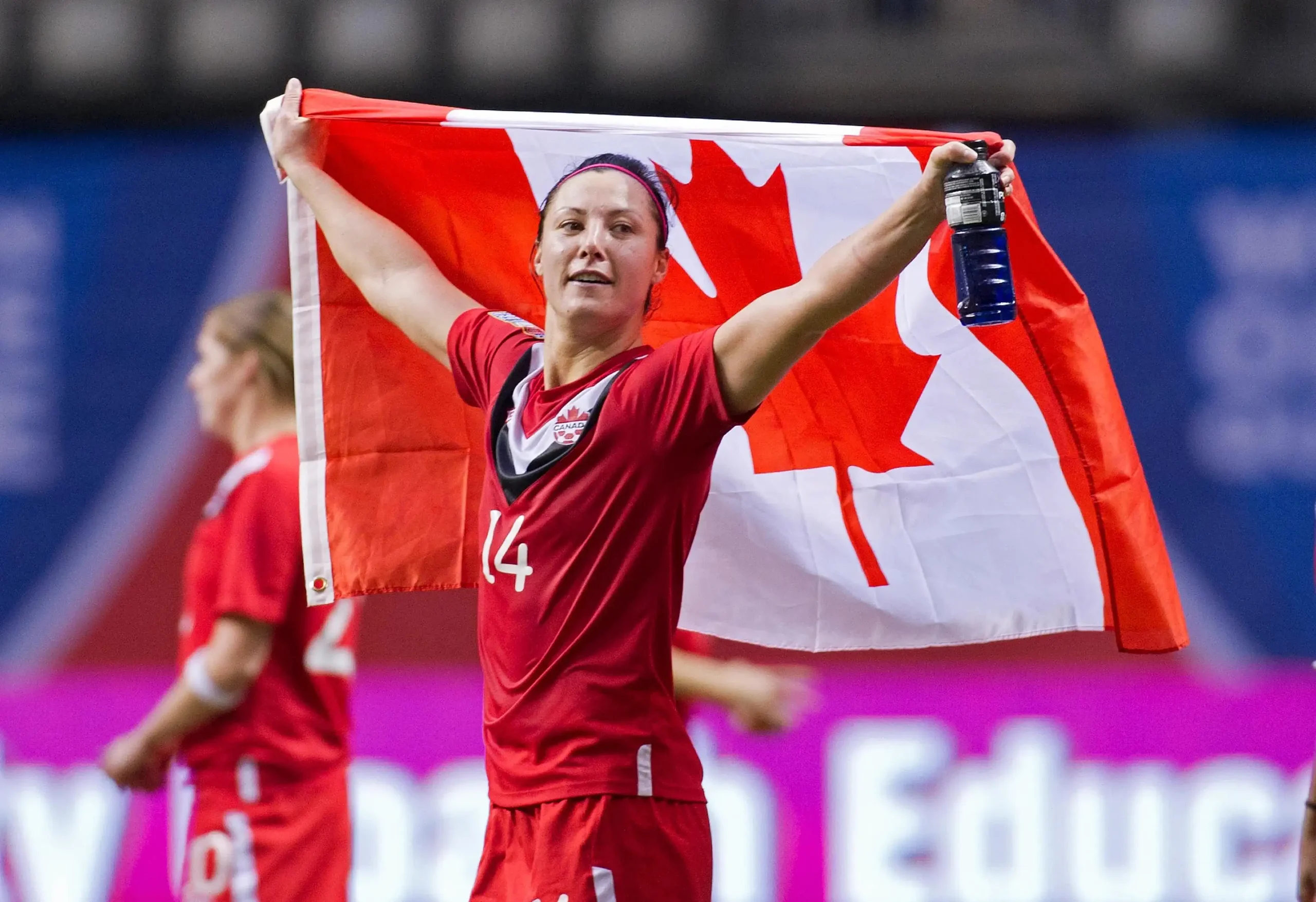
Melissa Tancredi etched her name into the history books during her FIFA Women’s World Cup™ debut when she scored after just 33 seconds against Australia in the group stage at China 2007.
The Canadian striker’s dazzling half-volley from just outside the area remains the fastest goal by a Women’s World Cup debutant and the second-fastest goal in the history of the global showpiece.
Tancredi went on to have an outstanding international career during which she took part in two further World Cups — Germany 2011 and on home soil four years later — as well as three Women’s Olympic Football Tournaments, where she won two bronze medals.
What is all the more remarkable is that the Notre Dame graduate took a two-year hiatus at the height of her career following London 2012 to complete her chiropractic doctorate, graduating top of her class at Logan University in St. Louis. She now works full-time in the field at the Workshop Performance Clinic in Vancouver and with Canada Soccer.
After scoring 27 goals across 125 international appearances — including the match winners that qualified Canada for Beijing 2008 and London 2012 — Tancredi was recently inducted into the Canada Soccer Hall of Fame as part of its Class of 2026.
Now 44, she spoke to FIFA about the pressure of playing in a home World Cup, the challenge of coming back from a two-year hiatus and her thoughts on Canada’s hopes at the FIFA Women’s World Cup Brazil 2027™.
Melissa Tancredi: Now that I have time to reflect, it means more than I could have anticipated. Having a family of my own and being able to have another excuse to look back on my career and just appreciate everything we’ve been through and what we did for soccer in Canada… it really means a lot to me.
Being inducted, it’s pretty cool to go back through memory lane and experience the highs and lows.
That is one of my favourite goals. It was a striker’s dream to hit a half-volley and it was a long ball from Kara [Lang] and it was coming on my right side and I knew I was going to be able to hit it on the half-volley with enough power and struck it really clean over the keeper. Definitely a dream goal to start off your World Cup career.
Very special and very nerve-wracking. I had never experienced that kind of pressure before. Those crowds were some of the biggest we had ever seen in Canada and for our team as well. Now that we’re having the men’s World Cup [in 2026], just looking back on the fact that we’ve hosted a World Cup here is unreal, the fact that I was able to play in that. I’m meeting people in Vancouver now who say, ‘I was at your games.’
You can tell it was definitely monumental to people in Canada and across the world. It was a movement for the sport in our country and I very honoured to be a part of. It was definitely a pressure cooker, being a forward and being part of a team that was having some issues putting the ball in the net. It was never a fun spot to be in but now it’s easier to look back on and just realize how big it was.
I think the timing was the hardest for me because it was right after London (2012 Olympics) and my best performance yet in a tournament. Definitely the height of my career and the peak of my performance. But school was calling, they were very lenient with timing and finishing my degree but they said, ‘You can finish now or we’re going to have to start you all over again from square one.’
At that point it was 2012 and I had started in 2006 and it’s a four-and-a-half-year programme and had only done half of it. If I had continued to play soccer it would have been really hard to get back into school. I wish I could have seen where my career could have gone at that point but I was thankful to get back into soccer after that. It was a very hard decision but at that time when you weren’t able to make an amazing amount in salary and looking at my future and long-term, I think school was the only option really… knowing that I could build my career off of that.
I don’t regret anything about where I am right now. It’s still pretty special to be in the sport in a different capacity and I still lived all those years on the playing field as well.
It’s pretty impossible to do two things 100 per cent. I did my best, I was playing with a men’s team, working out and trying to stay fit but I was also sitting for hours on end at school studying. Nothing could ever duplicate or mimic an international game and the high standards you need to be training at every single day. That was hard for me and it took about a year of transitioning back into the sport to calibrate in terms of my fitness and health… I kept getting injured because I wasn’t fit, my body wasn’t used to the volume and level of play at that time. I came back and tore my calf and put my back out, just had typical injuries of what a typical person sitting in a chair coming back to play soccer would have!
It took me about a year from 2014 to 2015 and after that World Cup I felt pretty good in my body and after that I had a lot of time, I didn’t have school any more, and in 2016 showed a lot of that hard work. So a year… not months or weeks but a year.
My goal against Sweden [to secure a 2-2 draw in the group stage at London 2012] was really special as it meant we made it through to the knockout phase against a team that was a top level at that time and we went on to win our first bronze in that Olympics. Also my goals against Germany in Rio [in a 2-1 victory in the group phase] helped us beat Germany for the first time and helped us solidify first place in our group and to go undefeated. Taking on a European giant was always on the list and we hadn’t done it before so it was really nice to get that done and be the captain of that team.
Myself and Selenia Iacchelli, another former player of Canada Soccer, own two multi-disciplinary clinics and we work with the regular population as well as [Northern Super League team Vancouver Rise] and multiple other local sporting groups around Vancouver. Myself, I am with Canada Soccer on the medical side so I work with them and go to all the camps. When I’m here, I work at the clinic.
This year will be very important for us. We’ve had a little bit of ups and downs in the past year and every great team goes through that… transition is so important for personal growth and getting a team on another level. I think there are a lot of players up and coming who are really exciting to watch and the fact that we have a whole year to nail our partnerships down. I’m excited. I feel like we’ve experienced a lot over the past six months which has challenged the players but also brought them closer.
Canada is always a favourite in my eyes. We’ve proven to be the best in the world at an Olympic Games and I will say we have the players to win a World Cup. It’s not like we’re lacking talent, we have the right amount of mix of veterans and youth. I feel like we have the best leadership right now and I think we can do some damage at the next World Cup.