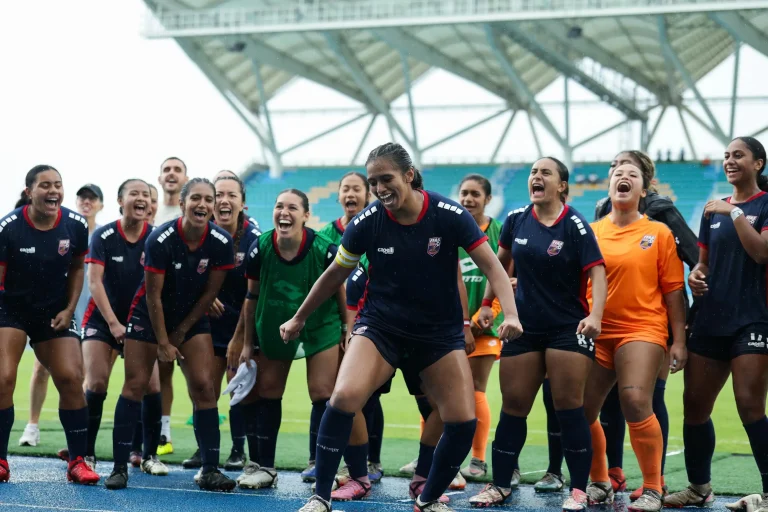
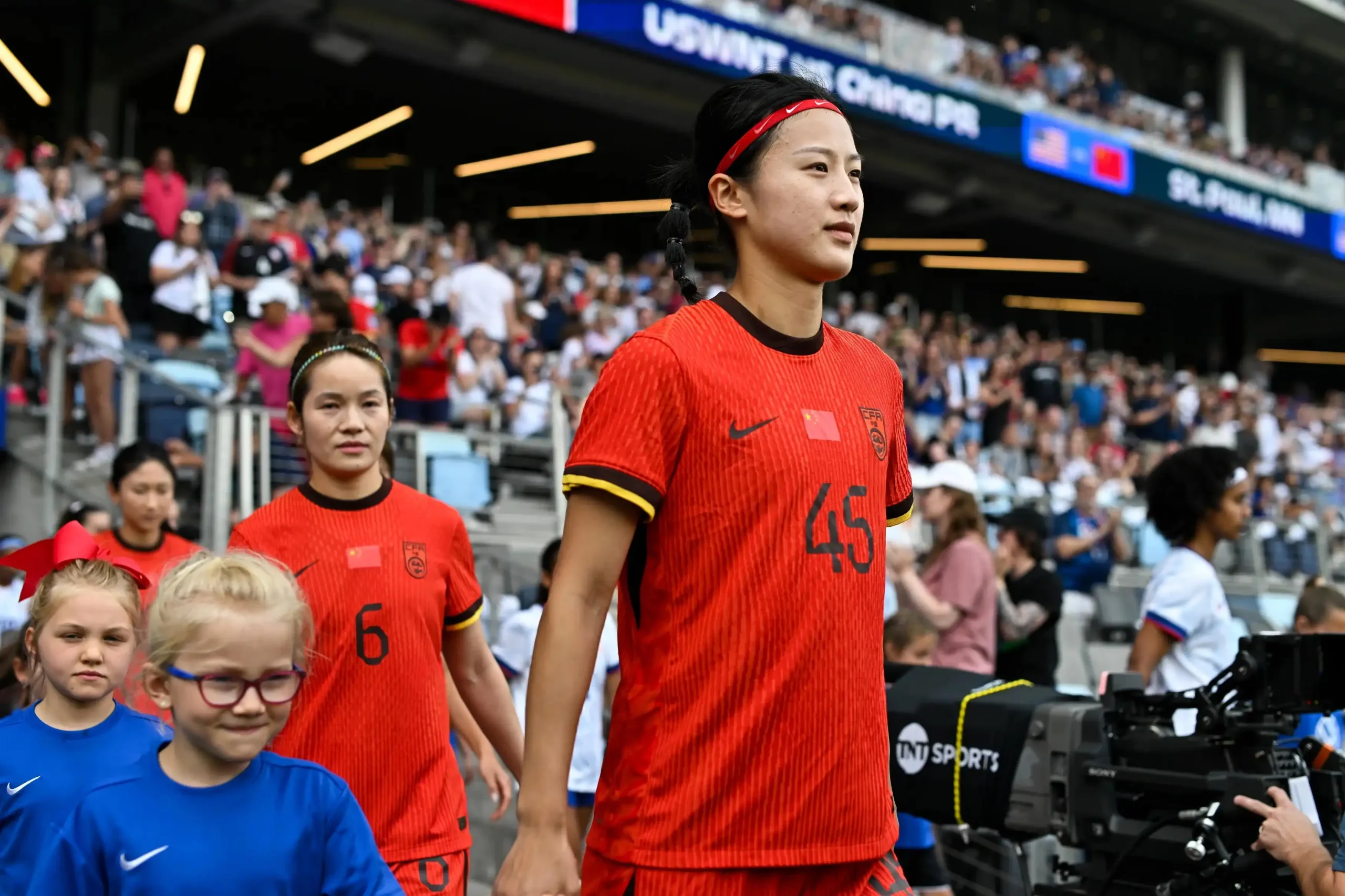
Sibling rivalry can take many forms, but it doesn’t often play out the way it is for China’s Wang sisters, Linlin and Siqian. Born four years apart, they not only grew up to play football but do so for the same club side, in the same position, while fighting for the same role on the national team.
While 25-year-old Linlin is part of the China PR squad taking part in this month’s AFC Women’s Asian Cup, which doubles as the FIFA Women’s World Cup™ qualifiers, 21-year-old Siqian didn’t make the cut. As Linlin explains to FIFA on the eve of her nation’s opening match with Bangladesh, that doesn’t mean that their dream of sharing the global stage in Brazil next year is over.
“If [that] dream actually comes true, I can’t even imagine how happy it would [make me] and being able to play in the World Cup together with my sister would be an unforgettable experience.
“Of course, there is competition for the same position and we have both had the experience of starting together, and we have also taken turns being a starter and a substitute.
“Even when the competition is intense, I believe it is a healthy kind of competition and it doesn’t affect our relationship.”
For now, it’s Linlin carrying not only the family name but also the hopes of a nation that is desperate to return to global prominence. For a long period, just prior to the sisters birth, China were the undisputed queens of Asian football. From 1986 to 1999, the nation won a remarkable seven consecutive continental crowns.
In that same span, China both hosted the inaugural Women’s World Cup and reached, in order, the quarter-finals, semi-finals and then the final across the tournament’s first three editions.
By any measure, it was a period of extraordinary success and a golden age for Chinese football. Although two further continental titles followed, including at the most recent edition four years ago, the nation’s performance at global level has waned.
Three years ago, in the tournament co-hosted by Australia and New Zealand, the team crashed out in the group stage after a 6-1 defeat at the hands of eventual finalists England. For Linlin, who like her sister plays as a central defender, it means that reaching Brazil 2027 is a non-negotiable.
“It is very important for us to qualify for the World Cup again. Representing China on the world stage means a lot, not only for the team but also for the fans and for the development of women’s football in our country.
“When I was young, I knew China had a great history in women’s football, and that always inspired me. We know there is history and expectation, but our focus is firstly to qualify.
“Step-by-step, we want to show that Chinese women’s football can compete strongly at the global level and I believe this team has ability to qualify and to become top-level again. For us as players, that is both a responsibility and an honour.”
The first step towards qualification for what would be a ninth appearance at the global finals comes in the Asian Cup group stage, where China will face fellow heavyweights Korea DPR, as well as Uzbekistan and Bangladesh.
Reaching the quarter-finals of the 12-nation tournament would then put the team in a prime position to reach Brazil, with the AFC having six direct berths and a further two potentially available via the Play-Off Tournament.
With standards across the continent, and in the women’s game more broadly, at an all-time high, Wang knows not only just how fierce a battle it will be to book a South American ticket but also the challenges the nation will face in Brazil should they do so.
“In recent Women’s World Cups, it has been more difficult because women’s football around the world has improved a lot. Many teams are stronger now, and every game is very competitive.
“I think the standard at [the Asian Cup] is also very high. You can see that many Asian teams have made great progress and there are no easy games. To qualify from Asia is never simple because the level is close and the competition is intense.
“Playing in one of the most competitive regions in the world helps us grow faster and improve ourselves and we know that only by giving our best in every game can we achieve our goals.
“For us, this is a challenge, but also a motivation. We want to keep improving and show our strength step by step.”
It was a challenge that Wang fell into almost by accident, as she confesses that she only took up the sport in order to help with her physical health. As the years have passed the Shanghai native has grown from an unsure child to an assured and influential member of the Chinese defence and stands now just four matches away from qualifying for the pinnacle of the sport.
“When I first started playing football, it wasn’t because I watched matches on TV, rather it was because I hadn’t been very strong physically since I was young. At the beginning, I just wanted to get into sports to improve my health.
“As football made my body stronger, it also made me fall in love with the sport. In the evenings, our coach would play match broadcasts for us, and we watched the older women competing live on television.
“I really admired them and I told myself that this was my dream and my goal and that I would work hard to represent the national team one day.”