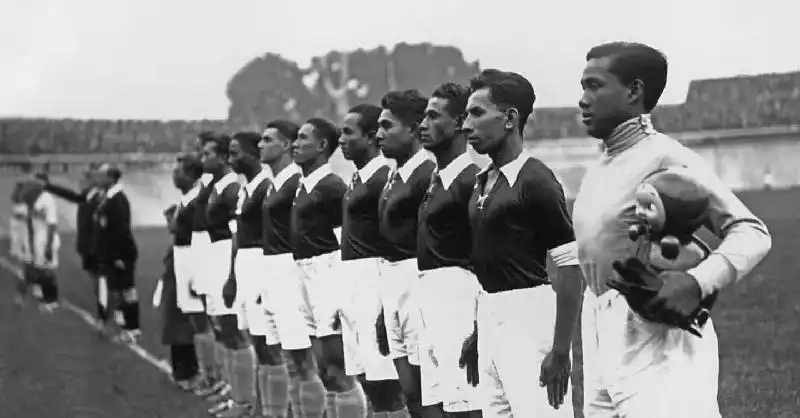
On 27 April 1938, the Port of Tanjung Priok was the site of a moment forever etched in Indonesian football history. It was from this port that a team representing the colonial territory of the Dutch East Indies, known today as Indonesia, embarked on the long journey to Europe.
Not only did their voyage of almost two months take them across continents, it took them from the small pitches of their homeland to the biggest stage in football, the 1938 FIFA World Cup™ in France.
The Dutch East Indies team that arrived on French soil was diverse in terms of their backgrounds. While most of the squad were of indigenous backgrounds, players of Dutch and Chinese descent made up the rest of the squad. The historic group included names such as goalkeeper Tan Mo Heng, Herman Zommers, Franz Meeng, Isaac Pattiwael, Frans Pede Hukom, Hans Taihattu, Pan Hong Tjien, Jack Sammuels, Suwarte Soedermandji, Anwar Sutan, and captain Achmad Nawir.
Far from the professionals of today, the team was mostly made up of amateurs who balanced their footballing careers with work, studies and the demands of daily life. The players didn’t have access to modern training centres or structured training programmes and there were no professional leagues.
What they did have, though, was a love for the game, the pride of representing their homeland and the guidance of their Dutch coach, Johan Mastenbroek, who relied on discipline and simple tactics.
The Dutch East Indies didn’t secure their place in the World Cup finals through their achievements on the pitch, but as a result of the geopolitical situation of the time. The Asian qualifying tournament for the 1938 World Cup consisted of just two nations, the Dutch East Indies and Japan.
At the time, international relations were in a precarious position, with Japan at war with China, and as a result of the conflict, Japan withdrew, allowing the Dutch East Indies to progress to the World Cup finals without playing a single qualifying match.
The standard of football across Asia was heavily imbalanced at the time, and infrastructure was limited, yet the side found the opportunity to make history in the most unusual of circumstances.
On 5 June 1938, the Dutch East Indies took to the field to face Hungary at the Stade Velodrome in Reims. However, their opponents were no run-of-the-mill side. Indeed, Hungary were a powerhouse of world football, and would continue to be at the top of the global game well into the 1960s.
The match turned out to be a one-sided affair. Although they managed to survive the first 12 minutes without conceding, Tan Mo Heng’s goal would eventually be breached time and again, as the match ended in a 6-0 victory for Hungary. It would be the largest winning margin of any of the first round matches at the 1938 World Cup. Hungary would go on to reach the final of the tournament, but missed out on the title, losing to Italy 4-2.
But for the Dutch East Indies, there was still much to be proud of. Isaak Pattiwael, a winger from Maluku, managed to find the net against legendary keeper Antal Szabo. Pattiwael’s goal would be disallowed, but his achievement still went on to become a treasured family story.
As his grandson, John Pattiwael, told BBC Indonesia: “I remember that my grandfather scored a goal (against Hungary, though it was disallowed by the referee).”
Isaak would often show his children and grandchildren, including John, photos of his time playing for the Dutch East Indies team. He would also tell stories about the immense pride he felt as an Indonesian of Maluku heritage who once competed on the biggest stage in sport.
“He was enormously proud to be Indonesian, especially as a footballer from Ambon who once played in the World Cup,” noted John. “For an Indonesian, being there was a once-in-a-lifetime experience.”
Although they were eliminated after just one match, the Dutch East Indies still went down in history as the first Asian representatives in the World Cup finals. To many, this may seem like little more than an interesting piece of trivia, but to Indonesians, this is the foundation of their footballing identity on the global stage.
It is a reminder that Indonesia once stood shoulder to shoulder with the world’s best, and can set their sights on achieving that dream again.